
"Understanding new cultures, new languages and new ideas.
Gaining new answers and asking new questions."
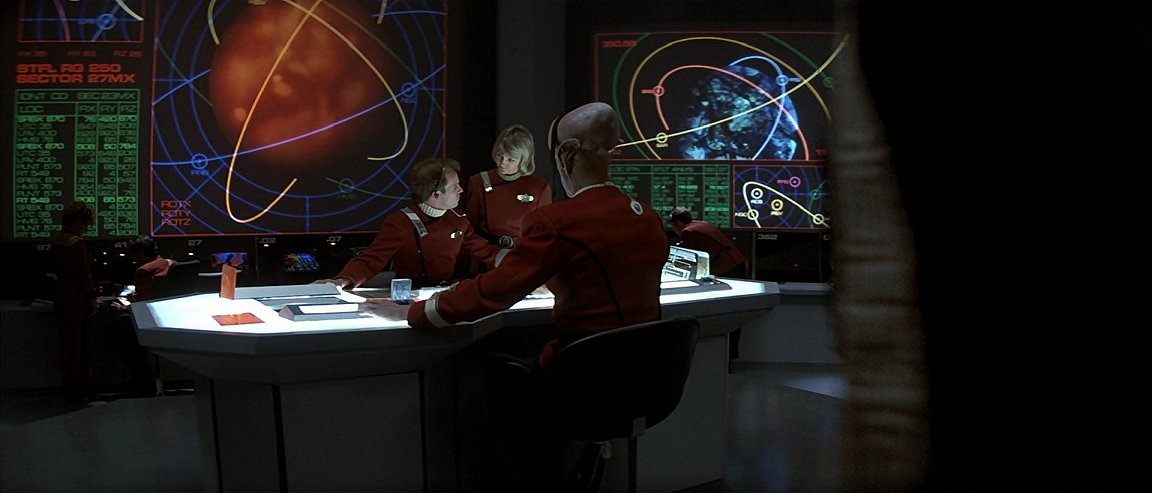
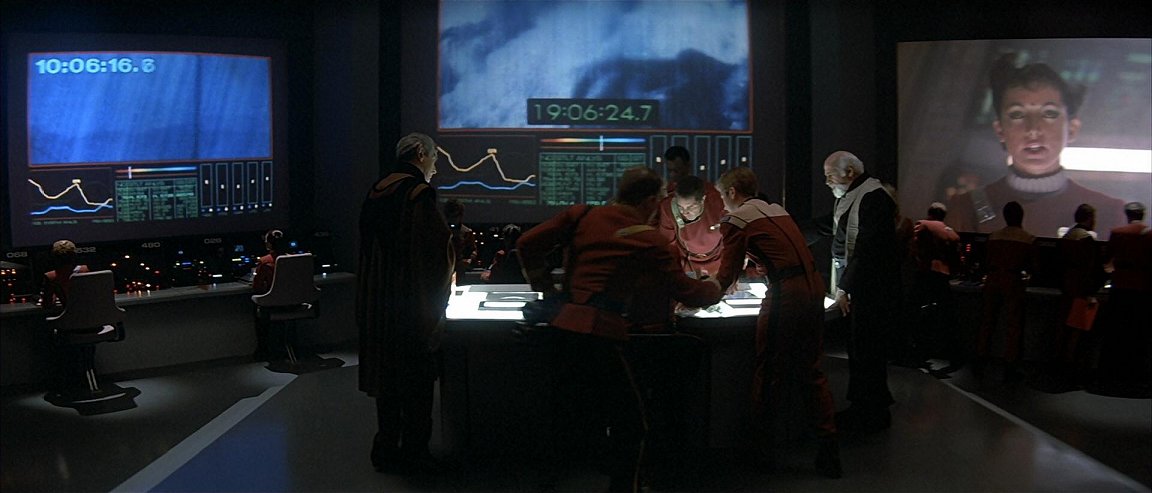
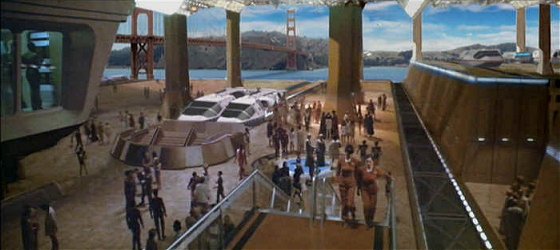
Welcome to the headquarters of the Federation's space exploration agency: Starfleet. Based in San Francisco, facing the Starfleet Academy, Starfleet Command is the organisational centre for Starfleet, where all the admirals and other flag officers reside.
Starfleet Command consists of 8 buildings, all of which are named after individuals who have forged Starfleet into the organisation it now is. The buildings are as follows: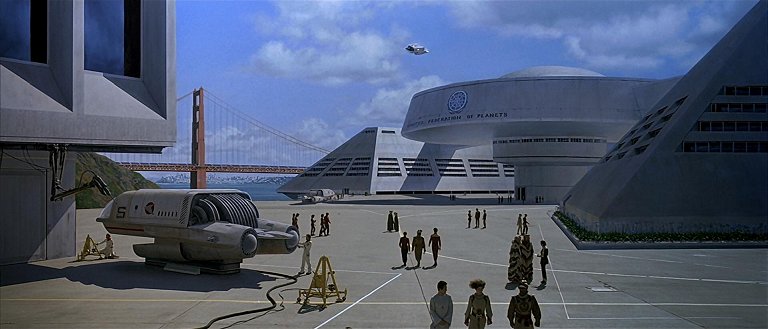
Jonathan Archer Building
James T. Kirk Building
Christopher Pike Building
Robert April Building
Zephram Cochrane Building
Quantum Cafe
Surak Building
Phillipa Georgiou Building
Starfleet Command was constructed in 2161 and has been the centre of operations for the Starfleet ever since. Overlooking the San Francisco Bay area, Starfleet Command is in itself just the heart, or brain area, for the 120-odd starbases and other space-dwelling residences all representing the United Federation of Planets' space division. Starfleet Command consists of the Strategic division, Research and Development division, Starfleet Security, Starfleet Intelligence, the Science division to name but a few. All of the division heads are here, the Rear Admirals, Vice Admirals, Admirals, Fleet Admirals and the Starfleet Commander-in-Chief herself. This is the command headquarters for Starfleet and the ultimate oversight over the activities of all of the starships, starbases, stations and facilities that Starfleet has or has ever had. This is where the peaceful exploration of the final frontier is directed and ethically guided by the flag officers with the wisdom and personal first-hand experience of being out on the frontier themselves.
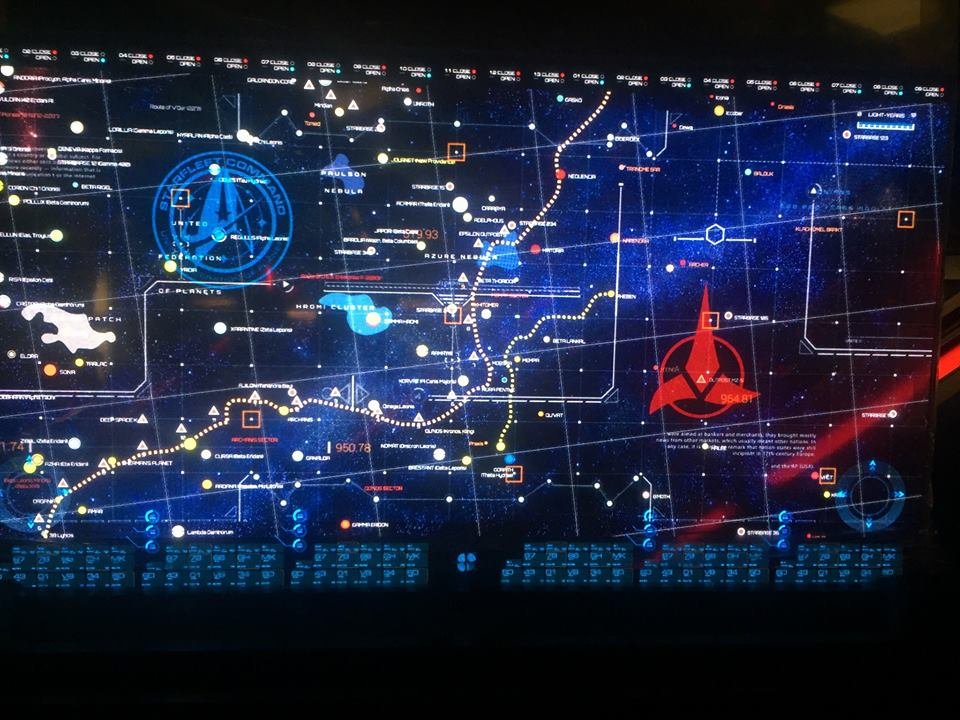
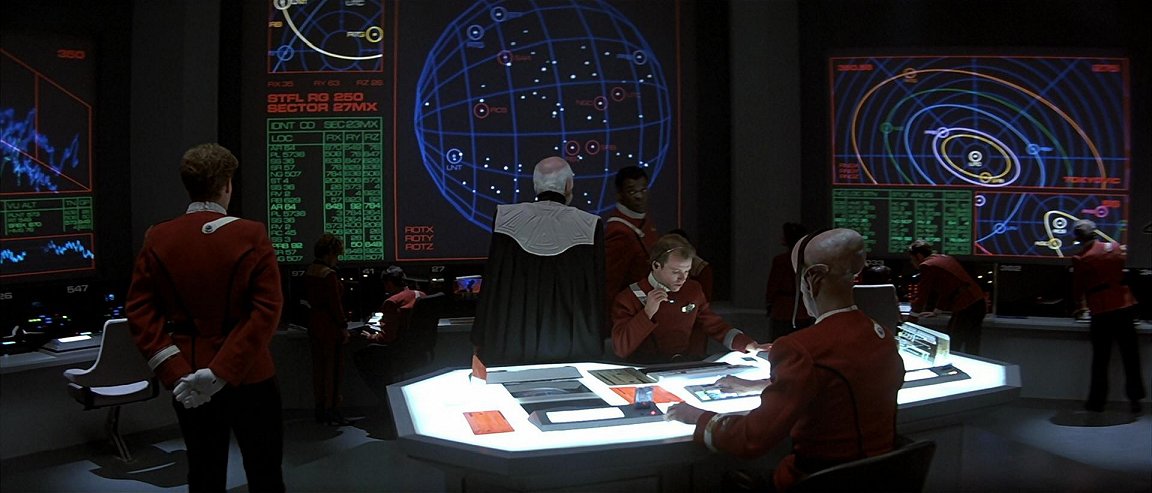
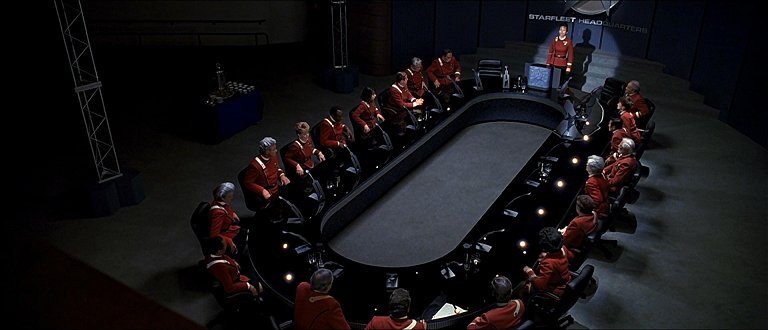 Starfleet Command boasts the most sophisticated communications network known of in either the Alpha or Beta Quadrants. Starfleet Command is able to communicate at any time to any of it's numerous starships, starbases or other facilities through billions of channels of communication, boosted to subspace speeds to counteract the vast distances covered. With the primary mission of Starfleet being exploration of space and scientific discovery, the importance of the chain of comand cannot be overstated. A command decision has to be made on whether to make contact with a new form of life or nation; whilst starship commanders had great latitude on making these decisions on the ground, they need to know they have a reliable link back up the chain of command. First contact or to leave a nation of species alone is the most important decision a command officer will ever make, beyond the life-and-death decisions regarding their crew and ship/station. The Prime Directive governs ALL encounters and is the final arbiter in the decisions made. Whilst Starfleet is out on the frontier trying to find new life and new civilisations, it is also morally driven not to contaminate a culture with ideas, waste products or technology. Non-interference in the natural order of things is paramount to Starfleet and the United Federation of Planets. Starfleet Command also liases with the non-Starfleet space-faring races that dwell in the area covered by Starfleet in order to discover new information and learn more about the universe and its contents. Starfleet Command has many briefing rooms where the various Captains and Admirals can discuss policies, deliberate on current situations and plan the next moves.
Starfleet Command is well served by airtrams, shuttlecraft and transporters, enabling all personnel rapid access to and from the Starfleet Headquarters to any number of Federation destinations including: the Presidential residence in Paris, the Starbase 1 facility orbiting Earth and the San Francisco Orbital Yards. Starfleet is ideally located for it's purpose and a day trip to the centre of operations of the Starfleet is rarely enough and a repeat visit, often in the form of enrolling into the Starfleet, is quite common. Enjoy your visit.
Author's Notes:
This is my interpretation of Starfleet Command/Starfleet Headquarters - the command centre for Starfleet Operations across all Federation space and beyond. Starfleet needs to have a chain of command that actually WORKS over the distances involved. Too often in Star Trek, for story reasons, the starship is out of range of Starfleet Command. Now okay, you might not get a signal back to Earth but we do have triple-figure number of Starbases operational. SOMEONE will generally be in contact as a sounding board. With Starfleet's primary mission being peaceful exploration and scientific discovery, we need to have an oversight and ethical element that helps decide if we SHOULD contact that life or nation, or whether an experiment should be done. I'm not talking about second-guessing, but it's also important to make the right call when deciding to make first contact, or wheter to walk away. Those elderly flag officers that Star Trek generally depicts as either insane, war-mongering or incompetant are actually the elders who've already been out there and done the job. Their WISDOM and EXPERIENCE should be pivotal in guiding starship captains and starbase commanders in making the big calls.
Like NASA mission control or the equivalent in the European Space Agency, Russian Space Agency or British military Joint Forces Command at Northwood, Starfleet Headquarters needs live feed for EVERYTHING they command or are responsible for. Thiswill act as a web for co-ordinating the acquisition and dissemination of knowledge and to formulate diplomatic or defensive initiatives as required. I wanted this to be the handover form the old guard to the new - not the unrealistic holding on of the old favourites well past retirement. Hikaru Sulu steps down as the Commander-in-Chief, Starfleet as depicted in the Federation: the first 150 years. He is succeeded by Irina Khmelnova, a Russian from the Karakalpakistan region of Uzbekistan, near the (by this era) renewed Aral Sea. This is about renewing Starfleet, like Star Trek, as an organisation primarily for peaceful exploration of space and scientific discoveries. Observing as non-participants until the appropriate time - whenever and if ever that is.
Star Trek needs to stop making other people act incompetant or antagonistically to make the hero crew look good. Starfleet, like NASA, ESA etc. all act as a TEAM. Starfleet Headquarters is just part of this and should be used as part of the story.
Starfleet Intelligence
A “soft” predictive system is possible for Starfleet Intelligence—as a decision-support tool, not a decision-maker.
It would highlight possibilities, not dictate outcomes, and would require strict Federation Council oversight, organic analysts, and ethical constraints to avoid sliding into Section 31-style determinism.
What a “Soft Predictive AI” Would Actually Be
This system would not be a quantum-probability engine or psychohistorical simulator.
It would be closer to:
- Trend analysis
- Scenario modelling
- Risk forecasting
- Diplomatic early-warning systems
Think of it as a galactic weather forecast, not a prophecy.
It would show:
- “High probability of Klingon political instability in the next 18 months.”
- “Romulan border tensions trending upward.”
- “Cardassian economic stress indicators rising.”
But it would never say:
“Remove this leader or war will occur.”
How It Would Work (Legally)
1. No autonomous decision-making
The system cannot act, recommend action, or generate covert strategies.
It can only present data.
2. Human analysts remain primary
Organic assets—diplomats, field officers, cultural specialists—interpret the results.
3. Federation Council oversight
A civilian committee would:
- audit the algorithms
- review data sources
- ensure no predictive behavioural modelling of individuals
- prevent mission creep into authoritarian territory
4. No modelling of individuals
Predicting people is illegal.
Predicting societies in broad strokes is allowed.
5. No closed-loop feedback
The system cannot update itself based on its own predictions (the flaw that doomed Section 31’s psychohistory).
What It Can Do
A soft predictive system could:
- Flag rising tensions between Houses of the Klingon Empire
- Identify patterns in Romulan Senate voting blocs
- Detect shifts in Cardassian public sentiment
- Predict resource shortages that might trigger conflict
- Highlight diplomatic opportunities before they vanish
This is strategic awareness, not manipulation.
What It Cannot Do
To remain legal, it must avoid:
- Behavioural prediction of individuals
- Political manipulation
- Covert influence modelling
- Autonomous threat elimination
These are the domains that pushed Section 31 into illegality.
The Non-Obvious Insight
A soft predictive system would still be controversial.
Even with oversight, many Federation worlds would fear:
- “algorithmic bias”
- “soft determinism”
- “data-driven diplomacy”
- “the first step toward psychohistory”
The Federation’s greatest fear is not war—it’s losing its moral identity.
A soft system walks that line carefully, but it can exist.
Why Knowledge Reduces Conflict
Starfleet operates on a simple principle:
Most conflicts begin with fear, and fear begins with ignorance.
Information allows Starfleet to:
- Predict misunderstandings before they become crises
- Interpret alien behaviour instead of misreading it as aggression
- Respect cultural boundaries
- Avoid accidental provocations
- Build diplomatic bridges based on genuine understanding
This is why Starfleet captains often quote data, history, or cultural insight during negotiations—they’re trained to know their counterpart before speaking.
Knowledge as a Diplomatic Tool
Starfleet uses information to improve relations, not leverage them.
- Understanding Klingon honour codes prevents unnecessary duels
- Knowing Romulan political factions helps avoid missteps
- Recognising Cardassian social hierarchies allows respectful negotiation
- Studying pre-warp societies avoids cultural contamination
Starfleet’s intelligence is designed to meet others where they are, not force them into Federation norms.
The Non-Obvious Insight
Starfleet’s greatest weapon is not technology—it’s context.
A single piece of cultural or scientific knowledge can prevent a war more effectively than a fleet of starships.
This is why the Federation invests so heavily in exploration:
Every new fact is a potential peace treaty.
By 2293, Starfleet and the Tal Shiar are locked in a systemic intelligence confrontation:
- Starfleet seeks transparency, stability, and early-warning knowledge to prevent war.
- The Tal Shiar seeks opacity, leverage, and internal regime security to preserve Romulan dominance.
v
This produces a rivalry defined by technological espionage, proxy manipulation, covert influence, and deep mistrust—a Federation–Romulan analogue to the U.S.–China intelligence competition
1. Strategic Context: Why 2293 Is the Flashpoint
Each side enters the decade with radically different anxieties:
- Starfleet fears a destabilised Klingon Empire after Praxis, and wants to prevent a Romulan power grab.
- The Tal Shiar fears that the Khitomer thaw will isolate the Romulan Star Empire and undermine its ideological legitimacy.
- Both sides believe the other is trying to reshape the post-Praxis order.
This creates a situation where information itself becomes the battlefield.
2. Competing Intelligence Philosophies
Starfleet Intelligence — “Knowledge prevents conflict”
- Collects broad-spectrum data on neighbours to reduce miscalculation.
- Prefers open-source, diplomatic, and scientific intelligence.
- Uses covert operations reluctantly, often with political oversight.
- Focuses on mapping intentions, not destabilising regimes.
Tal Shiar — “Control ensures survival”
- Views information as a weapon of state survival.
- Conducts coercive intelligence, internal purges, and external subversion.
- Seeks to shape the political environment around the Romulan Star Empire.
- Prefers deniable operations, infiltration, and psychological leverage.
This philosophical divide mirrors the U.S. (open, stability-seeking) vs China (state-security, influence-seeking) intelligence contrast.
3. The Intelligence War: Key Fronts
Technological Espionage — Warp, cloaks, and subspace
The Tal Shiar aggressively targets:
- Federation subspace sensor networks
- Transwarp and warp-efficiency research
- Early Federation quantum encryption
- Klingon–Federation joint technology projects
Starfleet counters by:
- Mapping Tal Shiar cloaked data relays
- Tracking Romulan signal anomalies
- Deploying passive sensor nets along the Neutral Zone
This is the 23rd-century equivalent of cyber espionage and tech-theft competition.
Influence Operations — The Tal Shiar’s asymmetric advantage
The Tal Shiar excels at:
- Funding anti-Khitomer factions
- Seeding disinformation in Klingon and Federation channels
- Manipulating border-world politics
- Using defectors as psychological weapons
Starfleet responds with:
- Quiet counter-intelligence
- Exposure of Tal Shiar front groups
- Diplomatic pressure
- Stabilisation missions on vulnerable worlds
This mirrors modern political influence campaigns and narrative warfare.
Proxy Conflicts — The frontier becomes the chessboard
Both sides avoid direct confrontation but compete through:
- Orion Syndicate intermediaries
- Border militias
- Klingon hardliner factions
- Independent research stations
- Merchant guilds and trade networks
Each proxy becomes a testing ground for intelligence reach.
Covert Penetration — The Tal Shiar’s obsession
The Tal Shiar attempts to infiltrate:
- Federation diplomatic corps
- Starfleet R&D
- Civilian scientific institutions
- Klingon political offices
Starfleet focuses on:
- Tracking Tal Shiar operatives
- Turning low-level assets
- Monitoring Romulan defectors
- Quietly mapping Tal Shiar command structures
This is the analogue to counter-espionage and mole-hunting between major powers.
4. Flashpoints of 2293
Three major crises define the year:
1. The Praxis Shockwave
The Tal Shiar sees opportunity in Klingon weakness.
Starfleet sees danger in Romulan opportunism.
Both sides scramble for real-time intelligence on Klingon internal collapse.
2. The Khitomer Accords
Starfleet views the treaty as stabilising.
The Tal Shiar views it as encirclement.
This triggers a surge in Tal Shiar covert sabotage and influence ops.
3. The Assassination Conspiracies
The Tal Shiar probes whether Federation or Klingon factions were involved.
Starfleet probes whether Romulan hardliners were involved.
Both sides suspect the other of strategic deception.
5. The Psychological Dimension
The Tal Shiar believes:
- The Federation is naïve, manipulable, and internally divided.
- Starfleet’s openness is a vulnerability to exploit.
Starfleet believes:
- The Tal Shiar is paranoid, brittle, and prone to overreach.
- Romulan secrecy hides deep internal fractures.
This mutual misreading fuels the cold war.
6. Outcome: A Cold Peace of Shadows
By the end of 2293:
- Neither side “wins.”
- Both sides entrench.
- The Neutral Zone becomes the galactic Berlin Wall.
- The Tal Shiar doubles down on secrecy.
- Starfleet doubles down on surveillance and early-warning systems.
The intelligence war becomes permanent, shaping the entire early 24th century.
Kavahr Prime is a liminal frontier society:
- Starfleet sees it as a stabilising outpost and early-warning sensor hub.
- The Tal Shiar sees it as a soft target for influence, infiltration, and political leverage.
- The population sees both as distant powers whose rivalry threatens their fragile autonomy.
It becomes the Berlin of the Neutral Zone—a world where information is currency, loyalty is fluid, and survival means learning to read the shadows.
1. Geography and Strategic Value
Kavahr Prime sits on a subspace faultline, a region where signals refract unpredictably.
This makes it:
- A perfect listening post for Starfleet
- A perfect infiltration corridor for the Tal Shiar
- A nightmare for local governance
The planet’s capital, Vethros, is a sprawl of prefabricated domes, old mining districts, and new Federation-built infrastructure.
The outskirts are a patchwork of independent settlements, many with Romulan cultural roots dating back to pre-warp diaspora movements.
2. The People: A Divided Identity
Federation Loyalists
Teachers, scientists, and settlers who believe Kavahr’s future lies in Federation membership.
They want stability, investment, and protection.
Neutralists
Merchants, miners, and local clans who distrust all major powers.
They want autonomy and minimal interference.
Romulan Culturalists
Descendants of ancient Romulan exiles who maintain language, ritual, and identity.
They are not Tal Shiar agents—but the Tal Shiar treats them as assets.
This demographic mix is exactly what the Tal Shiar loves:
fractured loyalties, old grievances, and exploitable identity politics.
3. Starfleet’s Presence: “The Quiet Shield”
Starfleet maintains:
- A subspace monitoring array
- A small science and diplomatic detachment
- A covert Starfleet Intelligence cell operating out of a research institute
Their mission is not domination—it’s stability.
They want Kavahr Prime to remain calm, prosperous, and predictable.
But their presence is resented by neutralists and feared by culturalists, who see them as a prelude to annexation.
Starfleet’s biggest weakness here is the same as the U.S. in foreign intelligence theatres: they assume transparency and goodwill are persuasive.
4. The Tal Shiar’s Presence: “The Shadow Embassy”
The Tal Shiar never appears openly.
Instead, they operate through:
- Cultural exchange groups
- Merchant guilds
- Romulan-language schools
- Anonymous investment funds
- Underground information brokers
Their goals:
v
- Undermine Federation influence
- Keep Kavahr politically fragmented
- Recruit informants
- Seed disinformation
- Identify potential defectors
To the Tal Shiar, Kavahr Prime is not a world—it’s a lever.
5. The Intelligence War on the Ground
Information Control
Starfleet tries to build transparent communication networks.
The Tal Shiar seeds rumours, forged documents, and false-flag transmissions.
Proxy Actors
Local militias, merchant guilds, and mining unions become pawns—sometimes willingly, sometimes unknowingly.
Recruitment
The Tal Shiar targets:
- Disaffected youth
- Romulan culturalists
- Smugglers
- Anyone with access to Starfleet systems
Starfleet targets:
- Administrators
- Scientists
- Neutralist leaders
- Anyone who wants stability
Economic Pressure
Romulan investors quietly buy up Kavahr’s mining rights.
Federation grants fund infrastructure.
Both sides claim they’re “helping.”
The locals know better.
6. The Human (and Romulan) Cost
Kavahr Prime becomes a society where:
- People speak in coded language
- Families split over political loyalties
- Businesses must choose which intelligence service to appease
- Every public protest is suspected of being foreign-backed
- Every unexplained disappearance is blamed on the Tal Shiar
- Every data breach is blamed on Starfleet
It’s a world where paranoia becomes a civic instinct.
7. The Breaking Point: The Vethros Incident
In late 2293, during the Khitomer upheaval, a subspace relay explosion kills 27 civilians.
Starfleet says it was sabotage.
The Tal Shiar says it was a Federation false flag.
Neutralists say it was Starfleet incompetence.
Culturalists say it was a warning from the Empire.
The truth is buried under layers of disinformation.
But the effect is clear: Kavahr Prime becomes the flashpoint of the new cold war.
8. Why This World Matters
Kavahr Prime is the perfect microcosm of your 2293 intelligence war:
- Starfleet wants knowledge to prevent conflict.
- The Tal Shiar wants leverage to shape conflict.
- The locals want to survive both.
It’s a world where the great powers’ philosophies collide—and where the cost is paid by people who never asked to be part of the game.
By 2293, the Tal Shiar launches a coordinated, multi-front intelligence offensive to penetrate Starfleet’s most advanced starship programs.
Starfleet Intelligence responds with counter-espionage, misdirection, and controlled leaks designed to frustrate, confuse, and trap Romulan operatives.The result is a quiet, escalating intelligence war fought across shipyards, research stations, border worlds, and diplomatic channels.
Why These Ships MatterThe Tal Shiar’s interest is not random. Each class represents a strategic threat to Romulan long-term planning.Excelsior-classBackbone of Starfleet’s heavy cruiser fleetLong-range endurance ideal for deep-space surveillanceTranswarp experiments (failed publicly, but the Tal Shiar suspects otherwise)
Excelsior Refit ProgramImproved warp coresEnhanced sensor palletsModular mission baysNew subspace encryption suitesThe Tal Shiar fears these refits will make Excelsiors too efficient at monitoring the Neutral Zone.
Project: Ambassador A next-generation heavy cruiser Designed for diplomacy and deterrence Rumoured to include early quantum-resolution sensors A symbol of post-Khitomer Federation confidence To the Tal Shiar, the Ambassador is the Federation declaring itself the stabilising power of the quadrant—a direct ideological threat.
2. The Tal Shiar’s Strategy: “Acquire, Disrupt, Undermine”
The Tal Shiar approaches the problem like a modern intelligence service targeting a rival’s aerospace and naval programs.
1. Industrial Penetration
Targets:
- Utopia Planitia
- San Francisco Fleet Yards
- Beta Antares Shipyards
- Independent contractors on border worlds
Methods:
- Shell companies
- Romulan-funded “neutral” investors
- Bribed subcontractors
- Disguised merchant crews
Their goal is to map supply chains, identify weak links, and insert operatives where oversight is lax.
2. Scientific Espionage
The Tal Shiar focuses on:
- Warp-field geometry research
- Subspace sensor harmonics
- Structural integrity field advances
- New computer core architectures
They target:
- Civilian universities
- Joint Federation research institutes
- Private warp-theory labs
Romulan analysts believe Starfleet’s “civilian openness” is a vulnerability.
3. Covert Acquisition
This is the Tal Shiar’s specialty:
- Stealing prototype components
- Intercepting starship debris
- Hijacking cargo shipments
- Using Orion intermediaries to buy stolen tech
They especially want:
- Excelsior warp-core diagnostic modules
- Ambassador-class sensor pallets
- Starfleet encryption chips
4. Political Influence
The Tal Shiar quietly funds:
- Anti-Starfleet factions on border worlds
- Neutralist politicians
- Anti-Khitomer Klingon hardliners
Their aim is to slow Starfleet’s expansion and create political pressure that delays shipbuilding.
3. Starfleet Intelligence’s Counter-Strategy
Starfleet Intelligence is not naïve.
By 2293, they treat the Tal Shiar as a peer adversary.
1. Counter-Infiltration
Starfleet embeds SI officers inside:
- Shipyard security teams
- Engineering corps
- Civilian contractors
- Diplomatic missions
Their job is to:
- Identify Tal Shiar tradecraft
- Track suspicious financial flows
- Map Romulan front companies
- Turn low-level Tal Shiar assets
2. Controlled Leaks & Deception
Starfleet uses misinformation as a weapon:
- Fake warp-core schematics
- Bogus sensor calibration data
- “Prototype” components that are actually traps
- False rumours about transwarp revival
The goal is to waste Tal Shiar resources and sow doubt inside their analysis divisions.
This is the Federation’s version of Cold War “paperclip traps.”
3. Hardening the Shipyards
Starfleet upgrades:
- Biometric access
- Subspace-encrypted internal comms
- AI-assisted anomaly detection
- Randomised personnel rotations
They also create black-box zones where only cleared engineers can enter.
The Shangri-la project is almost entirely compartmentalised.
4. Offensive Counter-Ops
Starfleet Intelligence quietly:
- Plants false defectors
- Hacks Tal Shiar data relays
- Tracks Romulan couriers
- Intercepts Tal Shiar merchant ships
These operations are deniable, quiet, and designed to force the Tal Shiar onto the defensive.
4. Flashpoints of the Shadow War
The Beta Antares Breach
A Tal Shiar cell steals a warp-core diagnostic module.
Starfleet lets them escape—because the module contains a tracking virus.
The Kavahr Prime Intercept
A Tal Shiar courier ship carrying stolen Shangri-la-class sensor data is intercepted by a “merchant distress call” that is actually a Starfleet Intelligence trap.
The Utopia Planitia Ghost
A Starfleet double agent feeds the Tal Shiar a year’s worth of false Excelsior refit data, causing the Romulans to miscalculate Starfleet’s sensor capabilities for years.
5. Outcome: A Stalemate of Shadows
By the end of 2293:
- The Tal Shiar has fragments of Excelsior and Shangri-la data
- Starfleet has mapped dozens of Tal Shiar networks
- Neither side trusts their own intelligence fully
- Both sides escalate their covert programs
The intelligence war becomes self-sustaining, shaping the early 24th century.
Section 31
Section 31 operates on a darker premise:
> “Survival is the only moral imperative.”
Its intelligence work includes:
- Covert manipulation of foreign governments
- Preemptive strikes against perceived threats
- Biological and technological black projects
- Deep infiltration of rival powers
- Internal surveillance of Federation institutions
Section 31 gathers information to shape outcomes.
Its goal is survival, not ideals.
Ethical Divide: Prime Directive vs. Pragmatism
Starfleet Intelligence
- Bound by the Prime Directive
- Transparent to the Federation Council
- Avoids interference
- Seeks peaceful solutions
Section 31
- Operates outside Federation law
- No ethical constraints
- Interferes freely
- Seeks decisive solutions
Starfleet Intelligence asks:
“How do we avoid conflict?”
Section 31 asks:
“How do we ensure we win?”
Operational Philosophy
Starfleet Intelligence
- Reactive
- Defensive
- Scientific
- Diplomatic
- Cooperative
Section 31
- Proactive
- Offensive
- Covert
- Manipulative
- Autonomous
Starfleet Intelligence is the Federation’s eyes and ears. Section 31 is its knife in the dark.
The Non-Obvious Insight
Section 31 exists because Starfleet Intelligence is too idealistic to handle existential threats alone.
Starfleet Intelligence exists because Section 31 is too ruthless to represent the Federation.
They are two halves of a single strategic ecosystem.
Section 31’s psychohistory program is one of its most secretive and most dangerous projects—an attempt to turn the galaxy into a predictable system, where political upheavals, wars, rebellions, and collapses can be forecast and manipulated with mathematical precision.
It is the Federation’s forbidden answer to Hari Seldon.
Section 31 uses psychohistory to predict the behaviour of entire civilisations, identify future threats decades in advance, and subtly manipulate events to ensure the Federation’s survival—often without anyone realising they’ve been nudged.
What Section 31 Means by “Psychohistory”
Not the academic Federation version.
Section 31’s psychohistory is a fusion of:
- Predictive AI modelling
- Sociopolitical data harvesting
- Cultural anthropology
- Covert influence operations
- Quantum-probabilistic forecasting
Their goal is not to understand societies. Their goal is to steer them.
The Three Pillars of Section 31 Psychohistory
1. Macro-Civilisational Modelling
Section 31 builds models of entire powers:
- Klingon succession cycles
- Romulan factional instability
- Orion economic collapse patterns
- Tholian strategic doctrine
- Gorn expansion vectors
These models are fed by stolen intelligence, intercepted subspace traffic, and deep-cover operatives.
2. Crisis Probability Forecasting
Section 31 calculates:
- When a Klingon Chancellor is likely to be challenged
- When a Romulan Senate faction will attempt a coup
- When a Federation world will radicalise
- When a border skirmish will escalate into war
They don’t wait for crises—they anticipate them.
3. Outcome Manipulation
Once a future crisis is predicted, Section 31 acts to:
- Push events toward the least dangerous outcome
- Remove destabilising individuals
- Leak information to shift political winds
- Engineer “accidents” that prevent wars
- Strengthen factions favourable to the Federation
This is where psychohistory becomes covert action.
Tools of the Psychohistory Program
Section 31 uses technologies Starfleet refuses to touch:
- Quantum-probability engines that run millions of political futures
- AI behavioural simulators that model alien leaders
- Sociometric implants in deep-cover agents
- Subspace sentiment analysis of entire populations
- Predictive cultural drift algorithms
These tools allow Section 31 to see patterns invisible to diplomats or admirals.
Why Psychohistory Is So Dangerous
Section 31’s models are powerful—but not perfect. Their greatest flaw is self-fulfilling prophecy.
If the model predicts a Klingon civil war, Section 31 may act in ways that cause it. If the model predicts a Romulan collapse, they may accelerate it to “control” the outcome.
Psychohistory becomes a trap:
the more they try to prevent disaster, the more they shape the galaxy into the disaster they fear.
The Non-Obvious Insight
Section 31’s psychohistory program is the closest the Federation has ever come to soft authoritarianism.
Not through force, but through prediction and nudging.
The Federation believes it is free. Section 31 believes it is guided.
Both may be right.
Section 31’s quantum probability engines are the beating heart of its psychohistory program—the machines that let them see the galaxy not as it is, but as it is likely to become.
They are the closest thing the Federation has to prophecy, built not on mysticism but on ruthless mathematics, stolen data, and forbidden AI.
Section 31’s quantum probability engines are predictive supercomputers that model political, military, and cultural futures across thousands of timelines, allowing Section 31 to anticipate threats decades in advance—and subtly manipulate events to force the “best” outcome.
What a Quantum Probability Engine Actually Is
A quantum probability engine is a hybrid system combining:
- Quantum computing
- Predictive AI
- Sociopolitical modelling
- Subspace data harvesting
It runs millions of simulations of galactic events, each branching into alternate outcomes based on:
- Klingon succession patterns
- Romulan Senate factional shifts
- Orion economic instability
- Gorn expansion vectors
- Federation internal politics
- Romulan strategic doctrine
The result is a probability map of the next 5–50 years.
How the Engines Work
1. Quantum Branching Simulation
The engine generates thousands of micro-timelines, each representing a plausible future.
It evaluates:
- Leadership changes
- Border conflicts
- Resource shortages
- Cultural radicalisation
- Technological breakthroughs
Each branch is scored for Federation survival probability.
2. AI-Driven Behavioural Emulation
The engine contains AI models of:
- Klingon High Council members
- Romulan Tal Shiar directors
- Klingon military units
- Federation Council blocs
- Tholian decision heuristics
These AIs simulate how real leaders would react to crises.
3. Outcome Convergence Analysis
The engine identifies:
- The most likely future
- The most dangerous future
- The most malleable future
Section 31 then acts to push reality toward the optimal branch.
What Section 31 Uses Them For
- Predicting wars before they begin
- Identifying future threats decades ahead
- Choosing which leaders to support or remove
- Manipulating political outcomes
- Engineering “accidents” to prevent catastrophic futures
- Guiding Federation policy without anyone realising
The engines don’t just predict—they shape
Why These Engines Are So Dangerous
1. They create self-fulfilling prophecies
If the engine predicts a Klingon civil war, Section 31 may take actions that cause it.
2. They tempt Section 31 into authoritarian thinking
If the model says a certain Federation Council member will cause instability in 20 years, Section 31 may “remove” them now.
3. They are built on incomplete data
A single misinterpreted cultural signal can skew an entire prediction chain.
4. They violate Federation law
Predictive AI of this scale is illegal under multiple Federation statutes.
5. They can be hacked or manipulated
The Tal Shiar and Obsidian Order have attempted to feed false data into the system.
The Non-Obvious Insight
The quantum probability engines don’t just predict the future—they narrow it.
Every intervention Section 31 makes reduces the galaxy’s natural variability, pushing it toward a smaller set of “acceptable” outcomes.
In trying to save the Federation, Section 31 may be slowly strangling its freedom.
Operative Profile: “The Quiet Divergence”
Designation: Asset 7-? (“Delta-Seven”)
Status: Active, unregistered, non-existent
Oversight: Presidential Eyes-Only
Identity Layering
Delta-Seven does not have a single identity. He maintains three parallel civilian lives, each fully documented, each psychologically reinforced through memory-anchoring implants. None of these personas know the others exist.
- Primary Shell — a mid-level Federation logistics analyst, invisible in his competence.
- Secondary Shell — a freelance xenotechnologist working on fringe research.
- Tertiary Shell — a quiet, solitary artist living on a remote colony.
Delta-Seven’s true self exists only in the quantum-secured vault of Section 31’s psychohistorical mesh.
Origin
He was not recruited.
He was identified — flagged by a probability engine at age nine as someone whose moral flexibility and pattern-recognition capacity would eventually diverge from societal norms.
Section 31 did not approach him.
They simply curated his life until he became the person they needed.
Psychological Profile
Delta-Seven is defined by three traits:
- Hyper-Empathic Coldness — he understands people with surgical precision but feels nothing about them.
- Narrative Awareness — he perceives social dynamics as story structures, predicting outcomes before they manifest.
- Existential Loyalty — not to the Federation’s ideals, but to its continuity.
He believes utopia is a fragile mathematical construct. His job is to keep the equation balanced.
Operational Specialty
Civilizational Pressure Management
Delta-Seven is deployed when the Federation faces slow-burn threats: ideological drift, cultural destabilization, demographic fractures, or political entropy.
His work is invisible because it happens before crises form.
- He seeds ideas into the right minds.
- He nudges conversations at critical moments.
- He redirects social currents with microscopic interventions.
- He ensures certain people meet, and others never do.
He is a gardener pruning futures.
Technology Interface
Delta-Seven is bonded to a Quantum Divergence Node, a device that exists in a state of partial temporal decoherence.
- It shows him possible futures in emotional, symbolic fragments.
- It warns him when a timeline begins to drift toward instability.
- It allows him to “feel” civilizational stress the way others feel temperature.
The node is embedded beneath the skin of his forearm. It looks like a faint, shifting shadow.
Field Methodology
He never uses violence.
He never issues threats.
He never breaks laws in ways that can be perceived.
Instead, he uses:
- Soft Influence — subtle conversational pivots.
- Micro-Event Engineering — arranging coincidences.
- Behavioral Resonance Mapping — identifying individuals whose actions ripple outward.
- Quiet Corrections — removing destabilizing elements without anyone noticing they’re gone.
His greatest operations are ones even Section 31 barely remembers authorizing.
A Recent Operation (2293)
During the Praxis crisis, Delta-Seven was not involved in diplomacy or military strategy.
His task was simpler and far more important:
He ensured that three Federation senators—each leaning toward isolationism—experienced personal events that softened their stance toward Klingon cooperation.
A chance reunion.
A medical emergency.
A rediscovered family archive.
None of them ever knew their lives had been edited.
But their votes preserved the Federation’s future corridor.
Non-Obvious Insight
Delta-Seven is terrified of one thing:
The day the probability engines stop predicting him.
If that happens, Section 31 will consider him a rogue variable.
And rogue variables are erased.
He knows this. He accepts it. It keeps him sharp.