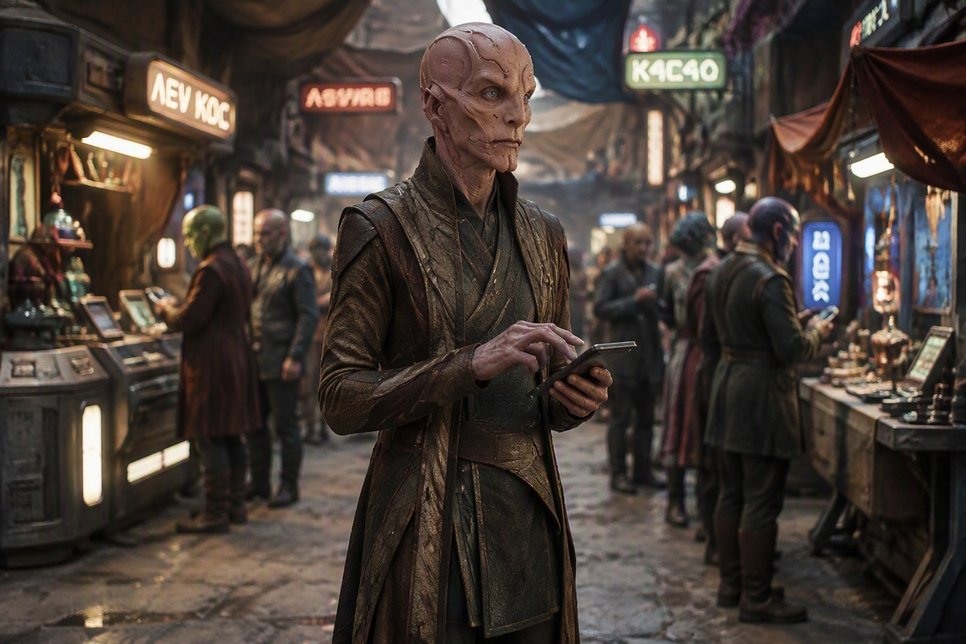
Kelpians in 2293 occupy a fascinating transitional moment: the species has only recently been liberated from Ba’ul domination (thanks to Saru’s intervention in the 2250s), yet they remain almost entirely absent from the political stage of the late 23rd century. What follows is a consolidated, lore-accurate ethnographic profile of the Kelpians as they would exist in 2293, grounded in canonical biology, culture, and historical trajectory.
Physiology and Sensory Profile (Unchanged by 2293)
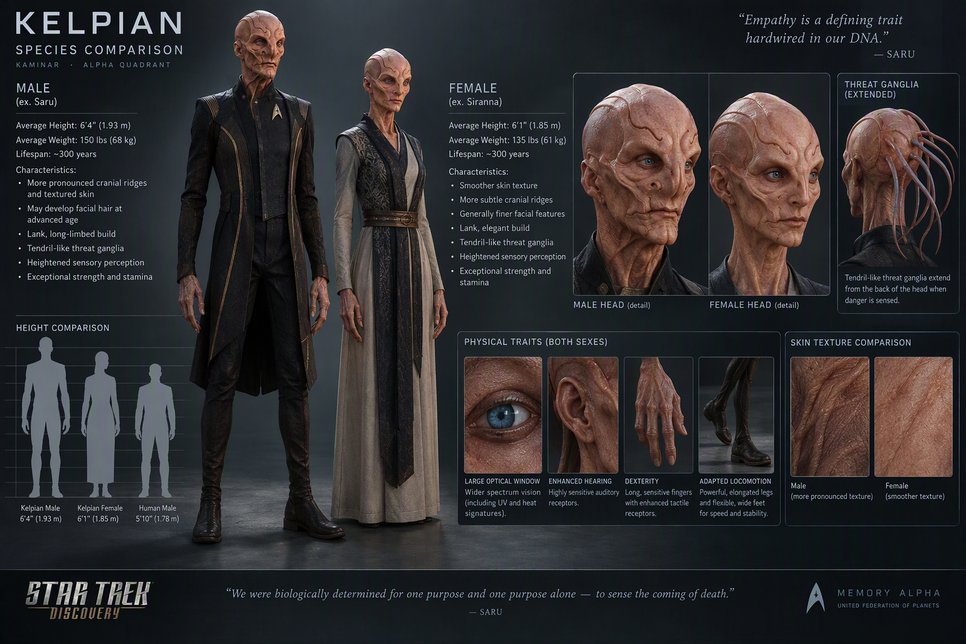
Kelpians retain their distinctive tall, lanky build, hairless heads, and brownish-orange skin, with females exhibiting smoother dermal texture than males. Their sensory suite remains one of the most acute among Federation species:
Ultraviolet vision and the ability to perceive heat signatures
Auditory and tactile sensitivity far exceeding Human baselines
Ability to detect threats up to 10 km away (pre-vahar’ai individuals)
Running speeds recorded at 80 km/h when stimulated by fear responses
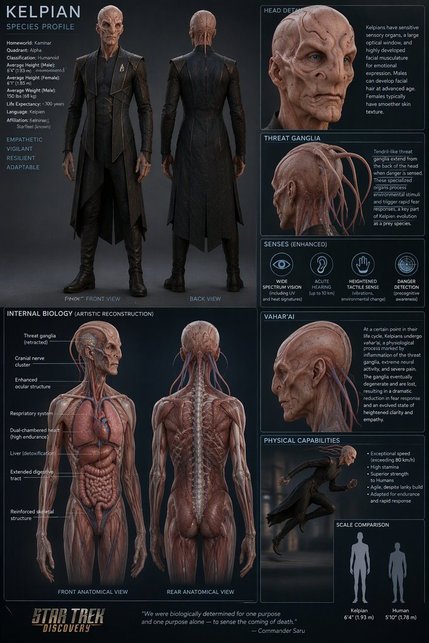
Their physiology is still shaped by the vahar’ai, the metamorphic process that transforms a Kelpien from prey-state to predator-state. By 2293, most Kelpians alive would be post-vahar’ai, possessing:
Retractable keratin dart-shooters replacing the former threat ganglia
A suppressed fear response and heightened assertiveness
A more confrontational, self-possessed behavioural profile
Homeworld Status: Kaminar in 2293
Although the Ba’ul’s domination ended in the 2250s, Kaminar in 2293 is still undergoing long-term sociopolitical reconstruction:
- The Great Balance ideology—the Ba’ul-imposed belief that Kelpians must submit to ritual harvesting—has collapsed, but its cultural residue persists in older generations.
- Ba’ul technology (e.g., Watchful Eye pylons) remains scattered across Kaminar, though no longer used for oppression.
- Kelpians are transitioning from a prey-conditioned society to one rediscovering its ancient predator heritage, which once nearly eradicated the Ba’ul.
By 2293, Kaminar is not yet a major interstellar actor. It is still stabilizing its internal governance, balancing Ba’ul technological sophistication with Kelpien demographic dominance.
Cultural Psychology in 2293
Kelpians of this era exhibit a dual cultural identity:
Pre-vahar’ai cultural residue
Older Kelpians who lived under Ba’ul rule retain:
- Hyper-cautious behaviour
- Ritualistic respect for the old Great Balance
- Strong communal bonds forged under oppression
Post-vahar’ai cultural emergence
Younger Kelpians and those transformed after Saru’s liberation event show:
- Assertiveness and willingness to confront danger
- A growing sense of national identity
- Interest in off-world contact and Federation integration
This generational divide defines Kelpien society in 2293 more than any external political factor.
Interstellar Presence in 2293
Canon sources indicate that Saru was the first Kelpien to join Starfleet, rescued in 2239.
By 2293:
- Kelpiens are not yet common in Starfleet or Federation institutions.
- Kaminar has limited spacefaring capability, still recovering from centuries of Ba’ul technological suppression.
- A few Kelpiens may serve as cultural envoys or scientific observers, but widespread off-world migration has not begun.
The species remains largely planet-bound, though no longer by force.
Sociopolitical Structure in 2293
Kelpians are rebuilding their society along lines that blend tradition with newfound autonomy:
- Local village councils remain the primary governance units.
- Ba’ul influence persists technologically but not politically.
- Post-vahar’ai Kelpiens increasingly push for planetary unification, while pre-vahar’ai elders emphasize caution and gradual change.
This creates a dynamic, sometimes tense, but ultimately forward-moving cultural evolution.
Summary: What Defines Kelpians in 2293?
Kelpians in 2293 are a species in recovery and renaissance:
- Physically powerful, perceptive, and biologically transformed
- Culturally divided but increasingly self-determined
- Politically emergent but not yet interstellar
- Living in the long shadow of Ba’ul domination while rediscovering ancient strengths
They are not yet a major Federation species—but the foundations for their 24th-century rise are firmly in place.
Kelpians in 2293 are one of the most culturally volatile, self-redefining peoples in the Federation sphere. Their society is in the middle of a once-in-a-species transformation: the collapse of the Great Balance, the biological revolution of vahar’ai, and the sudden absence of the Ba’ul have forced them to rebuild every institution, ritual, and identity from the ground up. What follows is a deep-structure ethnographic expansion of Kelpien society as it exists in 2293—its social orders, cultural tensions, emergent philosophies, and evolving interstellar posture.
Kelpiens in 2293 are a post-trauma, post-predation, post-fear civilization attempting to fuse two incompatible cultural lineages—prey-heritage and predator-heritage—into a single coherent society. Their culture is defined by reconciliation, recalibration, and rediscovery.
 The Cultural Architecture of Kelpien Society in 2293
1. Dual Identity: Pre-vahar’ai vs. Post-vahar’ai
Kelpiens are divided not by ethnicity, class, or geography—but by biology and lived experience.
Pre-vahar’ai elders
- Raised under Ba’ul domination
- Conditioned to avoid conflict, defer to authority, and prioritize communal safety
- Maintain rituals of caution: perimeter walks, dusk gatherings, threat-listening circles
- Often serve as moral anchors and memory-keepers of “the time before”
Post-vahar’ai Kelpiens
- Experienced the metamorphosis that removed fear and replaced ganglia with darts
- Assertive, exploratory, politically active
- Seek to reclaim ancient Kelpien predator traditions
- Often frustrated by the slow pace of societal reform
This generational divide is the central tension of Kelpien society in 2293.
2. Governance: A Planet Without a Constitution
Kaminar has no unified planetary government in 2293. Instead, it operates through layered, semi-formal governance:
Village Councils
The oldest political unit. Councils are composed mostly of pre-vahar’ai elders who guide local affairs through consensus and ritualised caution.
Regional Assemblies
Emerging bodies dominated by post-vahar’ai Kelpiens. They push for:
- Infrastructure modernisation
- Off-world trade
- Diplomatic contact with the Federation
The Ba’ul Question
Ba’ul technology remains everywhere—pylons, surveillance towers, atmospheric monitors—but the Ba’ul themselves are politically absent.
Kelpiens debate whether to:
- Dismantle Ba’ul tech (post-vahar’ai view)
- Repurpose it (pragmatic view)
- Preserve it as historical memory (elder view)
Kaminar in 2293 is essentially a planet in constitutional limbo.
3. Social Structure: From Herds to Clans
Kelpiens historically lived in herd-like communal groups, but post-vahar’ai assertiveness has reshaped this into a more complex social architecture.
Communal Houses
Still the basic unit of life—multi-family dwellings built around shared labor and shared meals.
Emergent Clans
Post-vahar’ai Kelpiens are forming identity-based clans:
- Dart-masters (martial tradition revivalists)
- Sky-seekers (aspiring spacefarers)
- Memory-keepers (cultural archivists)
- Balance-scholars (philosophers studying Ba’ul-Kelpien history)
These clans are not hereditary—they are ideological affiliations.
4. Ritual Life: Rewriting a Fear-Based Culture
Kelpiens once centered their rituals around fear, threat detection, and submission to the Great Balance. In 2293, ritual life is undergoing radical revision.
Rituals Being Abandoned
- The Harvest Vigil
- The Night of Listening
- The Balance Recitations
These are now practiced only by elders.
Rituals Being Reclaimed
Post-vahar’ai Kelpians are reviving ancient predator-heritage traditions:
- Dart-shaping ceremonies
- Predatory dances
- The Hunt-Song (a rhythmic communal chant)
New Rituals Emerging
A hybrid culture is forming:
- The Dawn Declaration — a daily affirmation of autonomy
- The Unbroken Path — a communal walk symbolizing unity between generations
- The Sky Offering — symbolic gestures toward the stars, representing future interstellar identity
Kelpien ritual life in 2293 is fluid, experimental, and politically charged.
5. Interstellar Posture: A Species Looking Up
Kelpiens are not yet a major Federation species, but 2293 marks the beginning of their outward gaze.
Spacefaring Capability
Still minimal. A few Ba’ul craft have been repurposed for:
- Atmospheric research
- Short-range orbital flights
- Federation liaison missions
Starfleet Presence
Saru remains the only fully integrated Kelpien officer. A handful of young Kelpiens have begun applying to Starfleet Academy, but:
- Most lack off-world experience
- Many elders oppose the idea
- Post-vahar’ai youth see it as destiny
Diplomatic Status
Kaminar is a provisional Federation protectorate, not a full member. The Federation is cautious, aware that:
- Kelpiens are culturally unstable
- Ba’ul relations remain unresolved
- Post-vahar’ai assertiveness could lead to conflict
2293 is the year Kelpiens begin imagining themselves as a future interstellar civilisation.
6. Philosophy: The Collapse of the Great Balance
The Great Balance—once the absolute moral law of Kelpien life—has shattered. In its place, three philosophical schools are emerging:
Continuity Keepers
Elders who believe the Great Balance contained wisdom worth preserving.
Liberationists
Post-vahar’ai Kelpiens who reject all Ba’ul-era ideology and seek a clean cultural slate.
Synthesis Scholars
A growing intellectual movement attempting to merge:
- Prey-heritage humility
- Predator-heritage strength
- Federation ethical frameworks
This school will eventually dominate 24th-century Kelpien thought.
7. The Central Conflict of 2293
Kelpiens are trying to answer one question:
What does it mean to be Kelpien when fear is no longer the foundation of identity?
Every political debate, ritual reform, clan formation, and philosophical argument in 2293 traces back to this existential crisis.
Kelpian Path to Membership of the United Federation of Planets
Kaminar’s path toward Federation membership in 2293 is unlike any other world’s. It is not a story of technological uplift, diplomatic negotiation, or ideological alignment—it is a story of a traumatized civilization learning how to govern itself after centuries of engineered fear. The Federation sees Kaminar not as a potential member state, but as a species in recovery, one whose political maturation must be carefully supported rather than accelerated.
Kaminar in 2293 is a provisional protectorate, not a candidate world. Its membership path is defined by internal healing, Ba’ul reconciliation, and the slow emergence of planetary governance capable of interfacing with the Federation Charter.
1. The Federation’s Initial Stance: “Observe, Support, Do Not Interfere”
The Federation’s approach to Kaminar after the Ba’ul collapse is shaped by three principles:
- Non-interference with post-trauma societies
- Avoiding power vacuums that could lead to civil conflict
- Preventing the resurgence of Ba’ul domination or Kelpien predatory backlash
Kaminar is placed under a Federation Observation Mandate, similar to early post-occupation Bajor but without the religious or geopolitical complexity.
This mandate includes:
- A small Federation diplomatic mission
- Humanitarian and infrastructural support
- Strict limits on political influence
- Monitoring of Ba’ul activity and Kelpien militarisation
Kaminar is not yet ready for membership discussions; it is still learning how to be a unified planet.
2. Internal Requirements for Membership
The Federation outlines three prerequisites before Kaminar can even apply for membership.
1. Planetary Governance Formation
Kaminar must develop a planetary council capable of representing both Kelpians and Ba’ul.
In 2293, this does not yet exist.
2. Inter-species Reconciliation Framework
The Federation requires a formal reconciliation process between Kelpians and Ba’ul.
This is the most difficult requirement, because:
- Kelpians remember centuries of oppression
- Ba’ul fear Kelpien predatory resurgence
- Both species distrust each other’s intentions
3. Stable Off-World Relations
Kaminar must demonstrate:
- Consistent diplomatic contact
- Reliable trade channels
- A non-militarised space presence
In 2293, Kaminar’s space capability is still embryonic.
3. The Ba’ul Factor: The Membership Obstacle No One Can Ignore
Kaminar cannot join the Federation as a Kelpien-only world.
The Ba’ul are technologically advanced, indigenous, and legally recognized as co-owners of the planet.
But in 2293:
- Ba’ul remain reclusive
- Their society is fragmented
- Their technological infrastructure is decaying
- They refuse to participate in joint governance
The Federation cannot admit a world where one species refuses political integration and another is still recovering from systemic oppression.
Thus, the Ba’ul are the single largest barrier to Kaminar’s membership path.
4. Kelpien Political Evolution: The Slow Rise of Planetary Identity
Kelpians in 2293 are beginning to form proto-national structures, but they are not yet unified.
Emerging political blocs:
- Liberationists — want rapid modernisation and Federation membership
- Continuity Keepers — elders who fear destabilisation
- Synthesis Scholars — intellectuals seeking a hybrid cultural future
- Sky-Seekers — youth pushing for space exploration and Starfleet integration
These factions agree on one thing: Kaminar must eventually join the Federation.
They disagree on when and how.
5. Federation Integration Milestones (2293–2350 Projection)
By 2293, Kaminar is at Milestone 1 of a long membership path.
Milestone 1 (2293): Stabilisation Phase
- Federation observation
- Humanitarian support
- No membership discussions yet
- Ba’ul monitoring
- Kelpien political emergence
Milestone 2 (2300s): Governance Formation
- Creation of a joint Kelpien–Ba’ul planetary council
- Establishment of interspecies legal frameworks
- First off-world Kelpien diplomatic corps
Milestone 3 (2310s–2320s): Pre-Membership Engagement
- Federation trade agreements
- Cultural exchange programs
- Starfleet Academy admissions increase
- Ba’ul technological integration
Milestone 4 (2330s–2350s): Membership Candidacy
- Formal application
- Charter compliance review
- Planetary unity assessment
- Full diplomatic normalization
Kaminar’s path is long because its trauma is deep.
6. Why the Federation Is Cautious
Kaminar is a textbook example of a post-oppression species with unstable internal dynamics.
The Federation fears:
- A Kelpien militaristic resurgence
- Ba’ul retaliation or withdrawal
- Civil conflict
- External exploitation by hostile powers (Klingons, Orions, etc.)
Thus, the Federation’s priority is stability, not speed.
7. The Central Question
Kaminar’s membership path hinges on one unresolved issue:
Can Kelpians and Ba’ul build a shared future, or will they remain two civilizations trapped in the memory of fear?
Until that question is answered, Kaminar cannot join the Federation.