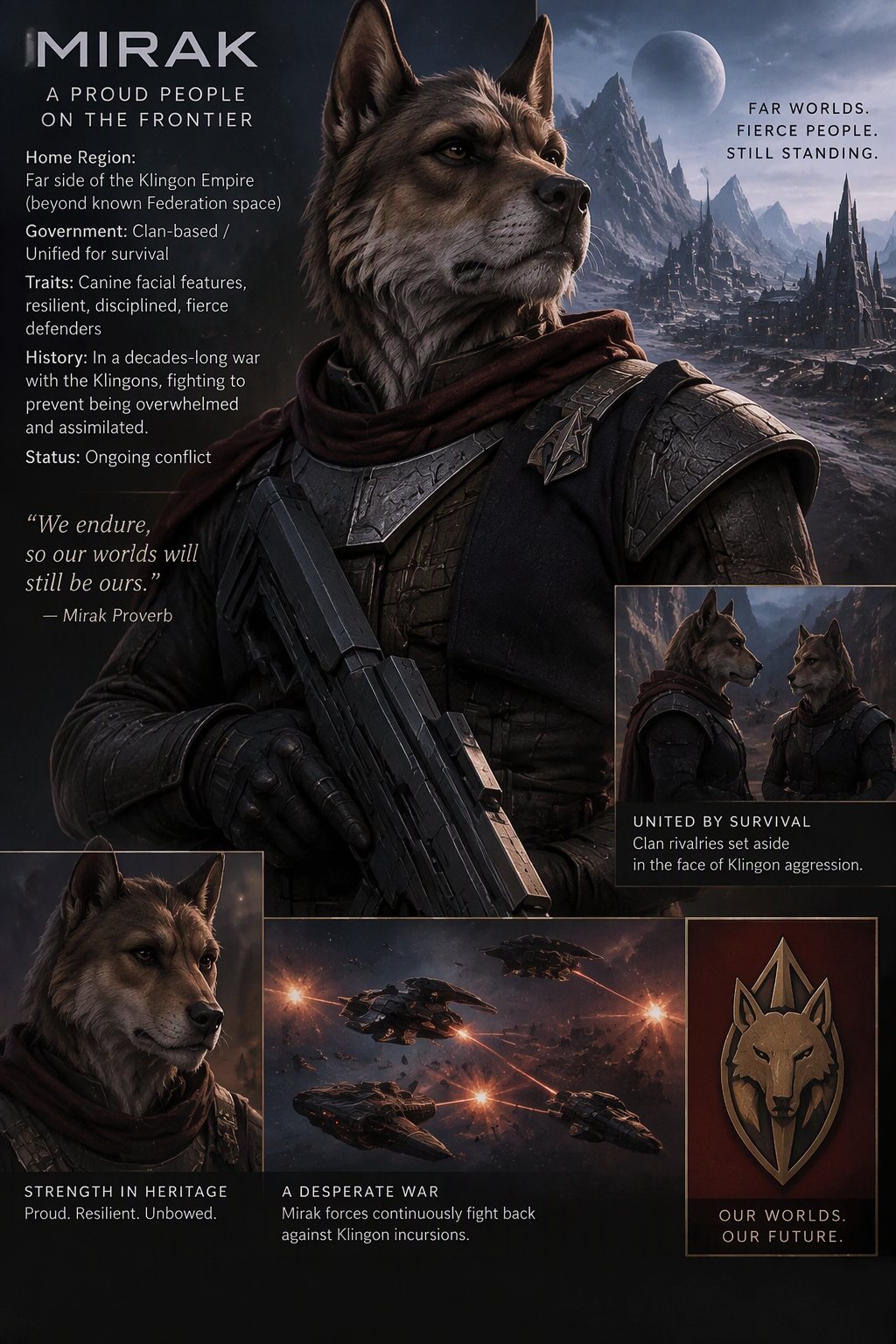
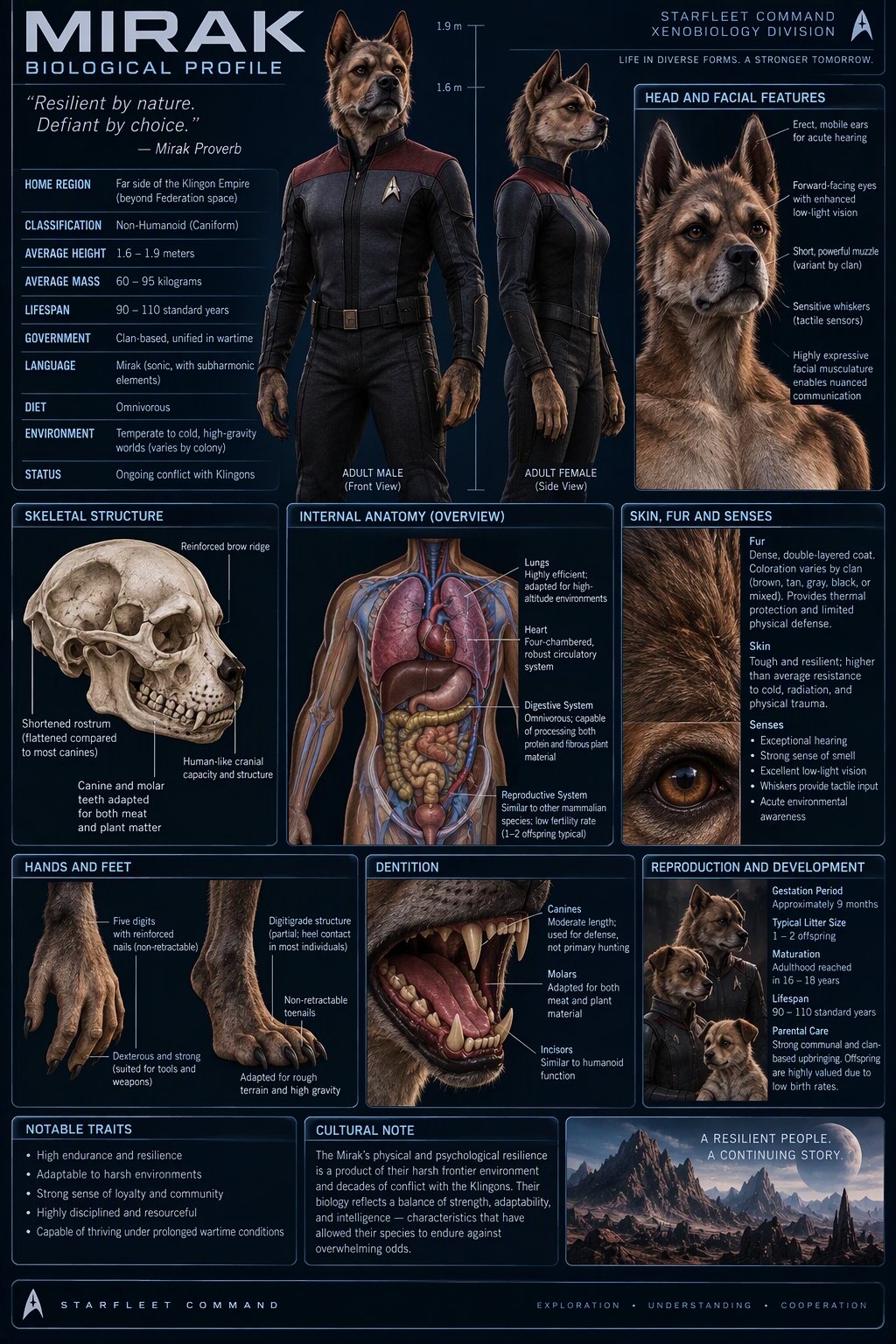
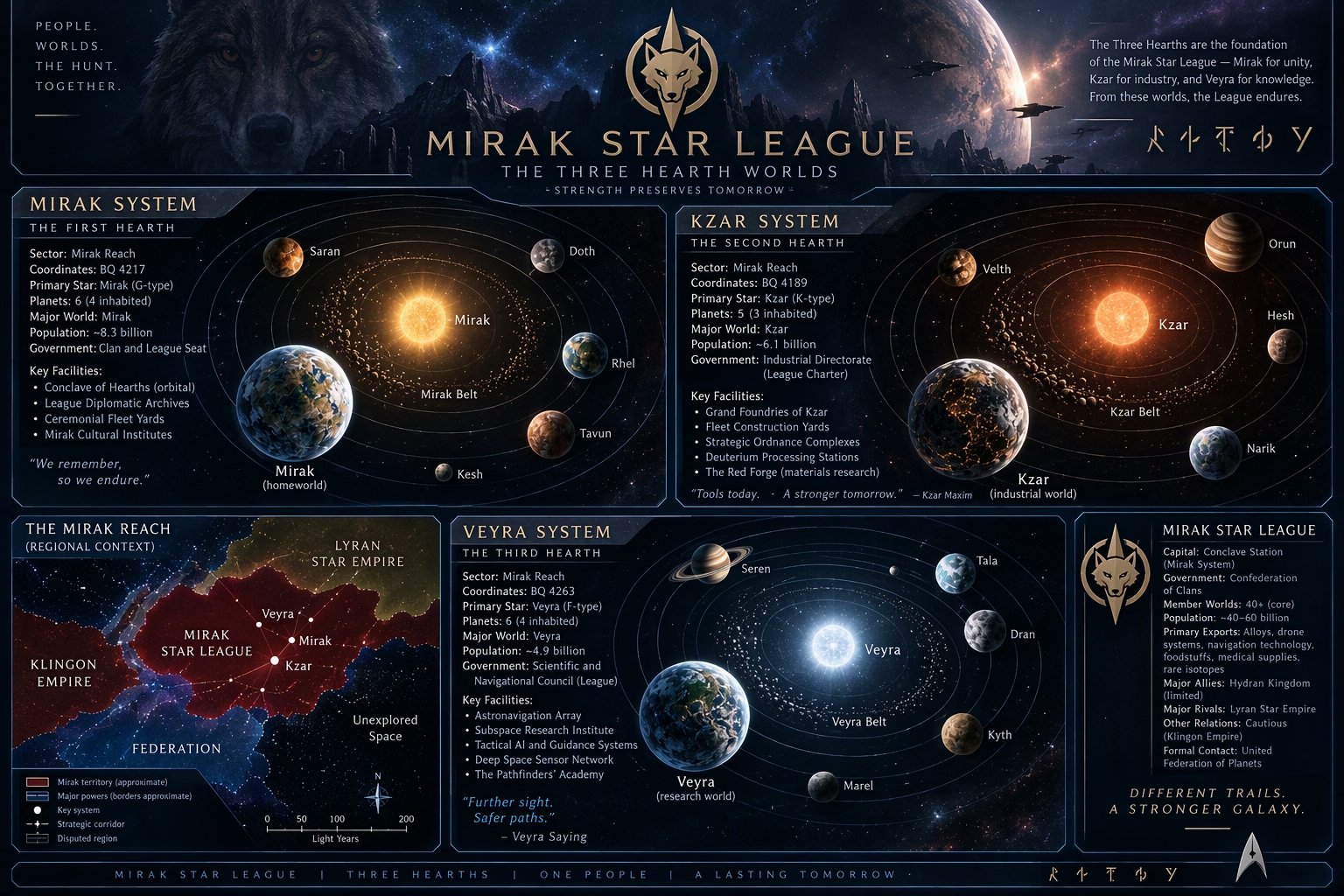
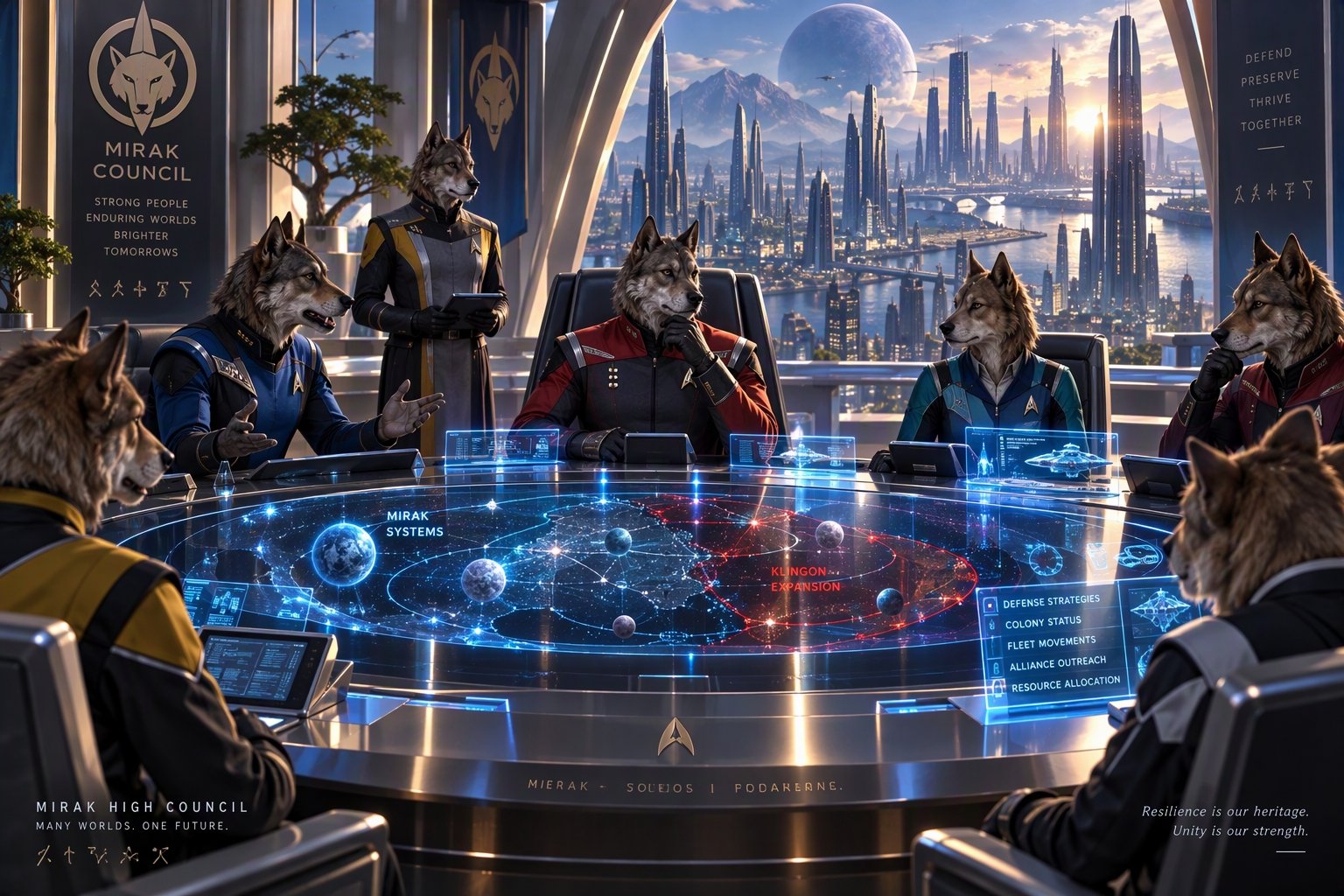
Page dedicated to Taldren, Inc and Interplay Games. For keeping the monster marooon era alive a little longer.
Torlek chronology
2292: Chang sends Torlek to the Mirak Reach
Publicly, Torlek is being given his first genuinely independent strategic command. Privately, Chang may already recognise that the political situation around Gorkon is becoming dangerous. It is ambiguous whether Chang already contemplated assassination when Torlek departed.
What's important is this: **Chang sends his heir somewhere far away from Qo'noS.** That simultaneously gives Torlek:
- an independent military reputation;
- distance from Chang's political circle;
- an impeccable record of where Torlek was during the conspiracy;
- relationships with Mirak commanders;
- command of an important Klingon field force.
The decision ultimately saves Torlek.
2292–93: The Mirak campaign
The Mirak campaign unfolds broadly as we've constructed it. Torlek discovers that destroying the Mirak fleet would be ruinously expensive, particularly after the Metar War. Instead comes the **Three Hearth Strategy**: **Mirak:** isolate politically. **Kzar:** pressure economically and militarily. **Veyra:** pull towards neutrality. Then the Lyrans overplay their hand. Torlek unexpectedly intervenes to prevent Kzar being taken. That establishes his crucial reputation: Torlek is an enemy who keeps his word. By early 2293, Torlek is nearing a settlement that would bring the Mirak into the Klingon strategic sphere without requiring occupation. Then Praxis explodes.
2293: everything unravels
The Empire recalls ships. Torlek's campaign essentially freezes. Then comes Gorkon's assassination and Khitomer. And the news reaches the Mirak frontier: **Chang was involved.** Now Torlek has a terrible problem. There is no holographic confession yet. From Torlek's perspective, Chang has died accused of murdering the Chancellor. But there is uncertainty about precisely:
- how deeply Chang was involved;
- why Chang did it;
- who else knew;
- whether the House of Chang was involved institutionally;
- whether Torlek knew anything.
So Torlek **cannot simply declare himself Head of the House of Chang**. The inheritance itself is politically radioactive.
Torlek returns to Qo'noS
This should happen around the beginning of the *Excelsior* series. Azetbur summons Torlek home. Torlek makes a very significant gesture.
Torlek leaves the Mirak fleet behind.
Torlek could bring warships. Torlek has loyal officers. Torlek has just demonstrated military competence. A lesser Klingon might return to Qo'noS surrounded by armed supporters. Torlek deliberately doesn't. That helps demonstrate that this isn't a coup. Torlek comes home to **answer for the name**.
Before 1.03: the House is effectively dead
This is where I'd alter our previous version. Torlek has *not yet reclaimed the House*. Legally, perhaps its final disposition is pending. Politically, it's finished. The Great Houses are already circling its property. Former clients distance themselves. Servants remove insignia. Allies stop answering messages. The House seal is removed from the High Council chamber. Its great estates are placed under imperial sequestration.
And Torlek is simply:
> **Torlek, heir of Chang.**
Not:
> **Torlek, Head of the House of Chang.**
That's important. The audience needs to see Torlek with virtually nothing before Balance of Honour gives him the opportunity to reclaim something.
1.03 – The Balance of Honour
Then the message arrives. Not simply a written confession. It is a **holographic testament**. And culturally that makes tremendous sense for the House of Chang. This was a House of performers, poets, writers, singers and keepers of Klingon literary culture. Chang doesn't merely leave words. **Chang performs his final testimony.** The High Council chamber darkens. A life-sized image resolves. And there is Chang. Not the theatrical warrior witnessed at Khitomer. Not the conspirator aboard the cloaked Bird-of-Prey. A Klingon who already knows how the story probably ends. And Torlek is watching.
Chang confesses completely
This is critical. Chang does **not** plead innocence. The confession makes Chang's guilt worse, not better. Chang admits the assassination. Chang admits the conspiracy. Chang admits acting against his Chancellor. Chang admits knowing the methods were dishonourable. And then comes the piece which transforms the status of Torlek. Chang makes clear:
> **The dishonour was mine.**
That becomes the legal and cultural fulcrum of the episode. Chang deliberately claims **personal responsibility**. Not responsibility of the House. Not responsibility of Torlek. Not even an ideological obligation imposed upon Chang's descendants. Chang condemns himself.
Chang reveals the intended Mauk-to'Vor
And suddenly the Council understands the intended structure of the conspiracy. Chang never expected to survive. As previously established, the plan was ultimately to perform Mauk-to'Vor. Chang accepts damnation to Grethor because Chang believes the personal sacrifice will preserve the Empire and prevent the dishonour attaching permanently to the House. *Excelsior* destroys Chang before that final act can occur. In Chang's worldview:
**Kill Gorkon.**Save the Empire. Accept personal damnation. Perform Mauk-to'Vor. Preserve the House. Die. Instead *Excelsior* interrupts the ritual narrative. Chang dies as a traitor. The House inherits the stain. And Torlek inherits the consequences.
Then Chang does something Torlek never expected
Chang didn't explicitly name Torlek as the successor. That's too convenient. Make the statement much more painful. Something along the lines of:
> **“What becomes of my House is not mine to command. I forfeited that right when I raised my hand against my Chancellor.”**
That puts everything onto Torlek. Chang cannot give the House back. Azetbur cannot simply give the House back.
**Torlek must earn it back.** And that's the *Balance of Honour*.
The Council fractures
This dovetails directly with the original episode plan, in which Chang's revelation splits the High Council. But now there are **three**, rather than two, positions.
The Gorkon/Azetbur faction
Chang was a traitor. The confession proves guilt. His motives cannot change that.
The hardliners
Chang was right. Gorkon was surrendering the Empire to Federation influence. Chang sacrificed himself for Klingon civilisation. These Klingons immediately begin turning Chang into a martyr.
Torlek's emerging position
This is the interesting one. Torlek agrees with neither. Chang was **wrong to murder Gorkon**. But that doesn't mean every fear Chang had about imperial decline was imaginary. Torlek can therefore say, in effect:
> *Do not turn my teacher into either a demon or a saint. Both are lies.*
That's a very strong foundation for Torlek's politics. The Mirak campaign now becomes decisive
Someone on the Council inevitably accuses Torlek:
> *You speak very carefully for the student of a traitor.*
Torlek's answer isn't rhetoric. It's his record. The Mirak campaign demonstrates precisely the difference between them. Chang believed an existential threat justified abandoning the rules. Torlek faced an enemy, had opportunities to betray agreements, and **didn't**. Most significantly, the Mirak themselves can attest to that. So the campaign is transformed retrospectively. What looked like an obscure frontier posting becomes **evidence of Torlek's character**. The climax: Torlek asks for nothing. This is where Balance of Honour lands.
Azetbur asks what Torlek wants.
Everyone expects:
*"My lands."*
*"My titles."*
*"My Council seat."*
Instead:
> **“The name.”**
Nothing else. Torlek wants the right to call himself:
Torlek of the House of Chang.
Torlek will earn everything else. That is an extremely Klingon act because he's taking the opposite path from his mentor. Chang sacrificed his honour because Chang believed the Empire mattered more. Torlek accepts political weakness because **honour matters more than power**. Azetbur grants it. Not the estates. Not the Council seat. Not Chang's commands. Not the wealth. **The name.**
And then Torlek goes back to Mirak. This is essential. After winning the right to use the name, Torlek does not remain at court collecting followers. Torlek leaves Qo'noS. That shocks everyone. Torlek returns to finish the duty Chang gave him. And this is where the **Compact of the Three Hearths** occurs. Only now does the Mirak settlement become synonymous with the restoration of the House. The first great deed performed under the reclaimed name **isn't a conquest**. It is a peace settlement. That's deliciously ironic. And it feeds directly into the larger Interim Years story
The whole series is about **change**, Starfleet adapting after the *Enterprise-A*, Spock becoming a diplomat, Sulu functioning as a seasoned Klingon hand, the Klingon Empire struggling after Praxis, and Azetbur's questionable succession while Waurg remains away fighting the Kinshaya. Torlek becomes another expression of exactly that theme. Sulu has to discover what Starfleet becomes without Kirk. Azetbur has to discover what Klingon government becomes without Gorkon. Spock has to discover what service becomes without command. And Torlek has to discover:
**what the House of Chang means without Chang.**
That makes 1.03 – The Balance of Honour much more than the episode revealing Chang's confession. It becomes the episode in which the series formally states its central thesis:
> **Honouring the past does not require repeating it.**
General Chang's hologram represents the old Empire explaining itself one last time. Torlek, standing silently before it, represents the Klingon Empire that now has to decide what comes next. General Chang's hologram represents the old Empire explaining itself one last time. Torlek, standing silently before it, represents the Klingon Empire that now has to decide what comes next.
 2287: the Klingon Empire at maximum apparent strength
2287 is the high-water mark of the late-23rd-century Klingon military system. The Empire may have the approximately 14,000 hulls we've been using in the wider setting, but that figure is deceptive. It includes everything from major battle formations to patrol ships, auxiliaries and provincial forces. General Chang and the High Command therefore have enormous capacity on paper, but they also have an enormous frontier to police. At this stage the Mirak Star League is already on Chang's strategic agenda.
His projected solution is essentially:
Lyran pressure ? isolate the Mirak ? split the clans ? destroy the League ? absorb the Three Hearths.
Then the Metar crisis intervenes.
2288: the war that saves the Mirak
The opening of the new region completely disrupts Klingon strategic planning. Our previous Metar chronology has Klingons, Romulans and Federation personnel initially competing over the newly accessible systems. The powers begin claiming systems and exploiting resources while scientific and scouting missions investigate the region. For the Klingons this is irresistible. Suddenly Chang has something potentially more important than the Mirak frontier. New territory. New resources. New technology. The proposed Mirak campaign is consequently postponed. Not cancelled. Postponed. That distinction becomes very important later. The Mirak effectively receive a historical reprieve because the Empire finds a more enticing quarry.
2289: the Metar strategic disaster
Then the situation changes. The Taubat are revealed to be cultivating or preserving the dormant Metar, and the Metar emerge at AP-173-B. In our earlier chronology this turns the second phase of the story into a broad defeat and retreat for the Federation, Klingons and Romulans. This would have enormous consequences for Klingon force allocation. Ships earmarked for the Mirak frontier disappear into the Metar theatre. So do: experienced crews, scouts, troop transports, engineering vessels, reconnaissance assets, replacement craft, ammunition, mobile repair facilities. Suddenly the Klingon Empire's 14,000-ship establishment isn't sitting around waiting for Chang to point it at Mirak. It is being consumed by a completely unforeseen strategic emergency. And the Mirak notice.
The Mirak response
This gives us a wonderful opportunity to make the Mirak active participants in history rather than passive beneficiaries. The Hunt Council studies Klingon fleet movements and recognises something extraordinary: ships are leaving the Klingon frontier and not coming back. The League doesn't initially know why. Mirak intelligence begins calling the phenomenon the Empty Trails. Klingon patrol density declines. Convoys are diverted. Border stations cannot obtain replacement components. Experienced squadrons disappear. For perhaps the first time in generations, the Klingon-facing frontier actually becomes quieter. Some Mirak clans immediately demand an offensive. The Hunt Council refuses. That decision becomes one of the defining moments of modern Mirak history. The League could attack the Klingon Empire while it is distracted. It chooses not to. Why? Because Mirak intelligence doesn't understand what is frightening the Klingons. And, culturally, that matters enormously. A hunter who sees another predator suddenly abandon its territory does not immediately rush into the abandoned territory. First, the hunter asks: What made it run?
2290: the Mirak discover the Metar
Eventually fragmented reports reach Veyra. Something has overwhelmed Klingon, Romulan and Federation forces. That alone is alarming. Much more alarming is that those three powers are beginning to cooperate. The Mirak strategic establishment reaches a chilling conclusion. Whatever is happening beyond the Reach is dangerous enough that centuries of hostility suddenly matter less than survival. Mirak spies, intercepted communications and returning merchant vessels gradually produce an incomplete picture of the Metar crisis. The Hunt Council therefore issues what later becomes known as the:
Closed Hearth Directive
No Mirak fleet will exploit Klingon weakness. No Mirak colonisation expedition will enter the affected region. Refugees will be recovered. Unknown biological material will be quarantined. Any unexplained autonomous technology approaching the Three Hearths will be destroyed at extreme range. It is an extraordinarily conservative decision. And probably saves the Star League.
The irony of 2290
Chang consequently finds himself in a bizarre position. The Mirak are exactly the sort of opponent he has always warned about. But they're behaving responsibly. Meanwhile, the Metar are behaving like Chang's worst theoretical enemy. They cannot be intimidated in normal political terms. That would affect him profoundly. Chang's later obsession with maintaining Klingon military supremacy now gains another layer. He has personally witnessed a situation in which the traditional balance of Federation, Klingon and Romulan power became virtually meaningless. The Metar demonstrate that civilisation can encounter something for which deterrence has no vocabulary. For Chang, the lesson is: Klingons cannot afford weakness. Ever. The Federation reaches almost the opposite conclusion: No civilisation can survive everything alone. And there, several years before Khitomer, you have the philosophical conflict of Star Trek VI already germinating.
2291: the Three-Power Alliance
Our previous chronology has the Enterprise-A and Sarek involved in bringing the Federation, Klingons and Romulans together against the Metar after the loss of Explorer. The ultimate solution requires three Shiva devices to close the affected space. Some vessels, including USS Apollo, are lost, while some Taubat escape. For the Mirak this is staggering. Three major powers have effectively fought the first coalition war of their era. And the Klingons return from it changed. Not necessarily socially. Militarily.
The Klingon fleet of 2291 is not the Klingon fleet of 2287
This is the crucial change to our previous model. The nominal fleet establishment might still look formidable. But the Metar War has produced something much worse than simple ship losses. It has consumed institutional capital. Veteran crews are gone. Experienced commanders are dead. Specialist engineering cadres have been depleted. Stockpiles are exhausted. Ships theoretically listed as operational require refits. Frontier bases have been cannibalised. Replacement crews have been rushed through training. Maintenance schedules have been deferred. And, most dangerously, Klingon politicians are unwilling to admit any of this. So the Empire emerging from the Metar War looks more aggressive precisely because it is becoming weaker. That fits beautifully with the late-Imperial atmosphere we've constructed elsewhere. And then comes the poison. The powers haven't merely returned from the Metar region with casualties. They have brought back Metar technology. Our earlier story explicitly ends with an after-credit sequence showing different powers studying recovered Metar technology. This is where the Mirak tragedy really begins.
The Klingons realise that recovered Metar technologies might compensate for the losses of the war. The Federation investigates carefully. The Romulans investigate secretly. The Klingons weaponise. And House Noggra becomes particularly important. House Noggra specialises in reverse-engineering captured technologies and begins experimenting with Metar remnants after the campaign. The House ultimately attempts to employ Metar energy technology to supercharge Praxis, with catastrophic consequences. So the road to Praxis now runs directly through the Metar War. And indirectly through the Mirak conquest.
2291–2292: Chang returns to the Mirak problem
The Metar conflict is over. Chang looks back toward the Mirak Reach. But he no longer has the pristine imperial war machine envisaged in 2287. So his strategy changes. He cannot afford: conquest by overwhelming force. He needs: conquest through political disintegration. The Metar War therefore transforms Operation Broken Hearth from a conventional invasion plan into something much more Chang-like. Intelligence. Provocation. Proxy warfare. Economic coercion. Lyran cooperation. Clan rivalry. Selective military strikes. And perhaps most importantly, recovered Metar technology.
2292: the Mirak trap
Chang knows the Mirak's greatest military advantage.
Drones.
So Klingon engineers begin studying whether technologies derived from the Metar campaign can disrupt Mirak autonomous guidance architectures. Not magical superweapons. That would make the Mirak too easy to defeat. Instead, the Klingons discover enough about adaptive control architecture to improve: electronic countermeasures, predictive tracking, automated point defence, drone identification, guidance spoofing. The Mirak's great advantage suddenly becomes less absolute. The League doesn't understand why. That creates paranoia. Kzar blames Veyra. Veyra blames compromised Klingon components. The clans blame one another.
Chang has found the fracture line.
2292–93: The War of the Dying Hunt
This replaces the earlier straightforward Mirak conquest.
The League now fights a three-sided strategic crisis.
The Klingon frontier
Chang applies controlled military pressure.
The Lyran frontier
Lyran forces exploit Mirak weakness.
Inside the League
Clans disagree over whether survival requires: Federation alignment, accommodation with the Klingons, escalation against the Lyrans, complete strategic isolation. The cohesion that made the League formidable begins breaking down. The tragedy is that the Mirak survived the Metar crisis by remaining cautious and united. They lose their independence because the Metar crisis changes everyone around them.
Then Praxis explodes
And now the whole history snaps into place. House Noggra's attempts to exploit recovered Metar technology catastrophically fail at Praxis in our established continuity. The Klingon Empire suddenly suffers the consequences of the very technological opportunism that grew from the Metar War. This happens before the Mirak campaign can be decisively completed.
Chang now faces a nightmare.
He has: an unfinished Mirak war; an exhausted fleet; a damaged economy; a shattered essential energy-production centre; restive subject territories; the Lyrans manoeuvring for advantage; Federation peace overtures; political rivals arguing that Klingon military policy has failed. This makes his behaviour around Khitomer considerably more comprehensible.
Chang's real nightmare
Chang isn't simply afraid of peace. He's watching the entire worldview upon which his career was built collapse. Consider what he has experienced in six years:
2287:
The Empire possesses apparently overwhelming military power.
2288:
The Klingons enter the new region expecting territorial gains.
2289:
The Metar drive Klingon forces backwards.
2290:
Klingons cooperate with ancient enemies because they have no alternative.
2291:
The Metar threat is contained, but at enormous cost.
2292:
Chang attempts to restore imperial authority by breaking the Mirak League.
2293:
Praxis explodes because Klingons attempted to exploit technology recovered from the very conflict that weakened them. Then Chancellor Gorkon says: We must make peace. To Chang, that is unbearable. He believes history is proving exactly the opposite. The galaxy is becoming more dangerous, not less. First the Metar. Then Mirak resistance. Tomorrow something else. In Chang's mind, Klingons therefore need more ships, more territory, more resources and more strategic depth. Gorkon has looked at the Metar War and Praxis and concluded: The Empire cannot survive alone. Chang has witnessed precisely the same events and concluded: The Empire cannot survive unless it is strong enough to stand alone. That's a vastly richer Chang.
The Mirak and Khitomer
And this gives us a rather Star Trek solution to their disappearance. The Mirak aren't completely conquered before Khitomer. They're half-conquered. Kzar is occupied. The frontier has fragmented. The League Fleet has suffered badly. Mirak itself remains resistant. Veyra remains semi-independent. Several clans have become Klingon protectorates. Others want Federation intervention. The Star League technically still exists. Then Gorkon is assassinated. Azetbur succeeds him. The Khitomer Conference proceeds. And suddenly Mirak becomes one of the awkward questions sitting underneath the peace table.
The secret price of Khitomer
This could become one of the most compelling pieces of your Interim Years political history. The Federation doesn't demand complete Mirak liberation. Instead, Azetbur negotiates a compromise. The Klingons withdraw from some recently occupied worlds. The Lyrans withdraw from others. The Three Hearths receive substantial internal autonomy. But the Federation acknowledges the Mirak region as lying within the Klingon strategic sphere. The independent Star League effectively ends. It is morally uncomfortable. Which is exactly why it works. Khitomer isn't suddenly utopia. It is the first stone in the very long road towards peace that your Excelsior series is about. And some people get left underneath that stone. The causal chain now becomes beautifully tight
2287
Klingon military high-water mark. Chang develops plans against the Mirak.
?
2288
Metar exploration begins. Klingon forces are diverted.
?
2289
Metar emergence. Klingon, Federation and Romulan expansion collapses into retreat.
?
2290–91
Temporary three-power cooperation. The Mirak wisely avoid exploiting Klingon vulnerability.
?
2291
Shiva devices contain the Metar region; recovered Metar technology begins circulating among the powers.
?
2291–92
An exhausted Klingon Empire returns to the Mirak question. Chang substitutes destabilisation for overwhelming invasion.
?
2292–93
The Mirak League fragments under Klingon, Lyran and internal pressure.
?
2293
House Noggra's exploitation of Metar-derived technology contributes to the Praxis catastrophe in our established chronology.
?
2293
Chang tries to destroy the peace process.
?
Khitomer
The Federation-Klingon settlement freezes the Mirak conflict rather than resolving it.
?
The Mirak Star League disappears from maps, but the Mirak do not disappear.
And that last distinction is the key.
By the 24th century, there can still be billions of Mirak living throughout the Three Hearths and surrounding systems. Their language, clans, Hearth traditions, Pathfinders, drone technology and old resentment survive.
What vanished in the 2290s was not the people.
It was the flag.
That also gives you a superb unexploded political bomb for the Excelsior series after Star Trek VI: Starfleet officers who fought alongside Klingons against the Metar now have to watch the Federation build peace with an Empire that has effectively swallowed the Mirak, while Mirak veterans quite reasonably ask, "When the Metar came, we did not strike you while you were weak. Now that you need peace, is this our reward?"
That feels very much like the sort of morally untidy foundation upon which your fifty-year road toward the Enterprise-C era should be built.
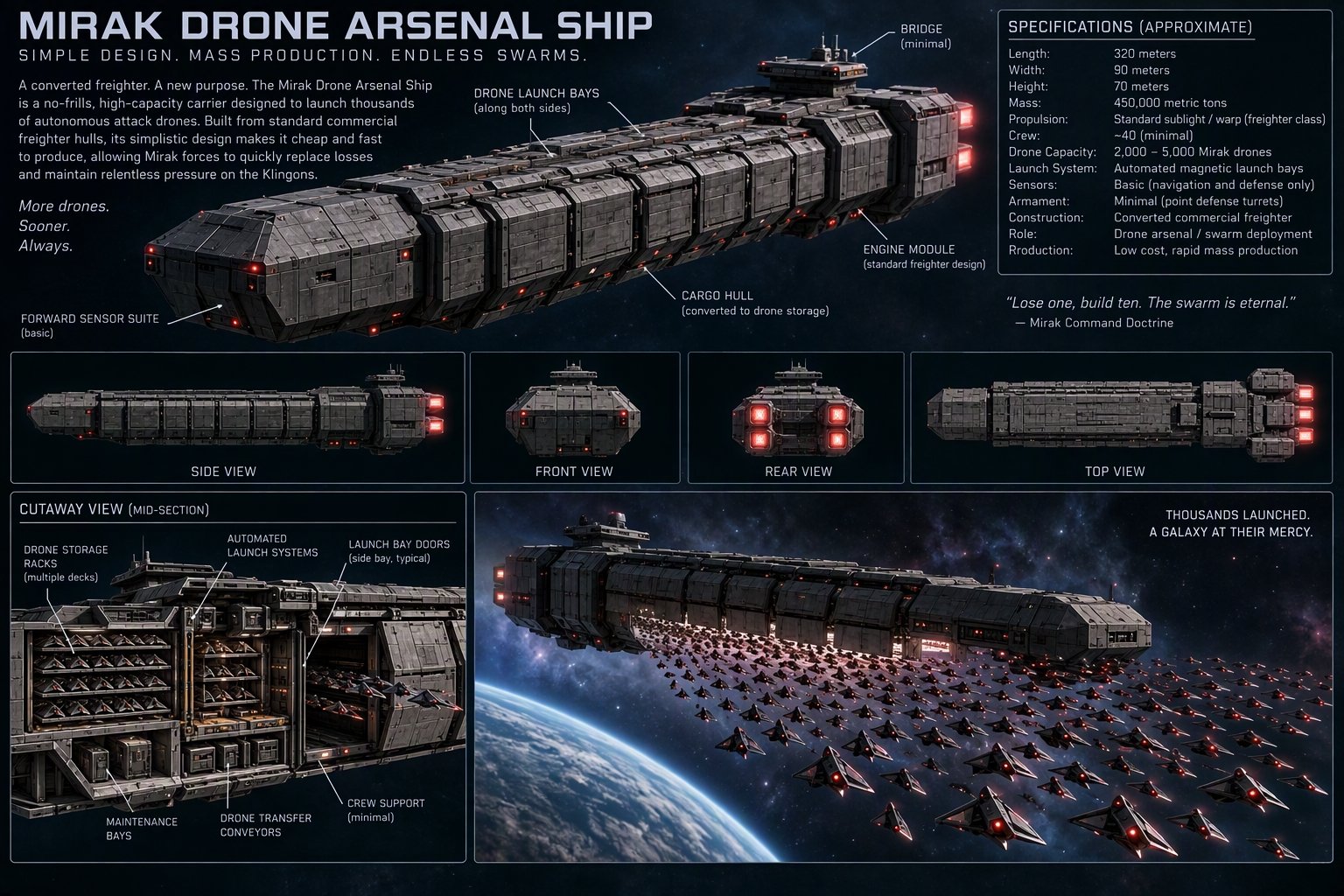
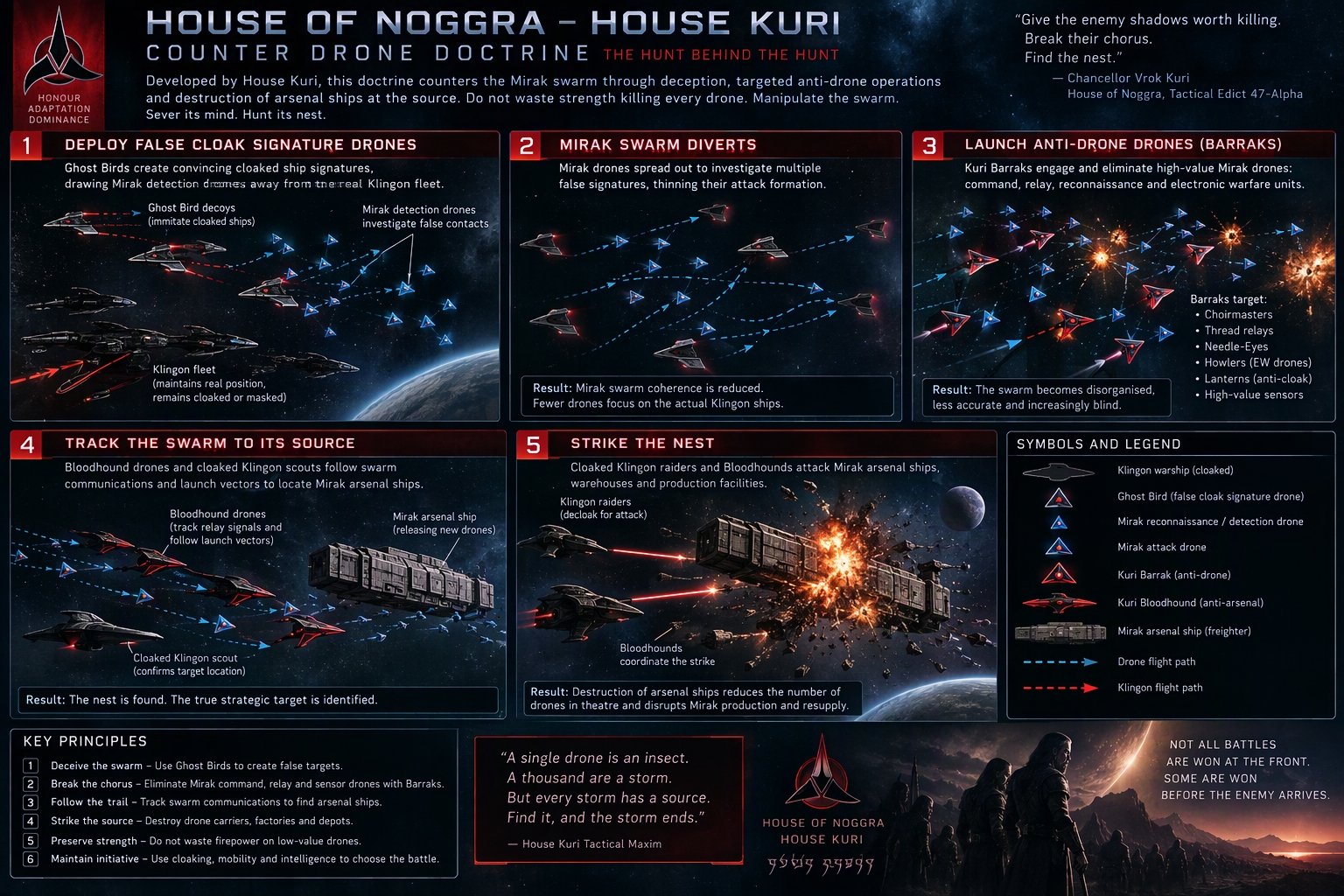
Mirak drone doctrine
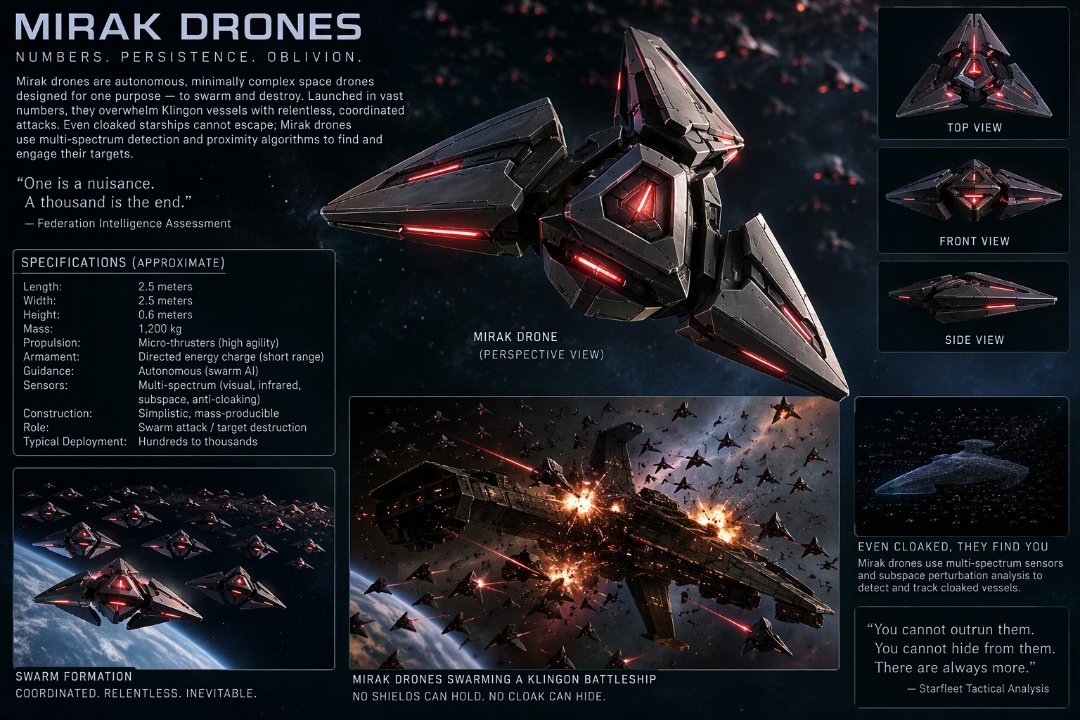
Core design philosophy
Every Mirak drone follows five rules:
Cheap enough to expend
Simple enough to manufacture anywhere
Modular enough to change between production batches
Autonomous enough to continue after communications fail
Numerous enough that individual intelligence is unnecessary
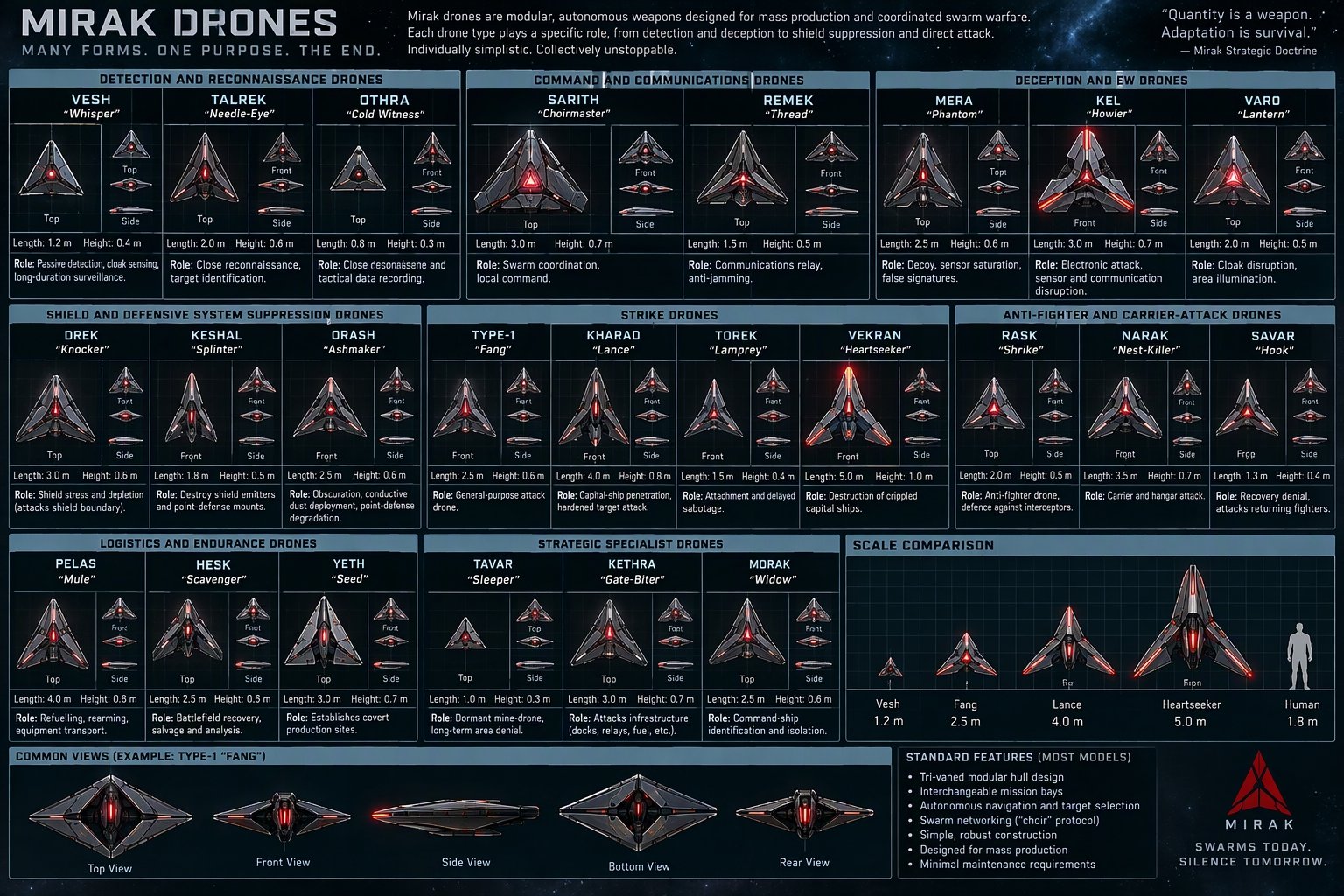
Most models share a dark, triangular hull approximately 2 to 4 metres across, three interchangeable equipment bays and a compact impulse drive. Components are deliberately standardised. A sensor drone can be converted into a strike drone by replacing its mission cassette, while damaged drones can be cannibalised without specialist equipment. Mirak drones do not possess a single central swarm intelligence. They form temporary local networks called choirs, usually containing several dozen to several hundred units. Each choir exchanges observations, votes on likely targets and appoints temporary coordinator drones. Destroying the coordinator does not disable the group. Another drone quietly assumes the role.
I. Detection and reconnaissance drones
1. Vesh “Whisper” passive detector
Role: Cloaked-ship detection and long-duration surveillance
Size: 1.2 metres
Armament: None
Endurance: Several months in dormant mode
The Vesh is little more than a passive sensor package, communications laser and cold-gas manoeuvring system. It emits virtually nothing while watching for: disturbed interstellar dust; background-radiation occlusion; subspace turbulence; minute gravitational anomalies; heat-management cycles; interruptions in natural electromagnetic noise. A single Vesh cannot reliably detect a cloaked Klingon ship. A field of several thousand can. Each detector reports only a probability. The network combines these weak observations into a moving three-dimensional volume called a ghost corridor. Attack drones then search that corridor rather than waiting for a perfect sensor lock.
Tactic: Dust Listening
Vesh units release microscopic reflective particles across likely Klingon transit routes. A cloaked vessel passing through the cloud leaves an expanding wake. The wake reveals direction, approximate mass and acceleration without requiring the cloak itself to be penetrated.
2. Talrek “Needle-Eye” scout
Role: Close reconnaissance and target identification
Size: 2 metres
Armament: Optional light cutting beam
Special feature: High acceleration
Needle-Eyes enter a suspected target area immediately before the main swarm. They approach from different angles, forcing Klingon vessels to reveal defensive weapons and shield geometry. Most are destroyed. Their purpose is to die informatively. The remaining drones transmit: shield frequency behaviour; active point-defence locations; engine-output changes; fighter-launch activity; damaged hull sectors; probable command-ship identity.
Tactic: The Question
A small Needle-Eye group performs an intentionally obvious attack against one shield quadrant. Klingon defensive reactions answer the Mirak’s practical questions: Which weapons fire first? Which sensors direct them? How quickly do shields reinforce? Which nearby ships provide support? The real assault is constructed from those answers.
3. Othra “Cold Witness” recorder
Role: Battle observation and tactical learning
Size: 0.8 metres
Armament: None
Cold Witness drones remain hidden at extreme sensor range. They record entire engagements and preserve the data even if the local swarm is destroyed. After the battle, surviving units either return to a Mirak depot or transmit compressed combat records through disposable relay chains. This allows manufacturers to modify the next production series. A Klingon captain may defeat the same Mirak tactic once. The captain is unlikely to encounter precisely the same tactic twice.
II. Command and communications drones
4. Sarith “Choirmaster” coordination drone
Role: Local swarm management
Size: 3 metres
Armament: Point-defence emitters
Special feature: Expanded processing and communications array
Choirmasters coordinate navigation, target allocation and collision avoidance. They are important, but never indispensable. A swarm contains several Choirmasters, only one of which broadcasts openly. The others imitate ordinary drones. If the active coordinator is destroyed, another assumes control and subtly changes the swarm’s behaviour, creating the impression that the Klingons attacked the wrong command vehicle.
Tactic: The Empty Throne
The most conspicuous coordination emissions come from an expendable relay drone. Klingon forces destroy it and expect the swarm to collapse. Instead, control migrates to a silent Choirmaster already embedded in the attack group.
5. Remek “Thread” relay drone
Role: Communications extension and anti-jamming
Size: 1.5 metres
Armament: None
Threads create a distributed optical and subspace communications mesh. They use tight-beam transmissions rather than continuously broadcasting in every direction. If Klingon jamming becomes overwhelming, Threads physically reposition around the interference source, allowing short-range communications to flow around it. Some Threads carry spools of tiny relay motes, leaving a communications trail behind advancing drones.
Tactic: Broken Music
The swarm deliberately divides into isolated clusters when jammed. Each cluster continues under prearranged tactical rules. When communications return, the clusters exchange their discoveries and reconstruct a shared battlefield map. The Klingons can interrupt the choir, but silence does not produce paralysis.
III. Deception and electronic-warfare drones
6. Mera “Phantom” signature drone
Role: Decoy and sensor saturation
Size: 2.5 metres
Armament: None, though some carry small explosive charges
Phantoms imitate the emissions of: arsenal freighters; Mirak cruisers; heavy attack drones; damaged Klingon vessels; warp-capable missiles; fighter formations. They can produce convincing signatures for only short periods, but short periods are sufficient during a confused engagement.
Tactic: The False Armada
Hundreds of Phantoms create the sensor appearance of several Mirak capital-ship formations arriving from different directions. Klingon vessels decloak, raise shields and turn broadside weapons towards nonexistent targets. The actual attack arrives from the least impressive contact group.
7. Kel “Howler” electronic-attack drone
Role: Sensor disruption and communications interference
Size: 3 metres
Armament: Electromagnetic pulse charges
Howlers do not merely generate noise. They transmit carefully constructed false returns: duplicate drone formations; phantom torpedo tracks; incorrect range information; delayed sensor images; false friendly identification codes; artificial cloaking disturbances. A Klingon tactical display may show 5,000 contacts when only 800 drones are present, or 200 contacts when several thousand are approaching in passive mode.
Tactic: The Hall of Ancestors
Howlers record Klingon command signals and rebroadcast altered versions from multiple locations. Ships appear to receive contradictory orders from recognised commanders. The deception rarely lasts long, but even a few seconds of hesitation can open a defensive corridor.
8. Varo “Lantern” illumination drone
Role: Cloak disruption
Size: 2 metres
Armament: Radiation and particle dispersal package
Lanterns flood a suspected area with charged particles, broad-spectrum radiation and overlapping low-energy sensor beams. They do not deactivate a cloak. They make the surrounding environment sufficiently structured that movement through it produces visible distortion.
Tactic: Lighting the Empty Room
Lanterns form a hollow sphere around a probable cloaked contact. The sphere contracts as different units detect disturbances. Once the search volume becomes small enough, attack drones saturate it with proximity warheads. The Mirak do not need to see the Klingon vessel clearly. They need only ensure that the vessel is somewhere inside the blast field.
IV. Shield and defensive-system suppression
9. Drek “Knocker” shield-stress drone
Role: Shield depletion
Size: 3 metres
Warhead: Directed plasma or shaped antimatter charge
Knockers detonate just outside the shield boundary. Their charges are inefficient as conventional weapons but produce intense, localised shield loading. They arrive in timed groups, striking the same shield sector fractions of a second apart. The objective is to force the target’s shield grid to transfer energy repeatedly until local emitters overheat or lose synchronisation.
Tactic: Hammering One Door
Mirak drones do not distribute their attacks evenly. Hundreds may appear to surround a ship, but the real effort concentrates on one narrow shield sector. Once that sector weakens, penetrator drones pass through while decoys continue attacking elsewhere.
10. Keshal “Splinter” emitter-hunter
Role: Destruction of shield projectors and point-defence mounts
Size: 1.8 metres
Warhead: Narrow shaped charge
Splinters are the precision weapons of the swarm. They wait behind the first-wave drones and use combat telemetry to identify exposed emitters, sensor apertures and disruptor mounts. Once a shield gap appears, Splinters accelerate through it and strike individual components rather than the main hull. A Splinter is too small to destroy a dreadnought. It can, however, destroy the shield projector protecting a section of that dreadnought.
11. Orash “Ashmaker” defence suppressor
Role: Obscuration and point-defence degradation
Size: 2.5 metres
Payload: Conductive dust, reflective fragments and sensor-confusing aerosols
Ashmakers release clouds of engineered material around the target. The clouds interfere with precision targeting and create thousands of transient sensor reflections. The debris is dangerous to both sides, but Mirak drones are expendable and navigate using shared local maps. Klingon fighter pilots and capital ships must operate more cautiously.
Tactic: Black Snow
Ashmakers contaminate the defensive perimeter before the main attack. Point-defence weapons can still fire, but their engagement range falls sharply. The battle becomes a close-range contest where drone numbers matter more than Klingon sensor superiority.
V. Strike drones
12. Mirak Type-1 “Fang” attack drone
Role: General-purpose ship attack
Size: 2.5 metres
Warhead: Shaped antimatter charge
Targets: Escorts, transports, exposed systems
The Fang is the standard Mirak combat drone: fast, simple and produced in enormous numbers. Its three vanes contain manoeuvring thrusters. The central body contains the sensor package, processor and warhead. It can detonate: on impact; at a preselected distance; after penetrating a hull breach; when another drone confirms the target’s shield has failed. Fangs rarely attack individually. They travel in groups of three: one attracts defensive fire; one measures the target’s response; one attempts the terminal strike.
13. Kharad “Lance” penetrator
Role: Capital-ship penetration
Size: 4 metres
Warhead: Tandem shaped charge
Special feature: Armoured frontal spike
The Lance is launched only after Knockers and Splinters have opened a pathway. Its first charge breaches armour. The drone’s remaining body passes into the damaged compartment before the second charge detonates. Preferred targets include: warp-plasma conduits; impulse manifolds; flight-deck machinery; torpedo magazines; shield-control trunks; command-centre access shafts.
Tactic: The Wound Remembers
Once a Klingon vessel is damaged, every Mirak swarm stores the breach location. Later attacks prioritise the same wound, even months after temporary Klingon repairs. A ship that survives one battle carries a targeting history into the next.
14. Torek “Lamprey” attachment drone
Role: Delayed sabotage
Size: 1.5 metres
Payload: Variable
Lampreys attach magnetically or mechanically to a ship’s hull. Their coatings imitate nearby hull material and reduce sensor visibility.
They may: detonate immediately; wait until the ship enters warp; cut into power conduits; transmit tracking information; release smaller drones inside a maintenance compartment; remain dormant until the vessel enters a repair yard.
Tactic: Carried Home
Some Lampreys deliberately avoid damaging the target during battle. They allow the Klingon vessel to carry them into a supposedly secure anchorage, where they identify other ships, transmit navigation data or attack repair infrastructure.
15. Vekran “Heartseeker” execution drone
Role: Destruction of already crippled capital ships
Size: 5 metres
Warhead: Heavy antimatter or warp-reactive charge
Cost: High by Mirak standards
Heartseekers are not wasted against intact shields. They remain behind the main swarm until a target is immobilised and a stable penetration route has been established. Several may enter through the same breach and distribute themselves around critical engineering spaces before detonating simultaneously. The Mirak prefer mission kills, but Heartseekers ensure that particularly valuable dreadnoughts and carriers cannot be recovered.
VI. Anti-fighter and carrier-attack drones
16. Rask “Shrike” interceptor
Role: Fighter suppression
Size: 2 metres
Armament: Short-range micro-torpedoes and pulse emitters
Shrikes do not attempt to outfly Klingon fighters in prolonged dogfights. They travel in dense groups and create overlapping engagement zones.
They attack: fighters pursuing the main swarm; craft returning to carriers; rescue vehicles; airborne command platforms. A Shrike formation often sacrifices half its number to draw fighters away from a carrier’s recovery corridor.
17. Narak “Nest-Killer” carrier-assault drone
Role: Flight-deck and hangar attack
Size: 3.5 metres
Warhead: Fragmentation and incendiary charge
Nest-Killers target open hangars, launch apertures, recovery systems and parked fighters. They are most effective when Klingon carriers are recovering a patrol and cannot close protective shutters immediately.
Tactic: Follow the Warrior Home
Needle-Eyes or Shrikes secretly follow returning Klingon fighters. The wider swarm uses those flight paths to locate the carrier and map the safest route through its defensive screen. The fighter survives the engagement and unintentionally guides the Mirak to its mothership.
18. Savar “Hook” recovery-denial drone
Role: Prevent fighter recovery
Size: 1.3 metres
Armament: Proximity fragmentation charge
Hooks linger around the approaches to a carrier. They do not pursue outbound fighters. They wait until the fighters return with reduced fuel, depleted weapons and predictable approach vectors. The objective is not necessarily to destroy every fighter. It is to compel the carrier to manoeuvre, suspend recovery or abandon damaged craft.
VII. Logistics and endurance drones
19. Pelas “Mule” support drone
Role: Refuelling, rearming and equipment transport
Size: 4 metres
Armament: None
Mules carry replacement mission cassettes, power cells, communications relays and compact warheads. They allow surviving drones to be retasked without returning to an arsenal ship. A sensor drone may dock with a Mule, exchange its passive array for an explosive charge and join the terminal attack. This makes counting Mirak strike drones extremely difficult. An apparently harmless reconnaissance field may transform into an attack formation.
20. Hesk “Scavenger” salvage drone
Role: Battlefield recovery
Size: 2.5 metres
Equipment: Cutting tools, manipulators and material processor
Scavengers strip destroyed drones, Klingon fighters and battlefield debris. Recovered components are returned to hidden fabrication sites. Some Scavengers collect fragments of Klingon sensors and defensive systems for analysis. Others turn wreckage into improvised mines.
Tactic: Nothing Leaves the Battlefield
After a Klingon withdrawal, Scavengers dismantle everything useful. The Mirak recover hardware, sensor records and raw material, while also denying Klingon intelligence access to intact drone components.
21. Yeth “Seed” fabrication drone
Role: Establishment of covert production sites
Size: 3 metres
Equipment: Industrial replicator, mining tools and autonomous factory controller
Seeds land on asteroids, moons or derelict stations and begin constructing basic infrastructure. A Seed cannot manufacture sophisticated electronics immediately, but it can produce structural components, fuel tanks, drone hulls and additional machinery. Given imported processors and warheads, a hidden Seed colony can become a small drone factory. The destruction of a Mirak arsenal ship therefore does not always reduce the enemy’s future strength. The ship may already have scattered Seeds throughout the system.
VIII. Strategic specialist drones
22. Tavar “Sleeper” dormant mine-drone
Role: Long-term area denial
Size: 1 metre
Endurance: Years
Sleepers resemble debris, rock or abandoned equipment. They awaken when local sensors identify a matching target profile. Rather than immediately colliding with the target, Sleepers may shadow it and transmit its route to a larger attack force.
Tactic: The Patient Constellation
The Mirak seed occupied and abandoned systems with millions of dormant units. Klingon fleets can never assume that a cleared region remains clear.
23. Kethra “Gate-Biter” infrastructure attacker
Role: Attack on docks, relays and logistics nodes
Size: 3 metres
Warhead: Modular
Gate-Biters avoid warships. They attack the infrastructure supporting those warships: orbital fuel farms; dry-dock mechanisms; tractor-beam arrays; communications stations; navigational beacons; munitions-transfer systems. One successful strike may delay an entire Klingon squadron without defeating a single combat vessel.
24. Morak “Widow” command-hunter
Role: Identification and isolation of flagships
Size: 2.5 metres
Armament: Light penetrator charge
Widows analyse communications patterns, escort behaviour and formation changes to determine which ship carries the Klingon commander. They then coordinate attacks on communications rather than attempting an immediate kill. The purpose is to isolate the flagship from surrounding ships and create contradictory local battles.
Tactic: Cut the Voice, Not the Head
Destroying a Klingon admiral may inspire furious retaliation. Preventing the admiral from issuing orders may be operationally more valuable.
IX. Standard Mirak swarm formations
The Spear Rain
Used against escorts and transports. Phantoms exaggerate the swarm’s apparent size. Howlers disrupt range estimates. Knockers stress one shield sector. Splinters destroy local emitters. Fangs strike propulsion and command spaces. Lampreys attach to retreating survivors. This is the simplest Mirak attack and the easiest for Klingons to recognise. Mirak commanders therefore use it primarily against inexperienced captains.
The Closing Hand
Used against cloaked ships. Five widely separated detection groups establish probable boundaries around the contact. Each group advances slowly, releasing Lanterns and Vesh detectors. The available space contracts until the target must: retreat along a predictable route; decloak and attack; remain within the closing search volume. Shrikes wait along likely escape vectors. Fangs saturate the final probability volume.
The Dying Star
Used against dreadnoughts. The Mirak attack every escort except the dreadnought. Logistics ships are destroyed, scouts are blinded and accompanying cruisers are driven away. The isolated dreadnought is then surrounded but not immediately assaulted. Drone formations remain outside effective weapons range, forcing the ship to maintain shields and combat readiness. Only when the dreadnought suffers fuel, heat-management or power limitations does the main attack begin. The tactic may take days.
The Empty Convoy
A group of arsenal freighters appears to move under weak escort. Klingon raiders attack, expecting a valuable drone stockpile. Most freighters are empty decoys carrying Phantoms and Howlers. The genuine arsenal ships remain silent elsewhere. When the Klingon vessels decloak and commit to the attack, hidden drones strike their rear arcs and pursue them away from reinforcement.
The Red Orchard
Seed drones, Sleepers and Vesh detectors are distributed through an entire star system months before an expected Klingon offensive. When the Klingon fleet arrives, the system appears empty. As ships pass through it, dormant units awaken in sequence. New contacts appear behind, beneath and inside the Klingon formation. The Orchard does not deliver one decisive blow. It produces continuous attacks over several days, depriving crews of rest and forcing the fleet to expend weapons against uncertain targets.
The Funeral Procession
Used against a withdrawing Klingon force. The Mirak do not concentrate on the strongest surviving ships. They attack damaged vessels, rescue craft, tugs and repair ships. Lampreys attach to ships assisting casualties. Hooks obstruct fighter recovery. The objective is to turn an orderly withdrawal into a choice between abandoning crippled comrades and exposing the entire fleet. This tactic is particularly effective against Klingon honour culture. Captains who refuse to leave damaged ships become predictable targets.
X. The Mirak combined swarm
A mature Mirak attack against a Klingon carrier group might contain:
40 per cent Phantoms and other decoys; 15 per cent reconnaissance and relay drones; 15 per cent Knockers, Splinters and electronic-attack units; 20 per cent Fangs and other general strike drones; 5 per cent anti-fighter drones; 5 per cent specialist penetrators, Lampreys and Heartseekers.
Thus, only a minority of the approaching contacts are actual ship-killing weapons. The problem for the Klingons is that they cannot confidently identify that minority before engagement.
Every defensive shot expended against a Phantom protects a Fang. Every Fang destroyed provides information to a Splinter. Every wreck may conceal a Lamprey. Every retreating ship passes through territory where Sleepers may already be waiting. The doctrinal essence of Mirak warfare is therefore: The swarm does not overpower a Klingon fleet in one moment. It creates more simultaneous problems than Klingon commanders can correctly classify, prioritise and solve. The drones are individually simplistic. The sophistication lies in how thousands of simplistic machines cooperate, specialise and sacrifice themselves to make the next wave more dangerous.
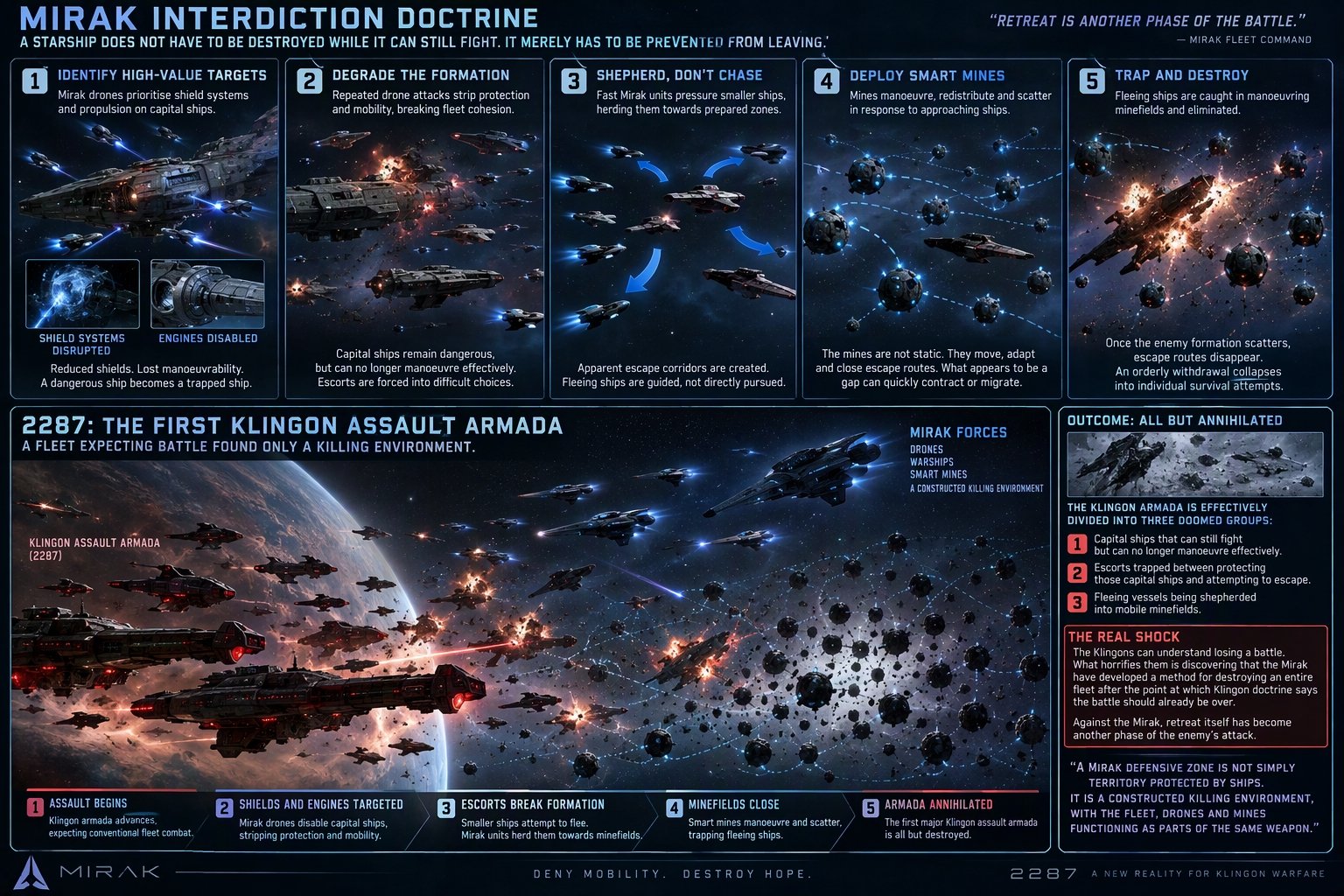
The Mirak Interdiction Doctrine
By the late 2280s, Mirak fleet warfare had evolved around a brutally simple principle: **A starship does not have to be destroyed while it can still fight. It merely has to be prevented from leaving.** Their drones therefore prioritise **shield systems and propulsion** rather than immediately attacking heavily protected hull sections. Against large capital ships, repeated drone attacks progressively reduce the target’s ability to protect itself or manoeuvre with the formation. The doctrine becomes still more dangerous when an enemy formation begins to break.
The shepherding phase
Mirak forces deliberately create apparent escape corridors. Smaller ships attempting to disengage are **herded rather than pursued directly**. Fast Mirak units and drones pressure them from selected directions, driving the fleeing vessels towards fields of smart mines. Those minefields are not static barriers. The mines manoeuvre, redistribute themselves and scatter in response to an approaching formation. What initially appears to be an exploitable gap can therefore contract or migrate. A ship changing course to avoid one concentration can find another forming across its new escape vector. The psychological effect becomes almost as important as the physical one. A captain sees: **drones behind them ? apparent clear space ahead ? mines begin moving ? formation scatters ? escape routes disappear.** Once several ships make independent evasive decisions, an orderly withdrawal collapses into individual survival attempts.
2287: The First Klingon Assault Armada
The first major Klingon attempt to smash Mirak resistance in **2287** becomes the engagement that changes Klingon understanding of the war. The assault armada enters expecting fleet combat in recognisably Klingon terms: concentrated warships, aggressive manoeuvre and a decisive contest between major combatants. Instead, the Mirak refuse to provide that battle.
Their drones descend on the Klingon capital ships, concentrating on **shields and engines**. The largest vessels remain dangerous, but progressively lose the two things the Mirak actually care about taking from them: protection and mobility. Then the smaller Klingon ships begin attempting to escape the developing battlespace. That is when the minefields activate. Mirak units pressure the surviving escorts into the prepared zones while the mines manoeuvre and disperse around them. Ships trying to avoid the fields lose formation cohesion. Ships remaining with damaged capital vessels remain exposed to further drone attacks.
The armada effectively separates into three doomed groups:
1. **Capital ships that can still fight but can no longer manoeuvre effectively.**
2. **Escorts trapped between protecting those capital ships and attempting to escape.**
3. **Fleeing vessels being shepherded into mobile minefields.**
By the end of the engagement, the first major Klingon assault armada has been **all but annihilated**.
And that matters enormously.
The real shock
The Klingons can understand losing a battle.
What horrifies them is discovering that the Mirak have developed a method for **destroying an entire fleet after the point at which Klingon doctrine says the battle should already be over**.
Normally, breaking contact preserves at least part of a defeated force.
Against the Mirak, *retreat itself has become another phase of the enemy's attack*.
That makes 2287 more than a catastrophic Klingon defeat. It becomes the moment both sides realise that a Mirak defensive zone is not simply territory protected by ships.
**It is a constructed killing environment, with the fleet, drones and mines functioning as parts of the same weapon.**
The Idea behind the Mirak way of Fighting
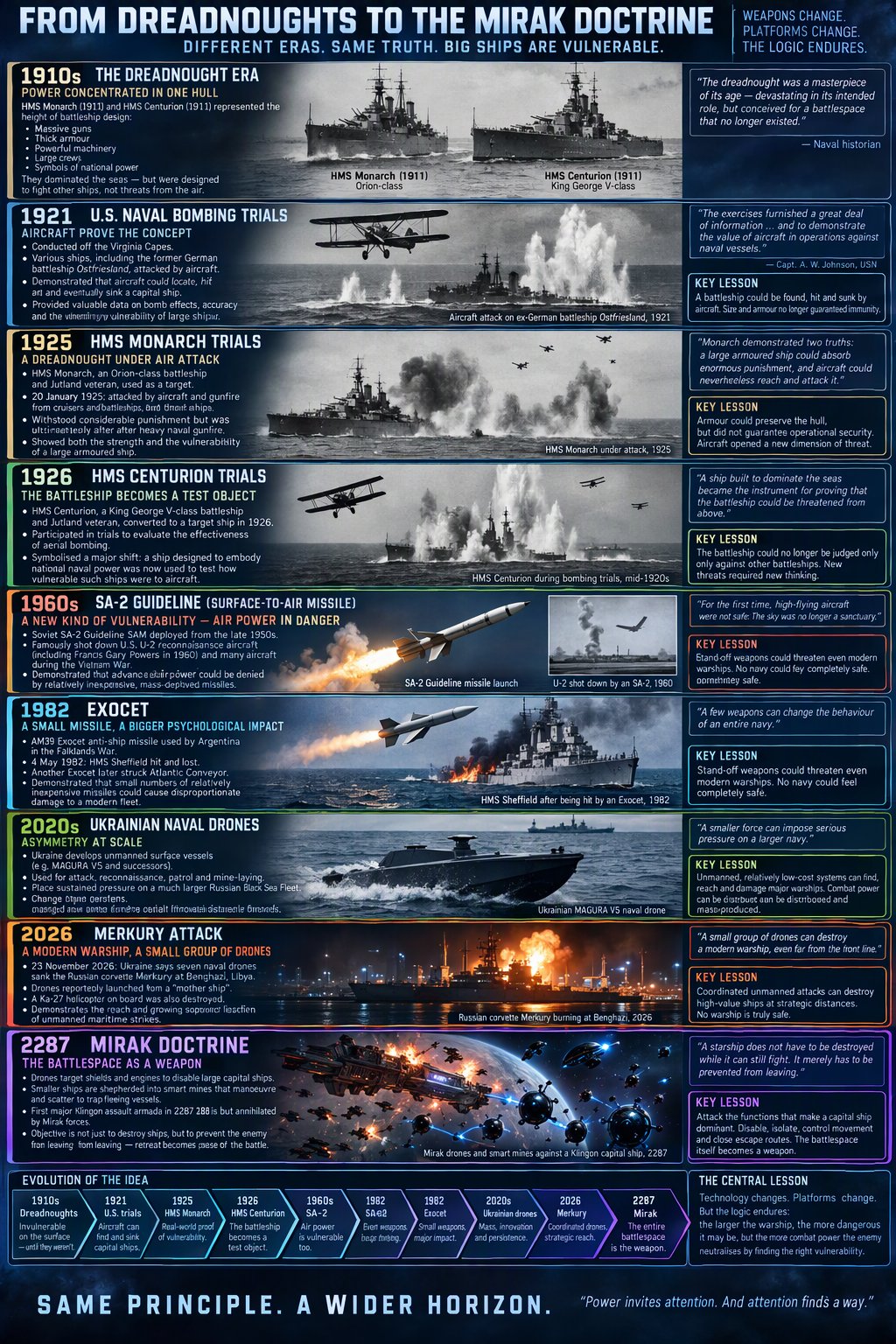
The British trials: the first crack in the battleship ideal
There is a strong connection between the interwar bombing trials and the Mirak defeat of the Klingon armada, but the chronology needs tightening.
The famous 1921 experiments were the American bombing trials off the Virginia Capes, culminating in the sinking of the former German battleship Ostfriesland. The exercises were intended to examine bomb effects, bombing accuracy and the ability of aircraft to locate and attack ships at sea. Contemporary naval analysis cautioned against the simplistic conclusion that battleships had instantly become useless, but accepted that aircraft had demonstrated real value against naval vessels. The British experiences with HMS Monarch and HMS Centurion came slightly later and provided a more specifically Royal Navy version of the same strategic warning.
HMS Monarch: bombardment and destruction, 1925
HMS Monarch was an Orion-class dreadnought that had fought at Jutland. After being withdrawn under postwar naval limitations, the ship was used as a target off the Isles of Scilly on 20 January 1925. The target exercise involved aircraft bombing and gunfire from cruisers and capital ships; Monarch ultimately required heavy naval gunfire to finish the sinking.
That outcome is more nuanced than “aircraft effortlessly sank a battleship.”
Indeed, Monarch demonstrated two apparently contradictory truths: A large armoured ship could absorb an extraordinary amount of punishment. Aircraft could nevertheless reach and attack that ship through a dimension for which the original dreadnought concept had not been designed. The lesson was not yet that the battleship was worthless. It was that armour and heavy guns no longer gave a battleship complete control over the terms of engagement.
HMS Centurion: the battleship becomes a test object
HMS Centurion, a King George V-class dreadnought and another veteran of Jutland, was converted into a target ship in 1926 and subsequently participated in trials evaluating aerial bombing.
That conversion is symbolically important.
A ship designed to embody national naval power was now being used to answer a disturbing question: How effectively could comparatively small aircraft attack a capital ship from outside the battleship’s traditional gunnery contest? The trials did not prove that every aircraft could sink every battleship. Targets were not necessarily operating under realistic wartime conditions, and a target ship was not equivalent to a fully crewed vessel manoeuvring with escorts, fighters, antiaircraft weapons and damage-control teams. But the conceptual breach had occurred. The battleship could no longer be judged only against another battleship.
The old capital-ship assumption
The dreadnought system rested upon concentration: the largest guns; the thickest armour; powerful machinery; elaborate fire control; hundreds of trained personnel; immense industrial and financial investment. All of this produced an imposing concentration of capability in one hull.
But concentration creates a corresponding vulnerability. If the hull can be reached, disabled or prevented from performing its mission, an enormous quantity of combat power is neutralised at once. Aircraft exposed that problem because aircraft did not accept the battleship’s preferred geometry. A battleship was built primarily to fight threats moving across the sea’s surface. Aircraft approached from above, attacked decks and superstructures, and extended the engagement beyond the familiar exchange of armour-piercing shells between opposing battle lines. The aircraft did not have to be “a better battleship.” The aircraft simply had to make some of the battleship’s advantages less relevant.
The Mirak make the same discovery about Klingon capital ships
The Mirak confront a Klingon fleet built around an equivalent concentration of power.
A Klingon capital ship possesses:
heavy weapon arrays; substantial shields; powerful engines; command-and-control facilities; large crews; considerable political and cultural prestige. Klingon doctrine consequently assumes that capital ships will dominate smaller opponents. A drone is individually insignificant compared with a battlecruiser, just as a 1920s aircraft appeared fragile beside a dreadnought. But the comparison is misleading. The relevant question is not: Can one Mirak drone defeat one Klingon capital ship in a conventional duel? The relevant question is: Can a coordinated drone force remove the functions that make the Klingon capital ship dominant? For the Mirak, the answer is yes.
Armour becomes shields
HMS Monarch and HMS Centurion were protected by armour intended to defeat the naval weapons anticipated when the ships were designed. Klingon capital ships rely on defensive shields for the same broad purpose. Shields preserve the hull, protect key systems and allow the ship to remain inside a hostile engagement zone. The Mirak do not treat this protection as an invitation to attack randomly until it collapses. Mirak drones concentrate on shield emitters, power-transfer systems and exposed projection nodes. The aim is to create local or progressive defensive failure.
The Mirak principle is therefore:
Do not compete with the whole defensive system. Attack the machinery that sustains it. This is the science-fiction extension of the aviation problem exposed during the interwar period. Protection optimised against one threat can become less effective when an attacker changes the direction, precision or character of the attack.
Propulsion becomes the decisive vulnerability
A battleship under air attack could still be immensely difficult to sink. But damage to steering, machinery, fire-control equipment or communications could reduce its operational value before the hull physically disappeared beneath the water.
Mirak doctrine makes that distinction explicit: mission kill first, physical destruction second.
Drone formations attack Klingon impulse engines, manoeuvring systems and exposed propulsion structures. The capital ship may retain functional weapons, and its hull may remain structurally intact, but it loses the ability to: maintain station; turn towards threats; support the formation; withdraw with the fleet; avoid the approaching minefield. At that moment, the Klingon ship becomes the spatial equivalent of a crippled battleship. It is still dangerous. It is simply dangerous in one place.
From vulnerable ship to vulnerable formation
This is where the Mirak go beyond the lessons of HMS Monarch and HMS Centurion. The interwar trials principally examined the vulnerability of individual ships. The Mirak attack the relationship between ships.
Once a Klingon capital ship loses mobility, the escorts face a doctrinal crisis:
Remain nearby and defend the disabled capital ship. Break formation and preserve themselves. Attempt to tow or cover the damaged vessel. Counterattack the drone carriers. Withdraw before the smart mines close the available routes. No choice is entirely safe.
The capital ship therefore becomes more than a damaged asset. It becomes an anchor holding the rest of the formation inside the Mirak engagement zone. Klingon loyalty, honour and command hierarchy intensify this effect. Abandoning a flagship may be tactically sensible but culturally intolerable. The Mirak can exploit the expectation that escorts will remain with an immobilised commander. The largest Klingon ship thus becomes bait without the Mirak needing to designate it as bait.
Aircraft opened the vertical battlespace; Mirak mines reshape it
The aircraft attacks of the 1920s demonstrated that naval warfare now extended above the sea. The surface fleet could no longer regard the horizon as the principal boundary of danger.
The Mirak equivalent is still more radical. Mirak drones attack through multiple vectors while smart mines manoeuvre around the retreating formation. The mines are not simply explosive obstacles waiting at fixed coordinates. They redistribute themselves, close apparent gaps and occupy likely escape routes. The Mirak are therefore not merely adding another direction of attack. They are changing the geometry of the battlefield while the Klingons are attempting to navigate it. A Klingon commander sees an open withdrawal corridor and orders ships towards it. Mirak pressure units reinforce that decision by attacking from other directions. Once the Klingons commit to the route, the mines scatter across it and converge upon the separated ships. The apparent Klingon decision was therefore anticipated and cultivated by the Mirak.
The shared lesson: size is not immunity
The strongest comparison is not that aircraft and Mirak drones are inherently superior to capital ships. It is that large platforms remain powerful only while the systems around them continue functioning.
HMS Monarch could withstand considerable punishment, and HMS Centurion remained useful for years as a target and experimental platform. The trials did not reveal fragile ships that disintegrated at the first touch. They revealed that even formidable capital ships could be reached by systems operating outside the assumptions that had shaped their construction. The same applies to Klingon capital ships.
A Klingon battlecruiser may possess: greater firepower than an entire Mirak drone group; stronger shields than any individual drone can penetrate; enough armour to survive multiple impacts; sufficient weapons to destroy numerous attackers.
None of that guarantees survival if the Mirak can: overload or isolate sections of the shield grid; damage engines and manoeuvring systems; separate the ship from its escorts; constrain its withdrawal route; surround it with mobile mines; repeat the attack faster than repairs can restore capability. The Mirak do not need a stronger capital ship. They need the Klingon capital ship to become slow, isolated and predictable.
1920s warning versus 2287 catastrophe
The British trials were warning signs. They helped expose a future in which a relatively small airborne attacker could threaten a vastly larger surface combatant. The Klingons receive no gradual warning. The first major assault armada enters Mirak-controlled space in 2287 expecting a recognisable contest between organised fleets. Instead, the Klingons encounter a mature doctrine built around capital-ship vulnerability.
The progression is devastating:
1. Klingon mass becomes target density
The assault armada concentrates to maximise firepower and mutual support. That concentration gives the Mirak numerous high-value targets moving within a limited operational area.
2. Mirak drones attack function rather than mass
The drones do not distribute their weapons evenly across every visible hull. They prioritise shields, propulsion and command vessels.
3. Damaged capital ships disrupt the advance
Immobilised ships force following formations to manoeuvre around them. Escorts slow down or change position to preserve defensive coverage.
4. The formation fragments
Smaller Klingon vessels attempt to escape or seek more manoeuvring room. Mirak ships and drones apply directional pressure rather than engaging in an unrestricted pursuit.
5. Smart mines close the retreat
The apparent escape corridors become traps. Mines redistribute across likely vectors and isolate ships that have already separated from mutual support.
6. Survivors are destroyed sequentially
The Mirak convert one large fleet battle into a succession of smaller engagements against damaged, isolated or channelled targets.
The Klingon armada is therefore not annihilated because every Mirak weapon is individually superior. It is annihilated because the Mirak possess the superior understanding of vulnerability, movement and system interaction.
Interwar naval lesson Vs Mirak lesson of 2287
Aircraft could approach capital ships through a domain inadequately covered by traditional battleship doctrine. Drones attack Klingon ships through numerous distributed vectors. Armour could preserve the hull without guaranteeing complete operational security. Shields can preserve a ship temporarily without protecting every emitter, engine or subsystem. Aircraft did not need to equal battleships in size or gun power.
Mirak drones do not need to defeat Klingon capital ships in individual duels.
Damage could reduce a ship’s usefulness before sinking it. Engine and shield attacks produce a mission kill before final destruction.
A concentrated investment could be threatened by comparatively small attacking platforms. Cheap or expendable drones can immobilise enormously expensive Klingon warships. The fleet needed aviation, detection and layered defence, not armour alone. Klingon formations need anti-drone coverage, distributed command and escape options, not merely stronger shields. Big ships remained powerful but were no longer invulnerable. Klingon capital ships remain lethal but can be converted into stationary traps for their own escorts.
The canonical strategic lesson
The connection between HMS Monarch, HMS Centurion and the Klingon disaster can be summarised in one line: The larger the warship, the more dangerous it may be, but the more combat power the enemy neutralises by finding the right vulnerability. The interwar trials suggested that aircraft could make the battleship vulnerable. The Mirak complete the intellectual journey. Their drones, ships and smart mines make the capital-ship formation vulnerable. That is why 2287 is not merely the year the Klingons lose an armada. It is the year the Mirak demonstrate that the largest ship is not necessarily the master of the battlespace.
Sometimes it is simply the largest object inside the trap.
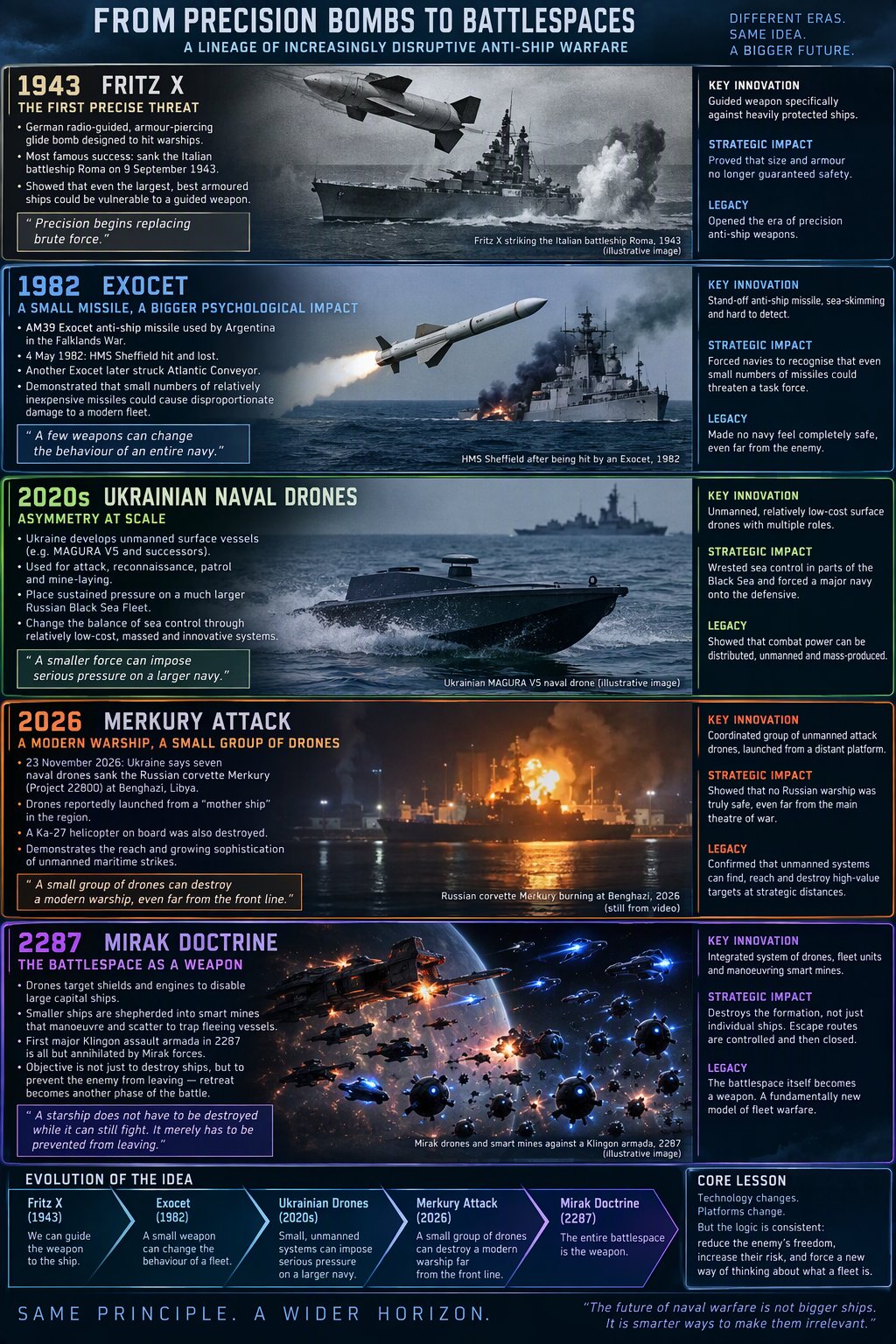
The Ukrainian drone inspiration:
Since 2022, Ukraine has changed drones from reconnaissance tools into strategic strike systems:
At sea, explosive uncrewed surface vessels, particularly the Sea Baby and Magura families, have penetrated harbours, attacked ships underway and forced Russia to devote substantial resources to protecting its Black Sea bases. One academic survey recorded 19 Russian ships sunk or damaged by Ukrainian naval drones through 2025, although broader counts that include missiles and aerial drones are considerably higher. 1
Against aviation, Ukraine progressed from long-range one-way attacks on individual bomber bases in 2022 to the simultaneous, locally launched FPV attacks of Operation Spiderweb in June 2025. Naval drones subsequently became armed mobile air-defence platforms, with Ukraine reporting the destruction of Russian helicopters and Su-30 fighters by missiles launched from Magura boats. On 22 November 2026, the campaign expanded into the Mediterranean when seven Ukrainian-made naval drones attacked the Russian corvette Merkury at Benghazi, Libya. Satellite imagery showed the ship capsized and largely submerged; Ukraine also reported destroying an embarked Ka-27 helicopter and striking the cargo vessel MV Angara.
2022: improvised beginnings
Ships
Ukraine initially relied primarily on conventional weapons and armed aerial drones rather than explosive drone boats. Bayraktar TB2 aircraft attacked Russian patrol and landing craft around Snake Island in May 2022. The sinking of Moskva in April and the destruction of Saratov in March were important naval successes, but neither was principally a drone-boat attack: Moskva was hit by Neptune missiles and Saratov by a missile strike at Berdyansk. The first strategically significant naval-drone raid occurred against Sevastopol on 29 October 2022. Although assessments of damage differ, the operation demonstrated that relatively small unmanned boats could enter a heavily defended fleet anchorage and threaten major warships.
Aircraft
On 5 December 2022, Ukrainian drones struck Engels-2 and Dyagilevo, bases associated with Russia’s strategic-bomber force. Russia acknowledged limited damage, while reporting differed over the aircraft affected. A further strike hit an oil-storage facility at Kursk the following day, and Engels was attacked again later that month. The wider importance was greater than the immediately verified damage: aircraft previously protected by hundreds of kilometres of Russian territory were now exposed to Ukrainian attack.
2023: systematic attacks on ports and airfields
Ships
Ukraine turned naval drones into a sustained operational capability:
Sevastopol and Crimean anchorages were attacked repeatedly. The landing ship Olenegorsky Gornyak was seriously damaged near Novorossiysk in August. The tanker SIG, associated with Russian military logistics, was damaged near the Kerch Strait. Patrol ships including Sergey Kotov and Pavel Derzhavin were attacked, although not every reported engagement produced independently confirmed destruction. Ukraine increasingly combined naval drones with cruise missiles and aerial reconnaissance, forcing Russia to defend both harbour entrances and ships at sea. Cruise-missile attacks also destroyed or disabled major vessels in port, including Minsk, the submarine Rostov-on-Don, Askold and Novocherkassk. Those were not drone kills, but they formed part of the same campaign to make Sevastopol untenable.
Aircraft
Ukraine expanded attacks against aircraft parked at Russian bases. Among the most notable were strikes on Soltsy, where a Tu-22M3 bomber was reportedly destroyed, and on other airfields including Shaikovka. These attacks were significant because some appear to have involved relatively small drones launched much closer to their targets than Ukraine itself. An August attack on Pskov also damaged or destroyed several Il-76 transports, illustrating that transport aviation, not only bombers and tactical aircraft, had become vulnerable.
2024: the Black Sea drone campaign reaches maturity
Ships
Early 2024 produced Ukraine’s most concentrated sequence of confirmed naval-drone successes:
1 February: the missile corvette Ivanovets was sunk after being struck repeatedly by Magura drones.
14 February: the landing ship Caesar Kunikov was sunk near Crimea.
5 March: the patrol ship Sergey Kotov was sunk after another multi-drone attack.
Subsequent operations struck patrol craft, support vessels, ferries and harbour infrastructure. These attacks generally used several drones approaching from different directions. Some drew defensive fire while others continued towards the waterline, propulsion system or weaker areas of the hull. The objective was not merely to exchange one drone for one ship, but to overwhelm the target’s ability to identify and engage every approaching craft. By this stage, Russia had moved a substantial part of its operational fleet from Sevastopol to Novorossiysk and strengthened harbour barriers, helicopter patrols and small-boat defences. The displacement of the fleet was arguably more strategically important than the individual sinkings because it reduced Russia’s freedom to operate around western Crimea and Ukraine’s export corridor.
Aircraft
Ukraine conducted increasingly large long-range drone raids against Russian airfields. On 5 April 2024, attacks targeted Engels, Yeysk, Kursk and Morozovsk. Ukrainian sources claimed numerous aircraft destroyed or damaged, but the Institute for the Study of War noted at the time that visual confirmation of the aircraft losses was unavailable.
Further attacks against Morozovsk targeted Su-34 strike aircraft and stocks of glide bombs. Open-source reporting supported damage to the base and its munitions infrastructure, though the number of aircraft destroyed remained contested. On 31 December 2024, Ukraine reported using a missile-armed Magura naval drone against Russian Mi-8 helicopters near Crimea. Ukrainian intelligence officially described one helicopter as destroyed and another as damaged, although some later Ukrainian accounts claimed two destroyed.
2025: Operation Spiderweb and armed naval drones
Operation Spiderweb
On 1 June 2025, Ukraine’s Security Service conducted Operation Spiderweb, concealing FPV drones inside structures carried by lorries and launching them near several Russian long-range aviation bases. The principal targets included Belaya, Olenya, Dyagilevo and Ivanovo Severny. The drones attacked Tu-95MS and Tu-22M3 bombers and other specialised aircraft while parked in the open.
Damage estimates vary substantially: Ukraine claimed more than 40 aircraft were struck. Two US officials cited by subsequent reporting assessed that approximately 20 were hit and around ten destroyed. Other open-source assessments placed confirmed destruction or serious damage below Ukraine’s initial total. The operation’s strategic importance did not depend solely on the final count. Small FPV drones assembled or positioned inside Russia bypassed much of the country’s conventional border and long-range air-defence architecture.
Naval drones attacking aircraft
On 2 May 2025, Ukraine used missile-armed Magura V7 naval drones against Russian Su-30 fighters over the Black Sea. Ukraine initially announced one destruction; later reporting based on statements from Ukrainian intelligence chief Kyrylo Budanov said two Su-30s had been shot down. The platforms reportedly carried adapted AIM-9 Sidewinder missiles. This represented an important change in naval-drone employment. The boats were no longer only explosive weapons intended to ram ships; they could act as remotely operated missile craft, reconnaissance platforms and ambush air-defence systems.
2026: the campaign reaches Libya
On 22 November 2026, Ukrainian naval drones attacked the Russian corvette Merkury while the ship was at the naval base in Benghazi, eastern Libya. According to Ukraine, seven domestically produced naval drones were used. Satellite imagery subsequently showed most of Merkury capsized and submerged, with the bow remaining visible. Ukrainian President Volodymyr Zelenskyy claimed responsibility on 23 November. Russia had not immediately issued a detailed official account when the first reports appeared.
Ukraine also said:
an embarked or associated Ka-27 helicopter was destroyed; MV Angara, described by Ukraine as carrying Russian weapons, was hit; all designated objectives were achieved. The Merkury attack was particularly significant because it occurred roughly 2,400 kilometres from the Ukrainian front, extending Ukrainian naval-drone operations from the Black Sea into the Mediterranean. 17 It also differed politically from attacks around occupied Crimea: the strike occurred in Libyan waters and prompted calls for an independent investigation into the use of Libyan territory in the conflict.
Overall assessment
Ukraine’s campaign evolved through four broad technological stages:
2022: armed reconnaissance drones and rudimentary long-range attacks demonstrated that Russian ships and bombers were reachable.
2023: purpose-built explosive naval drones began making repeated attacks on ports, logistics vessels and warships.
2024: coordinated drone swarms sank major vessels and helped displace the Black Sea Fleet from Sevastopol, while long-range aerial drones repeatedly struck Russian airbases.
2025–26: drones became covertly deployed strategic weapons and reusable missile platforms, culminating in Operation Spiderweb, the reported air-to-air kills from Magura boats and the long-range operation against Merkury in Libya.
The central achievement was therefore not simply a tally of ships or aircraft destroyed. Ukraine created a relatively inexpensive, replaceable family of unmanned systems that obliged Russia to disperse aircraft, relocate ships, defend distant bases and treat harbours far beyond the Black Sea as potentially vulnerable.

 Author's Notes
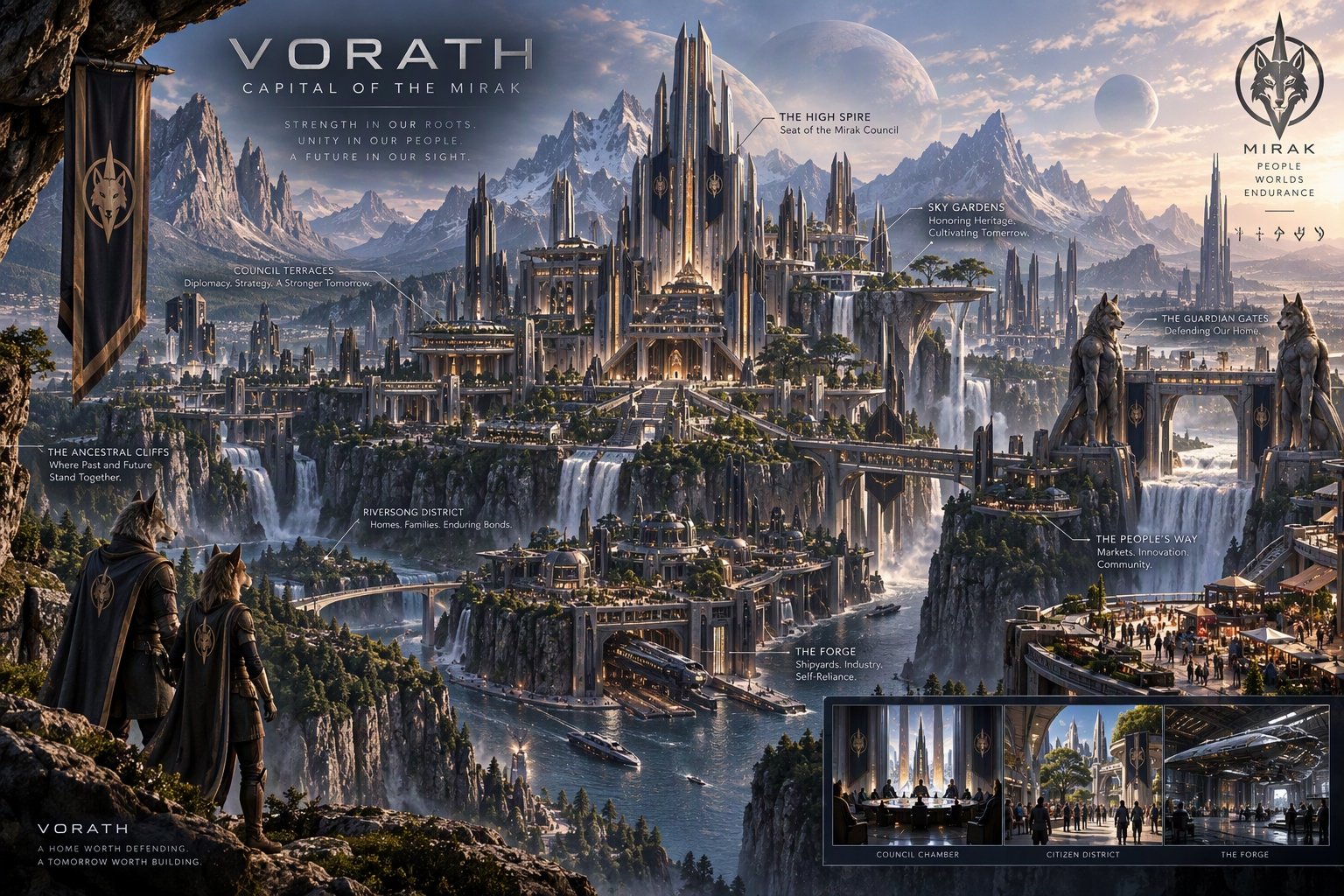
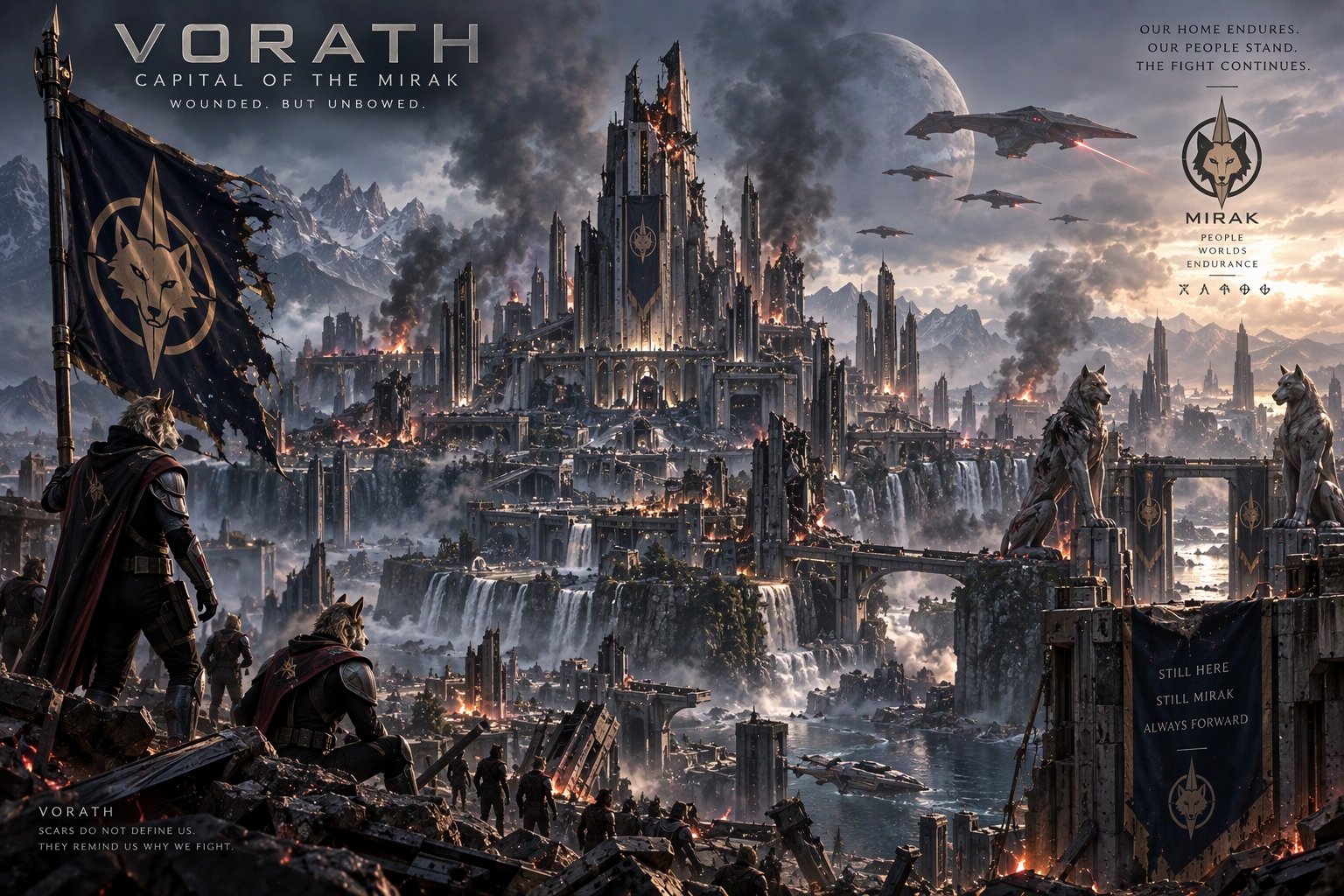
From 1997 to 2000, the monster maroon era of the Star Trek universe was kept alive a little longer by Interplay Games. They worked with Taldren, Inc to produce Starfleet Command II: Empires at War. This website and my stories wish to pay homage to these companies for their work in keeping this era alive, and expanding it. The Mirak were created by Taldren, Inc and are included here along with Torlek as elements both from Starfleet Command II and Klingon Academy: two of the games that kept the monster maroon era alive. I wish here to honour them, and continue their stories in the way they continued Star Trek V and VI.
Below are two images created from the original Mirak artwork, they were changed for being too much like Tolkien dwarves.