

Story Index Page

By Adrian Jones [1992].
Based on Star Trek created by Gene Roddenberry.
Stories by: Adrian Jones and Andrew Brown, with invaluable assistance from Nick Cook, Sean Paul Teeling, Gene Hendricks, Keith R A DeCandido, Dayton Ward and David R George III.
Technical assistance by: Rick Sternbach, Doug Drexler, Andrew Probert, Nick Cook, Sean Paul Teeling, Alex Rosenzweig, Michael C. Rupprecht, Bernd Schneider, S. John Ross, Ex Astris Scientia and ASDB websites and Curt Danhauser.
For their inspiration, thank you to: Nick Meyer, Harve Bennett, Leonard Nimoy, Greg Bear, H G Wells, James Cameron, Ridley Scott, George Lucas, Steven Spielberg, Joss Whedon, Jeff Wayne, with Persis Khambatta and the other Star Trek actors, writers, behind-the-scenes staff and the fans that helped Gene's universe to go to warp...

STAR TREK: The Interim Years - Anthology:
Star Trek: Grissom
Star Trek: Grissom - The Price of Virtue. (by Adrian Howard Jones and Andrew Brown)
Stardate 8134.6 - A Klingon invasion leads to a Federation liner rescuing refugees from the neutral zone border. Whilst the U.S.S. South Georgia works to prevent an intergalactic incident, Captain J. T. Estaban and the crew of the U.S.S. Grissom must work to uncover the truth behind the refugees, who they are and where they are from.
When the situation on the liner gets out of hand, Thor and the security operations personnel of the Grissom must work to resolve the situation without loss of life. What is the price of virtue? and can that price sometimes be too high?
Star Trek: Underworld
This looks for the first time at life in the Star Trek universe AWAY from Starfleet; what happens to those members of the Federation who either choose or are unable to join Starfleet? What is colonial life really like? This is about the ideals of the Federation in the outer colonies where people LIVE on the final frontier. There is substantially less of the technology and glamour of the core worlds. These are the self-reliant, self-built homesteads that farm, mine, manufacture or research for the Federation.
For those children growing up on these colonies the choice is a stark one: either follow in the path your parents have determinesd and live a life of building your colony: something that will take generations to achieve, or strike out on your own to either join Starfleet, the merchant marine or go into the private sector. Get a ship of your own and trade where you can. Join the Orion Syndicate or go independent at your own risk. Go for the big win and avoid the patrol ships of Starfleet. se your wits to eveade their superior sensors, speed, weapons and training.
Harry Mudd, Thadium Okona and Kassidy Yates all took this lifestyle to varying degrees with the Stella, Erstwhile and Xhosa as their loyal steeds. This series will look at the 'other' side of the Star Trek universe from the one that we're used to. Looking at illegal trading, trafficking, narcotics and the realities of colonial life away from the core worlds and founding colonies like Deneva and the Rigel Colonies. The truth is, like those who built log cabins in Canada, Alaska or Siberia, this is a harsh life that will determine the path for your children, grandchildren and great-grand children. Is it fair to do that? Not to mention the most important question that Star Trek really hasn't answered satisfactorily: What do people do that don't join Starfleet...? Away from those Star Trek tech Starfleet bases and core worlds, there isn't all the fancy tech beyond a 23rd Century generator, recycler and food synthesiser. The rest, with help from Starfleet, is up to you.
The whole point here is to do like the musical 'Wicked' and turn the Star Trek universe on its head. We've seen for over fifty years the universe form the perspective of Starfleet. Now it's time to see the perspective from the average person in the Federation. Where the people actually have a small freighter and AVOID Starfleet ships. This will explore criminality and the reasons behind it in the 23rd Century. It will also look at how much has changed - and how much really hasn't - since the 21st Century. My visit to McBride, British Columbia last year showed the realities of going back to basics and building your own log cabin. This is about starting from nothing. Sinking a well, digging an outhouse for sanitation and then building your home by hand from scratch. This takes a lot of time and energy. Whilst in the Star Trek universe they have technology, you don't have pop-up houses. This is out on the frontier. Most colonies are started for settling people, farming crops, mining dilithium or other minerals or performing research - either away from the public or where the item of research is available.
Life on the colonies isn't really any different from life in rural Canada, Alaska or Siberia now. Beyond the supertech power source for your home, the 100% recycler/food processor and fabricator you still have the same sort of possessions that someone out there would have now. There are no nightclubs or holiday resorts. Starfleet barely sends an Okinawa class corvette/frigate every now and then to see how you are. Transports arrive periodically with either more colonists, goods or supplies that are energy intensive to be replicating constantly. This is about daily hard work of taming a 100% wild planet, farming or mining or working the research station whilst clearing ground and building homes and bars. Home-schooling and residing either in home or at your place of work is the reality of colonial life. Barn-dances and home entertainment is the order of the day. Occasionally perhaps a Starfleet ship will come for shoreleave. Here, the values of Gene Roddenberry's Star Trek are put to the ultimate test. After all, as Ben Sisko once said, it's easy to be a saint in Paradise...
This also shows the Federation vision of the frontier - like the American Frontier of the 19th Century. Starbases like 77 and 111, facilities like Station Psi Five or Station Hurley One that conduct research - some of which is classified. Compare and contrast the lives and viewpoints. The Orion Syndicate, the drugs, the violence and the colonies living on the brink of the Federation boundaries. Their lives interlocked in a way that many don't see. An indefenceable, unimaginably vast border that is porous to immigration, trafficking and crime. Only ships like the Interceptor, Sheppey and other patrol and defender vessels stand in the way on this Final Frontier.
A series that won't hide away from the brutality of real life in the 23rd Century, that Tasha Yar's story would have told about Turkana IV - a FAILED Federation colony that the Federation Council allowed to fail on their watch. No starships rescuing them from drugs and violence as the tales of Yar to Wesley Crusher showed. Inspired by the Australian 5-season series "Sea Patrol", this shows life onbard the smallest patrol ships of Starfleet.
Star Trek: Pillars of Romulus
The strategic, long game Romulans. A series covering the plotting, strength and honour of the Romulans and their Star Empire. This shows the pillars of power: th Emperor (and Empress), the Praetor, Senate, Continuing Committee / Party, Tal Shiar, Department of Education, Military, Qowat Milat and Praetorian Guard. It shows the dance of power and succession between them. The winners and the losers. This truly is Game of Thrones meets Star Trek. It deals with Roddenberrian laws never seen before: dealing with others who are different, with different laws, customs and values. Respecting those differences, despite not agreeing with them. Not wanting regime change. Not wanting them to be like us. Seeing the Star Trek universe from another angle.
1.01 - The Glory of Romulus - Pilot episode that deals with Romulus at its height in the 2290s, prior to the destruction by the explosion of Hobus. An emphasis on the Senate and Praetor.
1.02 - Guilded Cage - The Palatine Palace introduced as the Forbidden City. Introduction of the Emperor and Empress.
1.03 - The Power of Shadows - The Continuing Committee revealed as the true power. Dictating the media and politics.
1.04 - Sword and Shield - The Tal Shiar depicted as the Kempeitai / Stasi / Guoanbu.
1.05 - The Pen is mightier than the Sword - the Department of Education and their propaganda and educational curriculum.
Star Trek: Excelsior
Mini-series Season 1 2293
1.01 and 1.02 – Brave New World
Star Trek: The Interim Years
The Excelsior Stories
1.01: “Brave New World, Part I”
Format: 55–60 minutes
Function: Series premiere, first half of the two-part pilot
Primary theme: The old world has ended before anybody has worked out what replaces it.
Logline
Three months after Khitomer, Captain Hikaru Sulu prepares a refitted USS Excelsior for a classified five-year mission intended to begin dismantling the Federation-Klingon Neutral Zone. While Starfleet adjusts to life without the Enterprise-A, Ambassador Spock begins a new career outside uniform, and Chancellor Azetbur struggles to govern a catastrophically wounded Klingon Empire while a more traditional claimant to her throne remains thousands of light-years away fighting the Kinshaya.
TEASER: THE WORLD AFTER PRAXIS
Do not open with Excelsior.
Open with Qo'noS.
Beautiful from orbit until the planet rotates.
Then the scar comes into view.
In this continuity, approximately half the planet has been seared by the effects of Praxis. Great areas that once supported cities, industry and agriculture are dark. Atmospheric contamination obscures parts of the surface. Orbital facilities hang crippled. Wreckage is still being recovered.
Three months have not made this historical.
The disaster is still happening.
On the surface, the new Chancellor walks through an emergency operations centre.
Azetbur doesn't look regal. She looks tired.
Every display contains another scarcity:
housing;
medical resources;
energy;
functioning transporters;
food;
clean water;
replacement components;
gagh production;
operational warships.
One officer is discussing ships.
The Imperial Navy once possessed something approaching 14,000 available and reserve warships in this continuity. The government can now identify roughly 7,000 potentially operational hulls, a reduction consistent with the battered post-Praxis fleet we've previously developed.
Azetbur asks:
“Potentially?”
The admiral hesitates.
“They exist, Chancellor.”
Not the same thing as being combat-ready.
Before she can pursue it, another report arrives.
CH'RAMAK: requested emergency gagh cultivation increased.
TERAJUN: negotiations regarding agricultural requisitions delayed.
Two names.
Nothing more.
For now.
Then Azetbur enters the High Council chamber and takes her father's seat.
Several councillors look at her.
One kneels.
Some follow quickly.
Others...
take slightly longer.
TITLE SEQUENCE.
ACT ONE: THREE MONTHS LATER
Cut to Earth.
The tonal difference should be startling.
Sunshine.
Starfleet facilities.
Construction.
Optimism.
The Federation thinks it has just won something.
Sulu has spent the last three months enduring the less glamorous consequences of saving history.
Debrief number... who knows?
An investigator asks him once again when he first became aware of Chang's cloaked Bird-of-Prey.
Sulu gives an answer he has clearly given before.
They discuss:
the Praxis shockwave;
his communications with Klingon authorities;
the decision to assist Enterprise;
Chang;
Khitomer;
the battle;
the conspiracy.
Sulu is courteous throughout.
Eventually the interviewer switches off the recorder.
“That's everything.”
Sulu looks at him.
“You said that last Tuesday.”
A tiny bit of dry humour establishes the man.
This isn't a young officer impatient to get back into space.
This is an experienced captain who understands that bureaucracy is part of command.
THE NEW EXCELSIOR
Sulu tours his ship.
This is where we properly introduce USS Excelsior.
Not as a prototype.
Not as the famous transwarp failure.
Not even principally as “Sulu's ship”.
Home.
He has commanded her since 2287 in this continuity.
Engineering spaces have accumulated six years of modifications.
Crew have histories here.
Some junior personnel have never known another ship.
But Excelsior is changing.
The most visible part of the refit is the bridge.
The old bridge has been stripped out.
Technicians are installing the newer architecture associated with the forthcoming Enterprise-B generation.
New displays.
Revised command stations.
Improved communications.
Better diplomatic and cartographic capabilities.
Sulu stands in the centre of his unfinished bridge.
Someone asks:
“What do you think?”
Sulu studies it.
“Ask me when you've finished putting the ceiling back.”
But he smiles.
The ship is moving forwards.
So is he.
ACT TWO: FATHER AND DAUGHTER
Now slow everything down.
Sulu has had something unusual over these three months.
Time with Demora.
Demora Sulu is preparing for her assignment aboard USS Enterprise-B.
She is excited.
The new Enterprise represents everything that Starfleet wants 2293 to mean.
A new ship.
New generation.
New technology.
New captain.
A future that doesn't require living permanently in the shadow of Klingon war.
There's a pleasant father-daughter dynamic here.
Demora teases him about Excelsior getting an Enterprise-B-style bridge.
“We're not even commissioned and you're already stealing our equipment.”
“Stealing? Excelsior tested half the things they're putting on your ship.”
The warmth matters because of what happens in 1.10.
The audience needs to associate Enterprise-B with something joyful before the finale turns it into something traumatic.
THE EMPTY BERTH
Sulu and Demora walk through the Starfleet complex.
Somewhere during this sequence we see an empty berth, memorial plaque, or mundane evidence that USS Enterprise-A is simply no longer part of the operational fleet.
Do not play enormous music.
The mundanity is the tragedy.
Starfleet has gone on without her.
But psychologically it hasn't caught up.
An officer discussing an emerging problem starts to say something like:
“Normally we'd give something like this to Enterp...”
Stops.
Everyone understands.
The Beatles have broken up.
Kirk has no Enterprise.
Spock has changed professions.
Sulu already commands another ship.
McCoy, Scotty, Uhura and Chekov are moving into the next phases of their lives.
Starfleet has lost the crew it could habitually throw at the impossible.
The institution now has to become better at solving the impossible itself.
SPOCK WITHOUT A UNIFORM
Sulu's next meeting introduces Ambassador Spock.
Someone greets him:
“Captain Spock.”
Spock:
“Ambassador.”
Perfectly neutral.
A fraction of a beat afterwards.
He is getting used to it too.
Spock has moved from a world where analysis produced action to one where analysis produces discussion.
He can no longer tell a helmsman to set course.
He can recommend that two governments agree upon what course ought perhaps to be set after suitable consultation.
It may be the greatest test of Vulcan patience ever devised.
Sulu quietly enjoys this.
“Missing the bridge?”
“I find diplomacy contains considerably more chairs.”
Their friendship immediately feels old.
ACT THREE: THE BRIEFING
This is the point where the whole television series reveals itself.
Sulu expects another Khitomer discussion.
Instead, he enters a classified joint Starfleet/Federation briefing.
Military personnel.
Diplomats.
Cartographers.
Intelligence.
Colonial specialists.
Spock.
Three-dimensional space appears around them.
At first:
FEDERATION
KLINGON EMPIRE
And between them:
NEUTRAL ZONE
Simple.
Then the map magnifies.
Hundreds of entries appear.
Settlements.
Moons.
Mining facilities.
Colonies.
Stations.
Old fortifications.
Indigenous populations.
Civilian shipping corridors.
Areas claimed by both governments.
Areas administered by one government but claimed by the other.
The border stops looking like a line.
It looks like a disease under a microscope.
EXCELSIOR'S FIVE-YEAR MISSION
The Federation representative gives Sulu his orders.
USS Excelsior is to undertake a five-year diplomatic-survey deployment.
Mission objectives
One: comprehensively chart the frontier.
Two: establish accurate demographic and political records for disputed colonies.
Three: identify outstanding Federation and Klingon territorial claims.
Four: determine which military installations can be removed.
Five: establish operational protocols with Klingon frontier commands.
Six: reduce the possibility that local incidents escalate to fleet action.
And finally:
Develop a viable framework for the eventual abolition of the Neutral Zone.
Sulu looks at the map.
That catches even him.
“Abolish it?”
Spock answers:
“That is the objective.”
Not now.
Not necessarily within five years.
But someone has to begin.
THE ORGANIAN PROBLEM
Sulu studies the historical boundaries.
Some are products of the old Organian settlement.
That leads naturally to a question:
What about the Organians?
Spock knows the answer better than anybody.
In the previously established continuity, Enterprise-A visited Organia after Star Trek IV and found the world abandoned.
Brief flashes could give us our first visual connection to that story:
Kirk.
Spock.
McCoy.
Empty streets.
Primitive buildings with nobody inside.
No bodies.
No explanation.
Back in 2293, Sulu asks:
“Any word from them?”
“None.”
The significance is enormous.
The old Federation-Klingon arrangement assumed there was effectively an omnipotent referee.
There isn't any more.
The Federation and Klingon Empire have to negotiate like adults.
THE CATCH
One civilian negotiator expands the map again.
Specific Federation colonies turn amber.
Sulu notices.
“Why are those highlighted?”
Silence.
Then:
“Potential territorial concessions.”
This is perhaps the most important moment in 1.01.
Sulu assumed the mission meant finding compromises with the Klingons.
Now he understands that it also means finding compromises with the Federation.
Some settlements may have to move.
Some may become autonomous.
Some may remain where they are but find themselves under Klingon sovereignty.
Sulu:
“They are Federation citizens.”
“Yes.”
“And we're considering giving their worlds to the Klingons.”
The diplomat chooses the careful wording:
“We're considering every viable route towards a permanent settlement.”
Sulu hates the sentence precisely because he understands what it means.
ACT FOUR: THE EASTERN FRONT
Now cut thousands of light-years away.
Everything changes again.
This is our first proper introduction to the Kinshaya war.
There is no polished starbase.
No magnificent parade fleet.
There are battered Klingon ships.
Damaged armour.
Temporary repairs.
Exhausted crews.
A frontier that has been fighting for so long that the war has become infrastructure.
General Waurg receives dispatches from Qo'noS.
Gorkon dead.
Khitomer.
Azetbur Chancellor.
His officers watch him carefully.
Everyone present understands the constitutional implication.
Waurg is the eldest son of Chancellor Kesh in the established continuity, and has previously challenged Gorkon before being defeated by Chang and sent east in what amounted to honourable political exile.
He could leave.
Perhaps he should leave.
One officer says:
“If you mean to challenge, we should depart immediately.”
Waurg looks towards the tactical display.
Kinshaya forces are preparing another attack.
“And leave this?”
“The throne may not wait.”
Waurg:
“Then it is not worthy of me.”
Alarm.
Enemy movement.
Waurg picks up his weapon.
The political scene ends because he has a war to fight.
This is how we make the future challenger to Azetbur sympathetic.
While she took the throne...
he stayed to defend the Empire.
ACT FIVE: THE COST OF THE MAP
Back on Earth, Sulu examines one Federation colony marked as potentially negotiable.
Population.
Settlement history.
Families.
Schools.
Graves.
This is where the abstract mission becomes personal to him.
Spock joins him.
Sulu:
“On the map it's a dot.”
“Most worlds are.”
Sulu expands the colony record.
“Not to the people living there.”
Spock doesn't disagree.
He may make the brutal diplomatic observation:
“Any permanent settlement in which neither party concedes anything is unlikely to differ materially from the present arrangement.”
Sulu:
“Easy to say from here.”
Spock:
“Yes.”
That's important.
No lecture.
No effortless Vulcan answer.
Spock understands exactly what Sulu means.
AZETBUR'S VERSION OF THE SAME PROBLEM
Cut to Qo'noS.
Azetbur has a Klingon frontier map before her.
Different symbols.
Same problem.
An adviser lists systems Federation negotiators may eventually demand.
Azetbur refuses one immediately.
Why?
Minerals.
Another.
Military position.
Another.
Historic House territory.
Another is technically dispensable...
until she learns how many Klingons live there.
Suddenly she is doing precisely what Sulu is doing.
Looking at dots.
Discovering people.
The pilot's two principal political stories become mirrors.
The Federation thinks the Klingons need to make concessions.
The Klingons think the Federation needs to make concessions.
Everybody supports compromise.
Provided somebody else compromises first.
AZETBUR'S SECOND PROBLEM
Then an intelligence adviser delivers something more delicate.
Support for House Kesh.
Waurg's name.
Azetbur asks:
“Has he left the Eastern Front?”
“No, Chancellor.”
That should almost worry her more.
He's not scheming.
He's being heroic.
Azetbur realises there is a dangerous comparison forming:
Azetbur seized the moment.
Waurg defended the Empire.
We don't yet say she rushed or manipulated the succession.
Just plant the discomfort.
FINAL SEQUENCE: CAST OFF
USS Excelsior is ready.
The redesigned bridge is complete.
Sulu steps onto it properly for the first time.
It feels new.
But still Excelsior.
The crew take their stations.
Orders come through.
The first survey sector lies along the Klingon frontier.
Sulu sits.
Perhaps somebody asks:
“Course, Captain?”
Sulu looks at the border map.
Thousands of systems.
Five years.
Generations of hatred.
Millions of people living inside disputed space.
“The Neutral Zone.”
Pause.
“Let's find out what's actually there.”
Excelsior clears spacedock.
Not towards the unknown.
Towards something arguably harder.
People they think they already understand.
TAG: THE ORGANIAN IMAGE
One final scene before credits.
Ambassador Spock remains on Earth.
He's examining archived records from the Enterprise-A visit to abandoned Organia.
One image shows the empty settlement.
Another displays sensor data.
Then something peculiar.
A pattern which was never explained.
Spock isolates it.
Three data structures briefly intersect.
Federation.
Klingon.
Something else.
Perhaps Romulan.
Then the computer reports:
INSUFFICIENT DATA FOR ANALYSIS.
Spock studies it.
No magical prophecy.
No explanatory speech.
Just the slightest suggestion.
The Organians had once predicted that Humans and Klingons could become friends.
Maybe their disappearance wasn't an ending.
Maybe it was permission.
Cut to black.
TO BE CONTINUED
What 1.01 establishes
By the end of “Brave New World, Part I”, the viewer understands the show's entire operating environment:
Sulu is already a seasoned captain and Klingon specialist.
Excelsior has begun a five-year border mission.
Ending the Neutral Zone may require Federation sacrifices as well as Klingon ones.
Spock is beginning his transformation into Ambassador Spock.
Starfleet is learning to live without Kirk's Enterprise-A.
Azetbur governs an Empire physically devastated by Praxis and politically far less secure than it appears.
Waurg has a credible claim to the throne, but is choosing duty on the Kinshaya front over immediate political ambition.
Ch'ramak and Terajun have been quietly planted.
The Organians remain absent.
The Praxis/Metar mystery has not yet been introduced explicitly. It should come later, once the audience thinks it understands the catastrophe.
The Neutral Zone is not empty space. It's full of people.
Most importantly, the episode establishes the governing principle of the entire five-season saga:
Khitomer didn't create peace.
It created the possibility that people might begin doing the work required to build it.
*Star Trek: The Interim Years*
*The Excelsior Stories*
1.02: **“Brave New World, Part II”**
**Format:** 55–60 minutes
**Function:** Second half of the series pilot
**Primary theme:** **Everybody wants peace until they discover what peace will cost them.**
### Logline
On the first mission of Excelsior's five-year frontier assignment, Hikaru Sulu discovers that a seemingly straightforward territorial survey conceals generations of contradictory claims and a Federation colony whose inhabitants refuse to become bargaining chips. On Qo'noS, Azetbur discovers the mirror image of the same problem: Klingons expect peace to cost the Federation territory, not the Empire. Meanwhile, the first reports from Waurg's Kinshaya front make the new Chancellor uncomfortably aware that her absent rival is behaving exactly as Klingons expect a leader to behave.
TEASER: THE LINE
Open in deep space.
A small Starfleet survey probe crosses an invisible point.
Nothing happens.
No explosion.
No Klingon cruiser decloaks.
The probe continues.
The navigation display aboard Excelsior identifies it as having entered the **Federation-Klingon Neutral Zone**.
For generations, this line has carried almost mythical significance.
Sulu looks at the display.
> “Position?”
His navigator gives precise coordinates.
Sulu:
> “According to whose map?”
A slight pause.
The navigator brings up the Federation chart.
Then the Klingon chart supplied after Khitomer.
The borders don't match.
Several systems change colour.
Captain Sulu smiles without amusement.
> **“Well. That's why we're here.”**
Cue titles.
ACT ONE: THE FIRST SURVEY
Part I showed the map.
Part II immediately exposes why the map is inadequate.
Excelsior enters its first full survey sector accompanied at a distance by a Klingon vessel assigned to monitor compliance.
The new bridge is now operational.
That matters visually.
In 1.01 it was construction.
In 1.02 it is a working command centre.
Huge cartographic databases are being reconciled:
- Federation astrography;
- Klingon records supplied under Khitomer;
- navigational data;
- colonial surveys;
- military records;
- old Organian-era treaty coordinates.
Nothing quite agrees.
The problem is not incompetence.
Different maps were created for different purposes.
A military patrol line isn't necessarily a recognised sovereign boundary.
A Federation settlement isn't necessarily evidence of recognised Federation sovereignty.
A Klingon taxation record isn't necessarily accepted by the Federation as proof of Klingon ownership.
The crew realise their mission isn't simply **mapping space**.
It is mapping disagreements.
THE FIRST COLONY
They arrive at the pilot's principal disputed world.
For now, it is deliberately unimportant on the grand strategic map.
That's what makes it useful.
Not Ch'ramak.
Not Terajun.
Not a great military fortress.
A Federation frontier colony.
Several thousand settlers.
Farms.
Mines.
A small city.
A Starfleet communications facility.
Some families have been here for generations.
The governor welcomes Sulu enthusiastically.
After Khitomer, people assume Excelsior is arriving to guarantee the peace.
Then Sulu explains why he's actually there.
The colony's legal status is disputed.
The warmth disappears.
“WE ARE THE FEDERATION”
The colonial governor produces records.
Federation citizenship.
Land grants.
Birth certificates.
Taxation.
Starfleet protection agreements.
A cemetery containing generations of colonists.
> “How much more Federation would you like us to be?”
It's a good argument.
Then the Klingons arrive with theirs.
THE KLINGON CLAIM
The Klingon representative produces an equally impressive archive.
Their maps place the system on their side of an old boundary.
They possess records of an earlier Klingon mining concession.
A Great House considers the region hereditary territory.
The Federation colony, according to Klingon interpretation, was tolerated during the Organian period but never legally sovereign Federation territory.
The Klingon argument is not:
> We want it.
It is:
> **It was already ours.**
That's much harder.
Sulu immediately understands that establishing who was “first” won't solve anything.
They have competing systems of legitimacy.
SPOCK'S FIRST REAL TEST AS AMBASSADOR
Spock participates remotely at first.
He approaches the dispute logically.
Establish chronology.
Identify applicable treaty.
Determine recognised sovereignty.
Resolve inconsistencies.
Except each side disputes which treaty takes precedence.
The colonial governor becomes frustrated with him.
> “Ambassador, with respect, you've turned my home into a legal exercise.”
Spock pauses.
This is important for his arc.
As a science officer, reducing a problem to its underlying variables was useful.
As an ambassador, sometimes those variables have children.
He adjusts.
Instead of asking:
> Who owns this world?
He begins asking:
> **What outcome could its inhabitants actually live with?**
That's Ambassador Spock beginning to emerge.
ACT TWO: AZETBUR'S MIRROR
Cut to Qo'noS.
Azetbur receives a briefing about the same dispute.
And suddenly the audience sees everything differently.
The Federation describes it as a small colony.
The Klingon strategic map shows the system forming part of a chain of territories protecting access to a larger region.
A Klingon councillor makes the obvious argument:
> “If we relinquish our claim now, why should they believe our claim to the next system?”
There is the real problem.
**Precedent.**
Azetbur can't give away an insignificant world because no territory is insignificant if surrendering it weakens the legal claim to another.
Exactly the problem Sulu will encounter repeatedly over five seasons.
THE POLITICS OF WEAKNESS
The High Council is already suspicious.
Half the Klingon heartland has been devastated in this continuity.
Their military condition is impaired.
Gorkon sought peace.
Azetbur succeeded him with remarkable speed.
Now the Federation starts talking about borders.
Some councillors see an obvious sequence:
**Praxis ? Klingon weakness ? Khitomer ? territorial concessions.**
That is extremely dangerous for the Chancellor.
One councillor asks:
> “How many Klingon worlds must we surrender before the Federation is satisfied with its peace?”
Azetbur:
> “None.”
> “Then tell them.”
Azetbur looks at him.
> **“Diplomacy is generally more complicated than shouting one's preferred conclusion.”**
She already sounds like Gorkon.
Some councillors notice.
They don't necessarily regard that as a compliment.
THE FIRST HINT OF A LARGER PROBLEM
Elsewhere in the briefing:
Ch'ramak has questioned an Imperial requisition.
Terajun has requested modification of another commitment.
Minor matters.
Azetbur barely has time for them.
But the names appear again.
A seed.
ACT THREE: PEOPLE, NOT TERRITORY
Sulu beams down.
This is essential.
He doesn't conduct the entire dispute from his bridge.
He walks through the colony.
He sees what the map concealed.
Schools.
Agricultural areas.
Businesses.
Homes.
Children who've never seen Earth.
Elderly colonists who probably never will.
One settler shows him the grave of her grandfather.
Starfleet uniform.
Killed during an old border incident.
> “Starfleet told him this world mattered.”
Pause.
> **“Does it?”**
Sulu can't hide behind Vulcan abstraction or diplomatic phrases.
He answers honestly.
> “Yes.”
> “Enough to keep?”
And there it is.
He has no honest answer yet.
THE FEDERATION'S OWN HARDLINERS
The episode needs someone inside the Federation establishment arguing passionately against concession.
Not an evil admiral.
Not a secret conspirator.
A perfectly honourable Starfleet officer who spent their career defending these territories.
Their argument:
If the Federation withdraws from one colony after Praxis, the Klingons will understandably conclude that pressure works.
Deterrence depends upon certainty.
This begins laying groundwork for **1.04 “Old Enemies”** and the season's examination of Kzinti-derived deterrence doctrine.
The Federation contains its own equivalents of Klingon nationalists.
They simply use different vocabulary.
SULU'S EXPERIENCE MATTERS
This is where we establish that Sulu isn't learning Klingons from scratch.
He recognises the Klingon commander's behaviour.
When the Klingon says:
> “This claim cannot be negotiated.”
A younger officer takes that literally.
Sulu doesn't.
He privately explains:
> “He didn't say there couldn't be an agreement.”
> “He said it couldn't be negotiated.”
> “Exactly.”
The distinction matters.
The Klingon officer cannot publicly bargain away hereditary territory.
But perhaps he can accept an arrangement which does not formally determine sovereignty at all.
This is diplomacy conducted through cultural literacy.
That's why Starfleet sent Sulu.
ACT FOUR: THE ORGANIAN GHOST
The legal teams find an old Organian-era document.
Rather than solving the case, it makes things worse.
The original settlement deliberately left some local sovereignty unclear because Organian enforcement made ambiguity survivable.
There was always a larger authority capable of preventing escalation.
Now there isn't.
This connects directly to the established *Enterprise-A* visit to abandoned Organia in your preceding continuity.
Spock remembers the empty village.
A brief flashback:
Kirk standing in the deserted settlement.
McCoy looking through an abandoned room.
Spock scanning...
nothing.
Back aboard Excelsior:
Sulu:
> “They left us a border nobody can agree on.”
Spock:
> “They left us a peace.”
Sulu:
> “Same difference?”
Spock considers this.
> **“Apparently not.”**
That exchange states the entire series.
THE KLINGON SHIP
Tension increases when an old Klingon warship enters the system.
This should be visually important.
Excelsior is magnificent.
Recently refitted.
Powerful.
Clean.
The Klingon ship isn't.
It has visible repairs.
Mismatched armour.
Older components.
Perhaps damage from another theatre which hasn't been properly repaired.
This reflects the battered Imperial fleet we've constructed previously, with thousands of theoretically available ships but major maintenance problems after the Metar War and Praxis.
Sulu notices.
His crew notices.
Nobody comments over open communications.
That's another form of diplomacy.
The Klingons know the Federation can see their weakness.
The Federation knows the Klingons know.
Everybody politely pretends otherwise.
THE MILITARY INCIDENT
A Federation colonial defence installation detects the Klingon ship moving across what its computer defines as Federation territory.
Automatic targeting begins.
The Klingon ship raises shields.
Suddenly everything becomes dangerous.
The colonial commander refuses to stand down:
> “They crossed the boundary.”
The Klingon responds:
> “There is no boundary.”
Both are correct under their respective charts.
Sulu places Excelsior between them.
Not dramatically.
Deliberately.
He orders neither side to fire.
The Federation commander protests.
Sulu answers:
> **“If we're going to start a war over a line, we should probably agree where the line is first.”**
The absurdity breaks through the tension.
Weapons slowly stand down.
No battle.
That's the episode's action climax.
The heroic act is preventing anything exciting from happening.
ACT FIVE: SULU'S FIRST SOLUTION
Sulu, Spock and Klingon representatives produce an ugly answer.
Not a permanent settlement.
Sovereignty is frozen.
Neither claim is recognised or abandoned.
Heavy military systems are removed.
Federation colonial defence installations are reduced.
The Klingons withdraw their capital ship from permanent stationing.
The civilian population stays.
Nobody gets forcibly relocated.
Existing civil administration continues.
But without this being treated as final sovereignty.
Both governments guarantee access.
No blockade.
No attempt to starve the other side out.
Survey teams begin properly documenting the system.
For the first time, both governments will rely upon the **same physical dataset** even if they interpret its politics differently.
It's bureaucratic.
Unsatisfying.
Complicated.
Nobody cheers.
Which makes it perfect.
# THE COLONIAL REACTION
The governor is furious.
> “So we're still Federation?”
Sulu:
> “Your citizenship hasn't changed.”
> “That's not what I asked.”
Sulu does not lie.
> “No.”
The governor understands immediately.
> “You're leaving open the possibility that it might.”
Sulu:
> “Yes.”
That's the pain.
Sulu doesn't get to be adored by the people he protects.
Sometimes his mission requires asking them to accept uncertainty for everybody else's future.
The governor:
> “Captain Kirk would never have done this.”
A wonderfully cruel line.
Sulu takes it.
Then:
> **“Captain Kirk doesn't command this ship.”**
Not angry.
Not defensive.
Just fact.
This quietly establishes one of the series' central transitions.
There will be no new Kirk.
There will be Sulu.
AZETBUR'S FIRST COMPROMISE
On Qo'noS, the same agreement is sold very differently.
Azetbur tells the Council:
Klingon sovereignty has **not** been surrendered.
The Federation military presence has been reduced.
No Klingon claim has been withdrawn.
That's a victory.
A councillor observes that the Human colonists remain.
Azetbur:
> “So do our claims.”
Again:
nobody really won.
Which means both governments can tell their domestic audiences that they didn't lose.
Azetbur learns a lesson that will define her relationship with Sulu:
**Sometimes the best agreement is one that allows everyone to go home and insist they prevailed.**
THE WAURG THREAD
Near the end, Azetbur receives an Eastern Front dispatch.
Waurg's forces have successfully held against another Kinshaya action.
Nothing sensational.
But his prestige is rising.
The established backstory makes Waurg the son of former Chancellor Kesh, an experienced Metar War veteran and the powerful leader of the Eastern theatre.
One councillor comments:
> “Kesh's son still wins victories.”
Azetbur:
> “Good. They are victories for the Empire.”
She means it.
But she also knows what else they are.
Political capital.
# FINAL SEQUENCE: EXCELSIOR MOVES ON
The survey ship launches new probes.
For the first time we see what Sulu's five-year mission will actually look like.
One system moves from:
**DISPUTED**
to:
**INTERIM JOINT STATUS / ARBITRATION PENDING**
There are hundreds more.
The navigator asks for their next destination.
Sulu brings up the map.
Another system.
Another dispute.
Another collection of people who believe their case is unique.
Sulu:
> “Next one.”
Excelsior goes to warp.
# TAG: AZETBUR AND THE MAP
End not with Sulu, but with Azetbur.
She studies the same frontier on a Klingon map.
However, her display extends much further.
West:
**FEDERATION**
South:
**GORN**
Elsewhere:
**ROMULAN**
Far east:
**KINSHAYA FRONT**
Inside the Empire:
Ch'ramak.
Terajun.
Dozens of subject systems.
Azetbur zooms out.
The Empire is enormous.
And suddenly vulnerable.
Her military adviser asks whether she intends to concede further territory.
Azetbur:
> “No.”
> “Then Khitomer will fail.”
Azetbur looks at the map.
> **“Then we must learn to compromise without conceding.”**
It's almost impossible.
That's why the series lasts five seasons.
Fade out.
# **END OF “BRAVE NEW WORLD”**
## What Part II accomplishes
By the end of the two-part pilot:
**The mission has stopped being theoretical.**
Sulu now knows abolishing the Neutral Zone may involve telling Federation colonists that their political future is negotiable.
Spock has discovered that populations are not variables in an equation.
Azetbur has discovered the paradox of her own position: she needs peace badly but cannot appear to surrender anything to obtain it.
Waurg has done almost nothing politically, which is precisely why his stature continues growing.
The Klingon military looks powerful but visibly tired, consistent with the battered fleet concept already established for this period.
And the Organians' absence now has practical meaning.
They once made ambiguity survivable.
**Now Sulu and Azetbur have to do it themselves.**
Most importantly, the audience understands the central dramatic mechanism of *The Excelsior Stories*:
> Every world will have a history.
> Every border will have two versions.
> Every compromise will help somebody and hurt somebody else.
> **And every peaceful outcome will require somebody to swallow a bitter pill.**
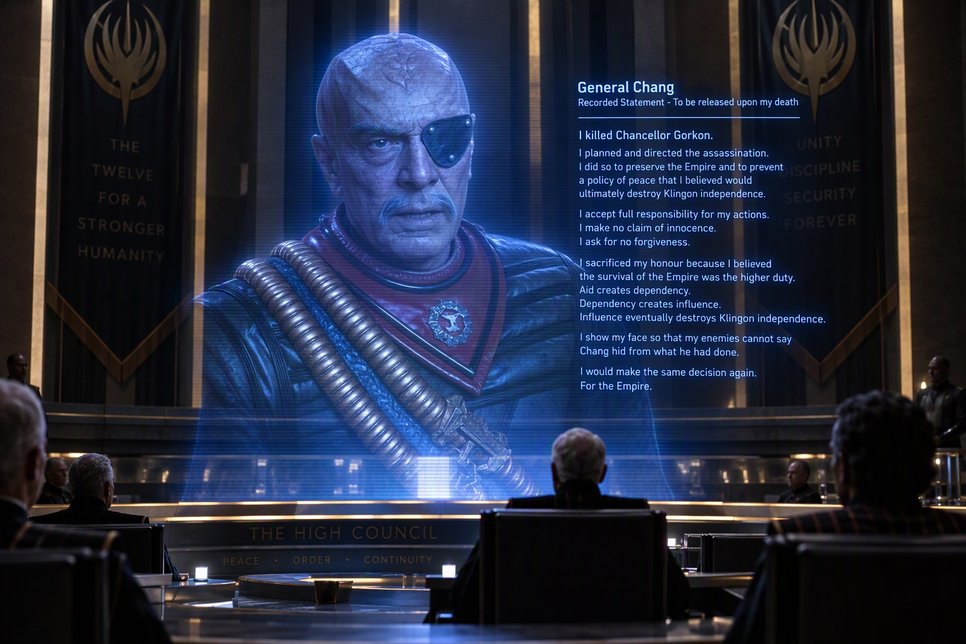
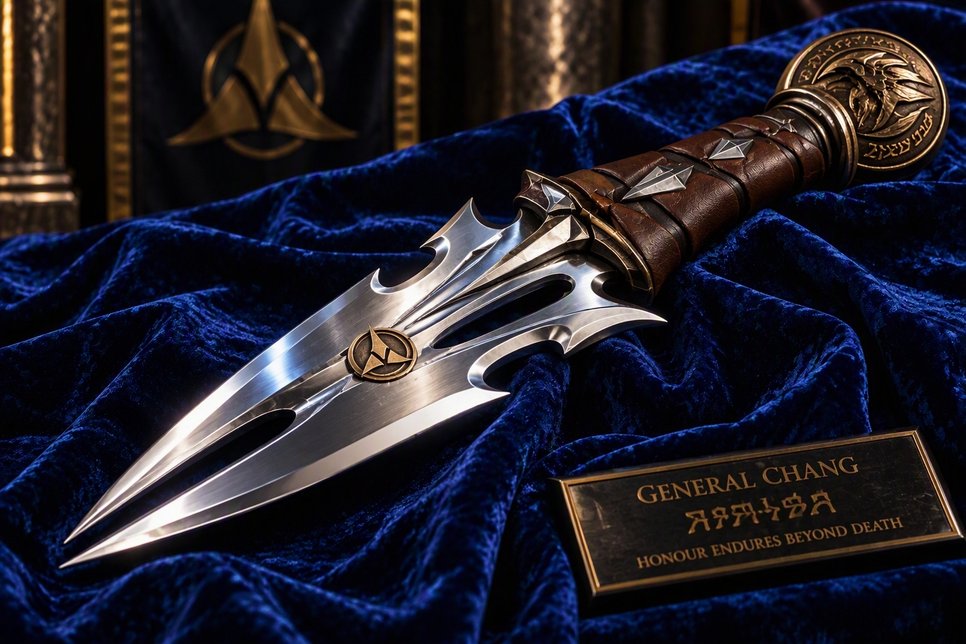
1.03 – The Balance of Honour - The revelation of General Chang; a blood oath document was delivered to the High Council shortly after Azetbur had attended the Khitomer talks, in the document, Chang confesses that he was behind the assassination of Chancellor Gorkon. The document was there as an admission of guilt, an honourable man who felt he had to do a dishonourable act to save the Empire. He went further to explain that he had always planned to carry out Mauk-to'Vor, not to redeem himself but to save the honour of his House. Chang knew he was damned to Grethor and was prepared to accept this burden to save the Empire. Chang had never planned for the Excelsior to have been there to stop him. He was denied honourable suicide. Chang, as a young lieutenant, had been on one of the warships approaching Earth in 2257. They had been called away from victory at the last moment by L'rell. Mother. Chang felt dishonoured and denied glorious victory. Gorkon was about to surrender to Federation aid; Chang felt he had no other honourable choice than to murder his friend Gorkon, and anyone else who attempted to befriend the true enemy of the Klingon people. The conspiracy was to maintain the status quo. hang sent this last message as he wanted to show his face to his enemy, as a true Klingon should. Chang had made General, was Chief of Staff and friend of Gorkon, then-Chancellor of the High Council. The murders and loss of personal honour were a worthwhile cost for the greater good.
Star Trek: The Interim Years
*The Excelsior Stories*
1.03: **“The Balance of Honour”**
**Format:** 55–60 minutes
**Position:** First regular episode after the two-part pilot
**Primary arena:** Qo'noS / USS *Excelsior* / Federation diplomatic service
**Theme:** **Can dishonourable acts serve an honourable purpose?**
Logline
A sealed blood-oath confession from the dead General Chang reaches the Klingon High Council, confirming that he orchestrated Chancellor Gorkon's murder and revealing that he knowingly sacrificed his own honour because he believed peace with the Federation would ultimately destroy the Empire. As Azetbur struggles to stop Chang becoming a martyr, Sulu discovers that killing Chang at Khitomer inadvertently denied him the ritual death he intended, while the Council begins asking what the Empire might look like under the absent General Waurg.
Story Function
Episodes 1.01 and 1.02 establish that **territorial peace is difficult**.
1.03 establishes that **cultural peace may be harder**.
There is almost no conventional external threat. The danger is an idea.
Chang is dead.
He cannot stage another coup.
He cannot assassinate anybody.
And yet by the end of the hour he may be more politically dangerous than he was alive.
His confession gives the opposition to Khitomer a coherent philosophy:
> The Empire is catastrophically weakened. The Federation knows it. Aid creates dependency. Dependency creates influence. Influence eventually destroys Klingon independence.
Azetbur therefore faces an enemy she cannot shoot.
**Her father's murderer has become an argument.**
TEASER: **“I SHOW MY FACE”**
Open on a Klingon courier arriving at the devastated capital.
The container it carries predates Khitomer.
It bears the seal of **General Chang**.
The document was arranged for delivery in the event of Chang's death.
It is authenticated.
The seal is broken before the High Council.
A recording begins.
Chang appears.
No theatrical eyepiece rhetoric. No Shakespeare initially.
Quiet.
Formal.
He identifies himself according to Klingon lineage.
And then:
> **“I killed Chancellor Gorkon.”**
Silence in the chamber.
Not:
*I participated.*
Not:
*I knew.*
**I killed him.**
Chang admits that the conspiracy was intended to preserve the strategic order which Gorkon sought to dismantle.
He makes no claim of innocence.
He asks for no forgiveness.
Then:
> **“I show my face so that my enemies cannot say Chang hid from what he had done.”**
Azetbur watches the image of the man who murdered her father.
**TITLE SEQUENCE.**
ACT ONE: THE CONFESSION
The complete document is explosive.
Chang admits involvement in:
- Gorkon's assassination;
- the conspiracy surrounding Khitomer;
- cooperation with Federation and Romulan conspirators;
- manipulation of Klingon judicial processes;
- attempted destruction of the peace process.
But the confession is not primarily evidential.
It is **philosophical**.
Chang explains why.
Chang and 2257
We learn that as a young Klingon lieutenant, Chang experienced the Federation-Klingon war from inside the Imperial Navy.
His formative memory is the abortive advance upon Earth.
Victory seemed possible.
Then L'Rell ended the conflict.
For the Federation, this was salvation.
For Chang, it became a lifelong humiliation.
He believed Klingon warriors had been denied a historic victory by political decision.
That experience formed a conviction:
> **Klingon warriors repeatedly win opportunities that Klingon politicians surrender.**
Decades later he believed Gorkon was repeating the mistake.
Only on a vastly greater scale.
ACT TWO: CHANG AND GORKON
The episode now complicates Chang.
He hated Gorkon's policy.
He did not hate Gorkon.
**They were friends.**
They had served the Empire together.
Chang had risen to General under Gorkon.
That makes what happened aboard Kronos One considerably worse.
Chang deliberately participated in murdering someone he respected because he decided personal friendship was irrelevant beside the survival of the Empire.
His argument:
Praxis has rendered the Empire vulnerable.
Federation food becomes Federation dependence.
Federation engineers become Federation technological access.
Federation assistance becomes Federation political influence.
Federation ideas concerning democracy, equality and self-determination enter the Empire alongside the aid ships.
Eventually Klingon subject populations ask why they are subjects.
Eventually Klingons ask why the Great Houses rule.
Eventually the Empire becomes something else.
For Chang:
> **Gorkon was not surrendering Klingon territory. He was surrendering the future Klingon right to determine what Klingon civilisation should be.**
THE MAUK-TO'VOR REVELATION
Then comes the most important revelation.
Chang knew his methods were dishonourable.
Murder.
Deception.
Conspiracy.
Collaboration with foreign enemies.
He knew what he had become.
His confession explains that, after destroying the peace initiative and restoring the old strategic balance, **Chang intended to undergo Mauk-to'Vor**.
Not to save himself.
He believed himself beyond saving.
Chang expected Grethor.
He accepted it willingly.
The ritual was for his **House**.
He would confess.
Accept responsibility.
Die.
His personal dishonour would die with him rather than poison his descendants.
That had been the ending.
Except something happened Chang had not planned for.
**USS *Excelsior*.**
Sulu arrived.
Chang's Bird-of-Prey was destroyed.
There was no confession before death.
No ritual.
No Mauk-to'Vor.
Sulu killed him first.
ACT THREE: EXCELSIOR
Sulu receives a diplomatic intelligence briefing on Chang's confession because *Excelsior* is specifically mentioned.
What bothers him isn't guilt.
He knows what Chang was doing at Khitomer.
But Klingon discussion increasingly frames Chang's death as an **unfinished death**.
A Klingon liaison explains the distinction.
Sulu:
> “So I denied him an honourable death.”
The Klingon thinks about that.
> **“No. Chang denied himself honour when he murdered his Chancellor.”**
Sulu looks over.
> “Then what did I deny him?”
> **“Control over the ending.”**
That's the distinction.
And it becomes the episode's title.
Who controls the **balance of honour**?
The individual?
Their House?
The Chancellor?
History?
SPOCK'S ANALYSIS
Ambassador Spock becomes valuable here because he initially treats Chang's confession analytically.
Chang's conspiracy failed.
Its participants are dead or exposed.
Therefore the immediate security threat has been reduced.
Sulu disagrees.
> “You're reading what Chang did.”
Spock:
> “And you are reading?”
> **“Why Klingons think he did it.”**
It is another stage in Ambassador Spock's development.
Starfleet Intelligence sees a confession.
Klingon society sees a **test case in honour**.
Spock begins approaching the document as Klingon political philosophy rather than merely forensic evidence.
ACT FOUR: THE TRIAL OF A DEAD MAN
The High Council explodes.
Nobody seriously argues that Chang was innocent.
The division is more sophisticated.
Azetbur's faction
Chang:
- murdered his lawful Chancellor;
- used deception instead of challenge;
- collaborated with enemies;
- attacked guests under diplomatic protection;
- placed personal judgement above Klingon law.
If that becomes honourable simply because he claimed patriotic motivation, then every Klingon officer can assassinate a Chancellor and call it sacrifice.
There is no Empire after that.
Only armed Houses.
The nationalist argument
Nobody has to declare Chang an honourable Klingon.
Chang himself says he wasn't.
That's what makes his confession persuasive to some.
He gained no throne.
No fortune.
No position.
He expected to die damned.
Therefore, they ask:
**What did Chang personally gain?**
Nothing.
To some councillors this makes him less like a traitor and more like a Klingon who deliberately destroyed himself attempting to save his civilisation.
KOLOTH STEPS FORWARD
This is the episode that properly positions Koloth politically.
Not ranting.
Measured.
Aristocratic.
Dangerous because he is reasonable.
Koloth does not defend Gorkon's murder.
He makes the distinction established in the earlier character work: Chang's methods were dishonourable, but that does not automatically invalidate his concerns about Federation dependency and the domestication of Klingon society.
Koloth:
> “Chang was wrong.”
Azetbur looks almost surprised.
Then:
> **“But must we therefore pretend he was wrong about everything?”**
That splits the room.
Because Federation influence is already arriving.
Doctors.
Engineers.
Relief workers.
Diplomats.
Political ideas.
Chang's predictions can now be attached to every uncomfortable consequence of rapprochement.
“CHANG WARNED US”
This becomes the ideological phrase the series can reuse.
Federation aid causes controversy?
**Chang warned us.**
Subject worlds demand greater rights?
**Chang warned us.**
Federation officials criticise Klingon internal policy?
**Chang warned us.**
Ch'ramak eventually invokes self-determination?
**Chang warned us.**
The dead General becomes a political Rorschach test.
ACT FIVE: THE MAN WHO ISN'T THERE
Then somebody asks the question Azetbur has dreaded:
> **“What does General Waurg say?”**
Silence.
Because Waurg's relationship with Chang makes the situation wonderfully complicated.
In the established backstory, Waurg, eldest son of former Chancellor Kesh, returned from the Metar War intending to challenge Gorkon. Chang defeated him, after which Gorkon promoted and effectively exiled Waurg to the Kinshaya front.
So:
Chang protected Gorkon's throne from Waurg.
Then Chang murdered Gorkon.
And while Chang and Gorkon are dead, Waurg remains alive.
Fighting.
His omission from the succession increasingly looks significant.
EASTERN FRONT
Brief sequence.
No grand hall.
No clean uniform.
Waurg is shown the confession between military operations against the Kinshaya.
His officers expect anger.
Chang humiliated him.
Chang stopped his return.
Chang helped keep Gorkon on Waurg's father's throne.
Now this same Chang confesses to killing Gorkon.
An officer asks:
> “Was he right?”
Waurg reads.
> “He murdered his Chancellor.”
> “That was not my question.”
Waurg looks up.
Perhaps just a trace of admiration for the officer's courage.
Then:
> **“He knew the price.”**
Alarm sounds.
Waurg closes Chang's document.
The political argument can wait.
The Kinshaya cannot.
Again, Waurg becomes more politically dangerous by refusing to behave like a politician.
THE AZETBUR DECISION
The High Council expects her to suppress the confession.
That would be easy.
Declare Chang dishonoured.
Seal the archive.
Prohibit reproduction.
Execute anyone distributing it.
Azetbur refuses.
She's learning.
Suppression would turn Chang into a martyr and validate his argument that her government survives only by silencing Klingon opposition.
Instead:
The confession is authenticated.
Chang's guilt is officially entered into the Imperial record.
His House remains legally tainted by his actions.
His complete statement is preserved.
It is not censored.
Let history judge him.
One adviser asks:
> “You would allow Klingons to hear this?”
Azetbur:
> **“They already will.”**
That's probably the smartest political decision she's made yet.
She cannot kill the idea.
She can prevent herself appearing frightened by it.
THE PERSONAL COST
Only after the political argument is finished do we see what this has actually done to Azetbur.
She watches one private fragment of Chang's statement again.
Not the political rhetoric.
Something personal about Gorkon.
An acknowledgement of friendship.
Perhaps:
> **“I mourned him before he was dead.”**
Azetbur finally stops the recording.
For the entire episode everyone has debated:
the Empire;
honour;
Federation influence;
history;
Gorkon's policy.
Very few people have acknowledged the simplest thing.
**Somebody murdered her father.**
She gets perhaps thirty seconds to be his daughter.
Then someone enters:
> “Chancellor?”
And she's Chancellor again.
TAG: THE VOTE
A summary of Council reaction comes in.
Not a formal vote on Chang's innocence.
A procedural measure supporting continuation of the Khitomer programme.
Azetbur expects comfortable passage.
It passes.
But narrowly enough to be disturbing.
The Council is dividing.
The adviser reports which Houses opposed her.
Then another category:
Houses that abstained.
Several are politically associated with the old Kesh bloc.
Azetbur asks:
> “And Waurg?”
> “Still on the Eastern Front.”
Azetbur looks towards the window.
That answer is no longer reassuring.
> “How soon could he return?”
The adviser doesn't answer immediately.
Cut to:
Waurg's battered command ship advancing with a Klingon formation against the Kinshaya.
He has Chang's confession lying on the table.
Unread final page visible.
The document bears the seal of House Chang.
Waurg turns away from it.
> “All ships. Advance.”
The Klingon fleet moves.
Black.
What 1.03 changes
This episode leaves physical geopolitics almost untouched.
But politically, **everything is worse**.
Azetbur
She now knows that Khitomer does not command anything approaching universal Klingon support.
Chang
Stops being merely the villain killed at Khitomer and becomes an ideological ghost haunting the series.
Koloth
Emerges as serious nationalist opposition rather than a simplistic warmonger.
Waurg
Becomes increasingly important despite remaining thousands of light-years away.
He defeated none of Azetbur's arguments.
He didn't need to.
His existence is the argument.
Sulu
Learns that his relationship with the Klingons now extends beyond practical border negotiations into questions of culture, history and honour.
Spock
Takes another step from Starfleet problem-solver towards diplomat. Understanding why somebody believes something becomes as important as proving whether the belief is logical.
Connection to the remainder of Season One
**1.04 – Old Enemies:** Chang's argument makes the Federation rethink its assumptions about deterrence, intervention and earlier Cold War settlements.
**1.05 – Praxis:** Once we truly see the catastrophe, the audience can understand why Klingons might simultaneously consider Gorkon's decision necessary and Chang's fears plausible.
**1.06 – Ascension:** Azetbur begins changing the composition of power rather than relying upon the divided old Council.
**1.07 – Encirclement:** Chang's prediction about Federation ideological penetration begins appearing prophetic to Klingon nationalists.
**1.08 – Gateway:** Federation asylum policy confronts Azetbur with concrete examples of Federation values protecting people the Empire considers criminals or rebels.
**1.09 – Independence Day:** Ch'ramak and Terajun begin using the language Chang warned would follow Federation rapprochement.
**1.10 – Fracture:** Azetbur finally proves that friendship with the Federation does not mean accepting Federation authority over Klingon internal affairs.
So **“The Balance of Honour”** does not rehabilitate Chang.
It does something more interesting.
It allows the audience to understand why a Klingon might condemn everything Chang did and still fear that **the dead man understood something real about the future.**
1.04 – Old Enemies - A look back to the Kzinti Cold War from 2155 onwards. The way the Archer dealt with first contact and then after the Romulan War, how the fledgling UFP used restraint and wisdom to build a wall and let the Kzinti carry on unmolested behind it. They avoided the Thucydide's Trap.
Star Trek: The Interim Years
The Excelsior Stories
1.04: “Old Enemies”
Format: 55–60 minutes
Primary story: USS Excelsior / Neutral Zone
Secondary story: Ambassador Spock / Federation strategic debate
Historical layers: Kzinti Wars, Organian settlement, Genesis, Star Trek V, Metar War
Theme: The lessons of the last war can prevent the next one, or cause it.
Logline
While surveying an abandoned Federation defence complex inside the Neutral Zone, Captain Sulu discovers that Starfleet's current Klingon deterrence doctrine rests upon assumptions inherited from the much earlier Kzinti conflict. Federation politicians see Klingon weakness after Praxis as an opportunity to accelerate demilitarisation, but Sulu and Ambassador Spock warn that treating a wounded Klingon Empire like a defeated enemy could destroy Khitomer. Meanwhile, forgotten military infrastructure demonstrates how difficult it will be to dismantle a Cold War whose weapons, colonies and political assumptions have survived the people who created them.
Episode purpose
After three episodes centred heavily upon the Klingons, “Old Enemies” turns the camera back onto the Federation.
The question is no longer:
Why are Klingons finding peace difficult?
It becomes:
What baggage is the Federation bringing into the peace?
The Federation likes to imagine itself as the enlightened party.
This episode complicates that.
Starfleet has fought border wars before. It has doctrines, institutions, defensive infrastructure and entire communities shaped by those experiences.
Most importantly, it remembers the Kzinti.
The Federation learnt that credible deterrence could contain a dangerous military power.
But contained isn't the same thing as reconciled.
Sulu begins to wonder whether Starfleet is trying to solve the Klingon problem using lessons from a completely different enemy.
The historical theme should be:
Generals aren't the only people who fight the last war. Democracies do it too.
TEASER: A DEAD FORTRESS
Excelsior arrives at the next sector in its survey.
Sensors identify a Federation installation that officially hasn't been operational for decades.
Yet its reactor is still producing power.
The facility is ancient by 2293 standards.
Heavy armour.
Primitive automation.
Weapons embedded beneath rock.
Long-range sensor arrays facing what eventually became the Klingon frontier.
A young officer assumes:
“Klingon War?”
Sulu checks the construction date.
“Older.”
Spock's records identify the original purpose.
Kzinti containment.
Everyone looks slightly uncomfortable.
Because parts of the installation are still active.
Then a proximity warning.
The fortress has detected Excelsior.
Ancient targeting sensors activate.
Weapons begin tracking Starfleet's most modern capital ship.
Sulu:
“Well, somebody remembers us.”
TITLE SEQUENCE.
ACT ONE: THE FIRST COLD WAR
The Excelsior survey team boards the facility.
Dust.
Dark corridors.
Old Federation insignia.
Equipment manufactured generations ago but designed to endure.
The station is a museum of Federation fear.
And through it we explain the Kzinti Cold War without turning the episode into a history lecture.
The crew finds old strategic displays.
Military planning maps.
Evacuation routes.
Weapons inventories.
Everything reflects a Federation that expected another Kzinti attack.
The Kzinti are therefore introduced through their effect upon Federation civilisation.
Starfleet fortified worlds because of them.
Ship designs reflected the threat.
Patrol patterns evolved around them.
Generations of officers learnt that security required:
preparedness + strength + credible retaliation.
The physical infrastructure remained long after the crisis changed.
That is what matters in 2293.
Sulu understands the doctrine
Sulu isn't dismissive of those officers.
That's vital.
A younger crewmember can look around and say:
“Seems excessive.”
Sulu responds:
“Not if you were there.”
This is not an episode arguing that deterrence is foolish.
It argues that deterrence is historical.
People build military systems in response to their experience.
The danger comes when the experience changes and the system doesn't.
THE KZINTI LESSON
A Starfleet strategic analysis team sends Sulu the current proposal for Klingon frontier restructuring.
Some officials believe Praxis creates a once-in-a-century opportunity.
The Klingons are enormously weakened.
Their fleet is badly reduced and overstretched. In the previously developed continuity, the Klingon Navy is down to roughly 7,000 potentially operational ships from around 14,000 before the recent catastrophes, while maintaining multiple strategic fronts.
The argument is therefore:
This is the time to make permanent Federation security gains.
Push Klingon capital ships farther from the frontier.
Reduce the number of Klingon fortified systems.
Demand verification.
Restrict certain weapon deployments.
Establish buffer regions.
On paper, it all sounds sensible.
Someone describes it as applying the successful lessons of Kzinti deterrence.
Sulu immediately sees the problem.
“The Klingons didn't lose a war.”
The analyst:
“They can't presently afford one.”
Sulu:
“That's not the same thing.”
And that becomes the episode's central strategic distinction.
ACT TWO: SPOCK AND THE FEDERATION ARGUMENT
Ambassador Spock finds himself participating in a difficult Federation policy debate.
Several positions emerge.
The security faction
Praxis has given the Federation leverage.
It would be irresponsible not to use it.
The argument isn't malicious.
If Klingon strength eventually recovers, future generations may ask why the Federation failed to secure safer borders when it had the opportunity.
The liberal faction
The Klingon Empire should be encouraged to liberalise alongside military de-escalation.
Political openness.
Greater rights for subject peoples.
Less power concentrated in the Great Houses.
More accountable government.
To some Federation politicians, political reform and long-term peace are inseparable.
Spock is sympathetic to the values.
But he's beginning to see the danger of turning Khitomer into a vehicle for remaking Klingon society.
The diplomatic faction
Azetbur has survived only months in power.
Demand too much and Federation policy may destroy the very government willing to negotiate.
And if Azetbur falls...
who follows her?
No one has a reassuring answer.
SULU'S CONTRIBUTION
Sulu participates remotely from Excelsior.
Someone asks him the practical question:
“How much pressure will the Klingons tolerate?”
Sulu dislikes the premise.
“Which Klingons?”
Silence.
Exactly.
Azetbur?
Koloth?
A border commander?
A Great House?
The Imperial Navy?
Waurg on the Eastern Front?
There is no single Klingon opinion.
Sulu adds:
“If you make peace look like surrender, Chancellor Azetbur won't be the person we negotiate with for very long.”
This is the beginning of Sulu becoming a statesman.
He's not simply reporting military intelligence.
He's telling the Federation government how Klingon domestic politics affects its own security.
ACT THREE: THE ORGANIAN LAYER
Back at the old Kzinti defence station, the crew discovers that it remained in use long after its original construction.
Its records tell the story of Federation strategy evolving.
Kzinti contingency.
Then Klingon contingency.
Then the Organian era.
Weapons remained.
Readiness changed.
The Federation could afford ambiguous frontiers because something more powerful than either fleet stood behind the rules.
Then that certainty disappeared.
This connects directly to the earlier Enterprise-A mission to abandoned Organia in the established continuity.
Spock talks about that mission with Sulu.
Not a flashback-heavy sequence this time.
Just memory.
The Enterprise-A investigated.
The Organians weren't there.
Not dead.
Not defeated.
Simply absent.
Sulu asks:
“Did Kirk think they'd come back?”
Spock:
“The Captain expressed several opinions.”
Sulu smiles.
“That's a yes.”
Spock:
“He hoped they would.”
A small beat.
“I am no longer certain I share that hope.”
That's new.
WHY?
Sulu challenges him.
Wouldn't having the Organians back simplify everything?
Yes.
That's the problem.
Spock has started considering whether Organian intervention prevented Federation and Klingons from developing the political mechanisms needed to coexist without them.
The Organians could stop weapons fire.
They could not create trust.
Perhaps eventually their presence became an obstacle to political maturity.
Not a conclusion.
Just a possibility.
The Organians predicted friendship.
Perhaps they understood that friendship could never be compulsory.
GENESIS AND GRISSOM
The historical thread then advances.
After the Organians disappear, restraint becomes less certain.
Genesis becomes the grim example.
A Federation science ship is destroyed by a Klingon vessel.
The old supernatural safeguard does nothing.
For the generation who grew up under Organian enforcement, the destruction of Grissom becomes psychologically significant.
The world is dangerous again.
It reinforces Starfleet thinking:
peace ultimately rests upon strength.
That lesson contributes to the military posture Sulu is now being asked to dismantle.
So Grissom matters not because we retell Star Trek III.
It matters because histories have consequences.
ACT FOUR: THE FORTRESS WAKES UP
The episode's physical plot now becomes dangerous.
The old station has been intermittently maintained by successive Starfleet administrations.
Nobody ever completely decommissioned it.
Why?
Because every generation thought:
We might need it later.
Classic Cold War thinking.
Then an approaching Klingon survey vessel triggers an automated defence protocol that hasn't been erased.
The computer recognises the Klingon ship according to threat parameters written decades ago.
Weapons activate.
Sulu orders the station shut down.
The local Federation officer responsible for the installation objects.
Not because he wants war.
Because his orders state that the weapons must remain effective until a replacement treaty has been formally ratified.
The bureaucratic absurdity becomes dangerous.
Khitomer says peace.
Old orders say readiness.
The machines followed the old orders.
SULU HAS TO CHOOSE
Sulu can't wait for Federation committees to resolve it.
The Klingon vessel has detected weapons activation.
It begins defensive manoeuvres.
Sulu places Excelsior between the station and the Klingons.
Again we see his doctrine:
strength in service of restraint.
He has the largest and most sophisticated ship in the immediate area.
He uses it to prevent either side making the first irreversible move.
The old defence station warns Excelsior away.
Sulu orders its weapons disabled.
Starfleet officer:
“Captain, that facility is Federation property.”
Sulu:
“So am I.”
A beat.
“Disable it.”
THE KLINGON REACTION
The Klingon commander is furious.
They interpret the weapons activation as evidence that Federation demilitarisation is fraudulent.
Sulu provides complete telemetry.
No edited summary.
No face-saving deception.
He shows them exactly what happened.
The Federation built the system.
The Federation failed to decommission it.
The Federation accepts responsibility.
That matters.
The Klingon commander eventually lowers shields.
Not because of trust in “the Federation”.
Because he has begun to trust Sulu.
Foundation stone.
ACT FIVE: FROM KZINTI TO METAR
Once the crisis is resolved, the station's archive offers one final historical layer.
The last significant updates occurred recently.
During the Metar War.
This is where the episode hints rather than explains.
The facility's strategic database briefly lists emergency protocols involving:
FEDERATION
KLINGON
ROMULAN
on the same side of an operational diagram.
A young officer finds the sight almost surreal.
“We cooperated with both of them?”
Sulu:
“We survived with both of them.”
That's all.
Do not explain the Metar War.
The audience learns just enough:
Something happened.
It was serious enough that normal geopolitical rivalry became secondary.
Federation, Klingon and Romulan assets cooperated.
And afterwards everyone apparently went back to being rivals.
Mostly.
This reinforces the question:
If cooperation was possible then, why is it so difficult now?
SPOCK ANSWERS
Sulu and Spock discuss it.
Sulu:
“We managed it against the Metar.”
Spock:
“Necessity simplified the diplomatic calculation.”
Sulu:
“And Khitomer?”
Spock:
“Requires us to cooperate when necessity does not compel us.”
That's harder.
This should be one of the defining exchanges of the season.
An outside enemy can create an alliance.
Peace requires a choice.
THE ROMULAN SHADOW
We also introduce a subtle Romulan element.
Nothing overt.
The old station's records indicate that someone has accessed a restricted archive remotely.
Starfleet Intelligence believes the intrusion was sophisticated.
No attribution.
Sulu asks:
“Romulans?”
The intelligence officer doesn't know.
Or won't say.
This quietly connects with the previously established 2293 Starfleet/Tal Shiar intelligence struggle over Federation technology and strategic secrets.
The Klingon question has a third observer.
Someone else is reading the map.
FEDERATION POLICY: THE LESSON CHANGES
At the Federation policy meeting, Spock proposes a refinement of the deterrence doctrine.
Not disarmament.
Not unconditional concessions.
Not permanent armed confrontation.
The principle becomes:
Deterrence without humiliation.
Keep sufficient Federation strength that Klingon military adventurism cannot succeed.
But avoid structuring the post-Khitomer settlement as though the Klingon Empire has been defeated and is being subjected to conditions by a victor.
Sulu supports it.
Because the difference will matter immensely on Qo'noS.
The objective isn't:
Make the Klingons incapable of war.
That is unrealistic and politically impossible.
It is:
Make war less rational than continued negotiation.
That's the strategic foundation of the five-season saga.
THE COLONIAL OBJECTION
We then bring the argument back to the people who have to live with it.
A Federation frontier representative asks:
“And if you're wrong?”
Sulu knows what the question really means.
If Klingons attack again, Earth doesn't take the first hit.
Frontier colonies do.
The representative:
“You're asking us to give up defences based on trust.”
Sulu:
“No.”
Then:
“I'm asking you to replace one kind of defence with another.”
Treaties.
Hotlines.
Joint inspections.
Patrol arrangements.
Starfleet presence.
Credible reinforcement.
None are perfect.
Neither was the fortress.
That's the point.
Peace isn't the absence of security.
It's another way of constructing it.
TAG: THREE OLD ENEMIES
End somewhere unexpected.
Not Excelsior.
A Romulan intelligence office.
We don't need names yet.
A Romulan analyst reviews three strategic maps.
The first:
Federation deployment.
The second:
Klingon deployment.
The third:
the emerging areas of Federation-Klingon agreement.
A superior asks:
“Will Khitomer hold?”
The analyst:
“Possibly.”
The superior isn't pleased.
“Then what changes?”
The analyst overlays the maps.
Klingon vessels formerly tied to the Federation frontier suddenly become available elsewhere.
Federation patrol commitments likewise change.
Romulan space lies beyond.
The analyst:
“Everything.”
The map fades.
Black.
What “Old Enemies” accomplishes
The episode significantly broadens the series without advancing the principal border plot very far.
That's deliberate.
It establishes that Sulu's five-year mission is negotiating not just geography but military psychology.
It gives the Kzinti history purpose
The Kzinti aren't trivia.
They explain why Starfleet thinks deterrence works and why frontier populations distrust rapid disarmament. Kzinti history is foundational to the post-Praxis Interim Years setting. 4
It advances the Organian mystery
Their absence may not simply be a problem.
Perhaps it is a necessary condition for the Federation and Klingons learning to coexist.
It places Genesis in historical context
Grissom becomes evidence that once Organian intervention disappeared, mistakes and aggression could again carry lethal consequences.
It introduces Metar history without explaining it
The audience learns that something extraordinary happened recently and that Federation, Klingon and Romulan powers cooperated.
Enough.
It begins the Romulan arc
The Romulans understand something that the Federation is only beginning to realise:
peace between two powers alters the security of the third.
It defines Sulu's strategic philosophy
Not pacifism.
Not disarmament.
Not Kirk-style improvisation.
Deterrence without humiliation.
And that gives the episode its deeper meaning:
The Federation spent decades learning how to prevent its enemies from attacking.
Now it has to learn how to stop needing enemies in the first place.
1.05 – Praxis- The story of the Klingon Chernobyl. The full details of the damage caused by the explosion of Praxis and the Delta Radiation and subspace wave sent out.
*Star Trek: The Interim Years*
*The Excelsior Stories*
1.05: **“Praxis”**
**Format:** 55–60 minutes
**Primary story:** Sulu, Spock, Azetbur and the aftermath of the Praxis catastrophe
**Secondary story:** the beginning of the gagh crisis and the first meaningful importance of Ch'ramak and Terajun
**Long-term mystery:** What really happened on Praxis?
**Theme:** **A civilisation can survive a catastrophe and still be destroyed by its consequences.**
### Logline
When USS Excelsior is permitted to accompany the first major Federation scientific and humanitarian mission into the devastated Klingon home system, Sulu and Ambassador Spock finally see the true scale of Praxis. As Federation scientists investigate the radiation, ecological collapse and destruction of the Klingon food chain, Spock discovers evidence that the official explanation of industrial negligence may be incomplete. Meanwhile, Azetbur must accept desperately needed Federation assistance without allowing her people to believe that Klingon survival has become dependent upon their oldest enemy.
Canon gives the starting point: Praxis was the Klingon Empire's key energy-production facility, its destruction generated a powerful subspace shockwave and severe environmental damage, and the resulting crisis forced the Empire to divert resources away from its enormous military establishment.
TEASER: BEFORE
We do something unexpected.
We show **Praxis before it exploded**.
Not a full explanation. A memory reconstructed from surviving Klingon industrial records.
It is ugly, magnificent and enormous.
Mining works extending kilometres underground.
Crystal processing.
Orbital elevators.
Dilithium shipments.
Matter-antimatter energy facilities.
Worker settlements.
Shipyards in the wider system taking deliveries.
Thousands of freighters.
Praxis isn't just a mine.
It is one of the organs pumping energy through an interstellar empire.
Dilithium is intimately associated with warp propulsion and matter-antimatter reactors in *Star Trek*, making it a logical technological foundation for this fictionalised industrial complex.
Workers complain about safety alarms.
Nobody is panicking.
Why would they?
Praxis has functioned for generations.
One technician notices an unusual fluctuation within a restricted energy facility.
An engineer says:
> “Noggra section.”
The first technician starts to enquire.
> “Clearance?”
A look.
Mind your own business.
Then we see something inside a sealed chamber.
Not long enough to identify it.
Something organic-looking amongst conventional Klingon machinery.
A field forms around it.
Cut.
Not to the explosion.
To black.
Then:
> **PRAXIS: 93 DAYS LATER**
We hear medical voices.
Screaming.
Transporter coordinates.
Numbers of casualties.
Then the image appears.
The scarred face of Qo'noS.
**TITLE SEQUENCE.**
ACT ONE: PERMISSION
The Federation has been offering major scientific assistance since the disaster.
Azetbur has finally agreed to a tightly controlled technical mission.
The political conditions are extraordinary.
Federation scientists may examine atmospheric effects.
Federation physicians may assist Klingon hospitals.
Federation agricultural and ecological specialists may advise on contaminated land.
But certain industrial and military facilities remain absolutely forbidden.
Sulu reads the diplomatic restrictions aboard Excelsior.
There are hundreds.
> “We can help them.”
An officer looks at the exclusions.
> “Just not with anything they don't want us to know.”
Sulu:
> “That's usually how helping another government works.”
This isn't an investigation.
Officially.
WHY EXCELSIOR?
A younger officer wonders why Excelsior is accompanying scientific vessels rather than continuing the border mission.
Sulu's answer is simple.
The Federation wants the same captain who first offered assistance when Praxis exploded.
The Klingons remember that.
The Federation remembers it.
And unlike an enormous relief flotilla appearing unannounced, Sulu is a known quantity.
He has six years of experience dealing with the Klingons in this continuity.
He isn't there to learn their culture.
He's there because both governments believe he might stop scientists and politicians accidentally insulting each other.
That turns out to be optimistic.
THE FIRST VIEW
Excelsior enters the Qo'noS system.
Nobody talks for a few seconds.
The absence of Praxis is almost more powerful than showing the explosion again.
Fragments remain.
Debris fields.
Industrial wreckage.
Radiation warnings.
Damaged orbital infrastructure.
Beyond it:
Qo'noS.
The devastated region occupies an enormous portion of the world in this continuity.
Sulu has seen sensor records.
That's different from seeing it.
He finally says:
> “Put the affected regions on screen.”
The computer overlays them.
Half the planet changes colour.
Nobody says anything.
AZETBUR'S WELCOME
Azetbur does not welcome them personally at first.
A Klingon minister does.
This is intentional.
The Chancellor cannot look like she is waiting at a transporter pad for Federation rescue.
That distinction is one Sulu immediately understands.
Federation officials are faintly offended.
Sulu isn't.
> “She's Chancellor.”
Someone:
> “We're here at her request.”
Sulu:
> **“Which is exactly why she can't look grateful.”**
That's Sulu's political sophistication.
ACT TWO: WHAT DELTA RADIATION DOES
This is where the *Chernobyl* influence really enters.
The episode slows down and teaches the audience the science.
A Klingon physicist and Federation specialist reconstruct the effects.
The canonical foundation is that delta radiation can be associated with warp-core environments and can produce severe cellular disruption at dangerous exposure levels; Christopher Pike's catastrophic injuries followed exposure to delta rays after an accident aboard a training vessel.
The extreme effects used here are **our setting's extrapolation** from those fictional premises.
First zone
Thermal destruction.
Structures gone.
Industrial facilities vaporised.
Second zone
Extreme radiation effects.
Organic material catastrophically damaged.
Third zone
Survivable exposure for some.
But severe injuries.
Chronic cellular damage.
Neurological problems.
Organ dysfunction.
Fourth zone
Long-term environmental contamination.
The physician says:
> “People survived here.”
The Klingon scientist responds:
> “For now.”
That phrase hangs over the episode.
THE TRUE HORROR
We do not revel visually in liquefied victims.
The horror should be conveyed through absence and testimony.
Recovery teams found buildings.
Armour.
Metal.
Stone.
Weapons.
But in some areas the organic inhabitants were subjected to such extreme fictionalised radiation effects that recognisable bodies simply weren't recoverable.
Family members have no remains.
For Klingons, this becomes culturally devastating.
Death rituals assume something about the relationship between warrior and body.
Here there is simply...
nothing.
A Klingon rescue worker tells Sulu:
> “My House had eighty-three members in the city.”
Pause.
> “We buried three.”
Sulu:
> “Only three survived?”
The Klingon shakes his head.
> **“Only three could be buried.”**
That's enough.
THE RELIGIOUS PROBLEM
The catastrophe has created theological questions too.
What constitutes an honourable death when an entire city disappears?
Did warriors killed without battle enter Sto-Vo-Kor?
Do children?
Workers?
Farmers?
Engineers?
What about people of whom there are no remains?
Different Klingon religious authorities give different answers.
Azetbur refuses to let the High Council decree one.
That's significant.
This catastrophe is already political enough.
She will not make grief another loyalty test.
THE FEDERATION MAKES ITS FIRST MISTAKE
A Federation relief coordinator proudly demonstrates nutritional support.
Protein compounds.
Synthetic supplements.
Emergency rations.
Enough basic material to prevent immediate malnutrition in several affected districts.
The Klingon agricultural specialist is not impressed.
> “Where is the gagh?”
The Federation official assumes this is pride or cultural preference.
Sulu knows better than to laugh.
The specialist explains.
And now the episode pivots.
ACT THREE: GAGH
The audience has historically treated gagh as Klingon culinary colour.
This series changes its meaning.
In *The Interim Years* continuity, gagh is biologically important.
Different worms and the associated microbial ecosystems provide compounds useful to Klingon digestion and metabolism.
Other food can keep Klingons alive.
But large-scale long-term nutritional replacement is difficult.
The problem isn't merely worms.
It's their **ecosystem**.
Water.
Mud.
Microbiology.
Temperature.
Trace minerals.
Breeding environments.
The blast didn't simply kill adult gagh.
It destroyed the swamps that produced them.
Eggs.
Larvae.
Microbial cultures.
Entire local varieties.
This links elegantly to establish House of Mogh material, where the House's supposedly unglamorous agricultural identity includes raising crops and gagh, a role explicitly intended to make agriculture significant in the Excelsior storyline.
A BOWL OF GAGH
Have one painfully understated scene.
A Klingon official and Sulu share a working meal.
A tiny portion of gagh is served.
Sulu notices.
He has eaten with Klingons before.
The offering is unusually sparse.
He doesn't mention it.
The Klingon notices him not mentioning it.
> “Rationed.”
Sulu:
> “I didn't ask.”
> **“Which is why I answered.”**
That's the relationship we want.
The bowl tells us more about Klingon weakness than another fleet-strength graphic.
THE SUPPLY MAP
Now the Klingon agricultural ministry presents its emergency projections.
Qo'noS cannot simply replace the destroyed ecosystems.
Some regions may take decades to recover.
Some may never be viable again.
Off-world production must increase dramatically.
Several suitable worlds illuminate.
Two names stand out.
Ch'ramak
Wetland regions suitable for mass gagh cultivation.
Terajun
Existing production capacity capable of major expansion.
Neither is politically simple.
We've already planted both names earlier.
Now the audience learns why they matter.
Azetbur studies the display.
> “How much?”
The agricultural minister gives her an answer we don't necessarily need to hear.
Her expression tells us enough.
Those worlds just became strategically indispensable.
THE COLONIAL PROBLEM BEGINS
An adviser notes that both worlds are seeking modifications to Imperial obligations.
Food exports.
Taxation.
Local authority.
Nothing yet amounts to rebellion.
But Praxis has radically altered their bargaining power.
Before the catastrophe they were Imperial agricultural regions.
Now they feed Qo'noS.
One official says:
> “They know what they possess.”
Azetbur:
> “They always possessed it.”
> “Now they know we need it.”
That's different.
Seed planted for **“Independence Day”** and **“Fracture.”**
FEDERATION FOOD AND KLINGON PRIDE
The Federation offers a solution.
Replicated nutritional substitutes.
Agricultural assistance.
Microbiological reconstruction.
Possibly even Federation facilities dedicated to producing Klingon dietary requirements.
Scientifically reasonable.
Politically poisonous.
Koloth or another sceptical councillor immediately sees it.
> “And when our children eat Federation food, what exactly will remain Klingon about our independence?”
The line is unfair.
It's also powerful.
Chang's ghost enters the room.
Nobody even has to say his name initially.
Then someone does:
> **“Chang warned us.”**
There it is.
ACT FOUR: THE SCIENTIFIC ANOMALY
While examining surviving data, Spock encounters something inconsistent.
Official explanation:
overmining;
poor safety;
cascading industrial failure.
Canonically, Praxis' destruction is attributed to over-mining and insufficient safety precautions.
That remains the official history.
But the energy propagation pattern doesn't entirely fit.
There are peaks.
Temporal irregularities.
An energy conversion efficiency that shouldn't have been possible using the officially documented Klingon systems.
Spock asks a Klingon physicist:
> “What was located here?”
He indicates a destroyed complex.
The Klingon's face changes.
> “Research laboratories.”
> “Researching?”
> “Energy.”
Spock waits.
Nothing else comes.
He recognises that the conversation is finished.
Ambassador Spock is learning something Captain Spock occasionally ignored:
sometimes forcing the answer immediately is counterproductive.
THE SHARD
A Federation science team recovers an unusual fragment from wreckage in orbit.
It's apparently industrial debris.
Except its internal structure is peculiar.
It appears partly manufactured and partly grown.
Spock examines the preliminary scan.
Something about it is familiar.
We don't give a Metar flashback.
Just a tiny reaction.
Sulu knows him well enough to catch it.
> “You've seen that before.”
Spock:
> “Something similar.”
> “Where?”
A beat.
> **“During the incident in the Metar region.”**
That's all casual viewers get.
Long-term viewers feel the floor move slightly.
THE KLINGONS TAKE IT
Before detailed Federation analysis can occur, Klingon authorities arrive.
The material is Imperial property.
The Federation scientist protests.
Spock doesn't.
He returns it.
Sulu asks privately:
> “You gave it back rather quickly.”
Spock:
> “They were unlikely to permit us to retain it.”
> “That's not what I meant.”
Spock meets his eyes.
> “No.”
And moves on.
Spock has learned enough.
HOUSE NOGGRA
This episode should **not** expose House Noggra's guilt.
But we can introduce the name.
An archived component identifier contains their House seal.
To the audience:
nothing.
To future rewatchers:
everything.
In your established continuity, House Noggra are the Klingon reverse-engineering specialists experimenting with salvaged Metar technology and secretly responsible for the attempt to use Metar-derived energy technology to supercharge Praxis; the official blame instead fell elsewhere.
That's a major series mystery.
Do not burn it in Season One.
We need only:
**NOGGRA**
A technician notices.
Spock notices him noticing.
End of scene.
WHAT AZETBUR KNOWS
This should remain ambiguous.
Does Azetbur know?
Perhaps she knows there are classified Praxis programmes.
Perhaps she knows the official explanation isn't complete.
Perhaps she doesn't know House Noggra's exact actions.
She's just inherited the government.
There should be information even the Chancellor isn't automatically cleared to see because Great Houses control sections of Klingon industry.
That makes the eventual truth potentially devastating for her too.
She may be defending a lie she doesn't yet fully understand.
ACT FIVE: HUMANITARIAN POLITICS
A Federation medical ship requests permission to begin mass treatment in another affected province.
The local Great House refuses.
Azetbur has to intervene.
The House leader argues:
> “We do not need Human charity.”
Azetbur:
> “Your hospitals are full.”
> “Then our people will endure.”
Azetbur's temper finally appears.
> **“The dead endure nothing.”**
Silence.
She orders the Federation teams admitted.
This is a major step for her.
Her logic is ruthlessly practical:
Klingon pride that kills Klingons is no longer useful pride.
But she adds conditions.
Klingon medical command remains in authority.
Federation teams operate under Klingon coordination.
Federation insignia are kept discreet in treatment zones.
Patient information stays under Klingon control.
She isn't merely accepting aid.
She's learning how to **accept aid without making it look like surrender**.
SULU AND AZETBUR
Give them one substantial private conversation.
Not romance.
Not sentimentality.
Two experienced leaders who know exactly how awkward the other one's position is.
Azetbur:
> “Your Federation believes assistance creates friendship.”
Sulu:
> “Sometimes it does.”
> “And sometimes it creates debt.”
Sulu:
> “Yes.”
That answer surprises her.
He isn't selling Federation virtue.
Azetbur:
> “My father believed we could accept one without the other.”
Sulu:
> “Which one?”
Azetbur almost smiles.
> “Exactly.”
This is the beginning of a relationship that may become one of the five-season saga's most important.
Sulu will never entirely approve of her government.
Azetbur will never entirely trust Federation motives.
They may nevertheless learn to trust **each other**.
THE FEDERATION'S UNCOMFORTABLE QUESTION
Back at the Federation Council, some politicians start asking:
Why are Federation resources supporting the Klingon imperial government?
Why not distribute aid directly?
Why should the Great Houses control Federation assistance?
Why aren't subject worlds receiving equivalent access?
Why should the Federation help rebuild a state which denies many people Federation-equivalent political rights?
These are reasonable questions.
They're also exactly the questions Azetbur fears.
The Federation believes humanitarianism and political values can be separated.
The season will steadily demonstrate that they cannot.
THE KLINGON RESPONSE
Koloth uses those Federation debates as evidence.
He doesn't need propaganda.
He simply plays Federation politicians' own words.
> “They have not even buried our dead and already they discuss improving us.”
That's a devastating line.
Azetbur doesn't have an easy rebuttal.
Instead:
> “Then give them less reason to.”
That surprises him.
She isn't going to defend every Klingon institution merely because the Federation dislikes it.
But neither will she permit the Federation to dictate reform.
Azetbur's political philosophy is beginning to emerge.
FINAL MOVEMENT: THE SEARCH BEGINS
Praxis creates one other consequence.
The empire now needs:
- new energy sources;
- new mineral supplies;
- replacement dilithium;
- alternative agricultural regions.
So the Klingon government reactivates scout programmes.
Old Raptors.
Birds-of-Prey.
Survey ships.
They're sent into remote Imperial territory and beyond existing frontiers.
This connects directly to later settings, where post-Praxis Klingon scouts search distant regions for replacement minerals and energy.
That creates another quiet theme:
**Praxis pushes the Empire outward just as Khitomer forces it to retreat politically in the west.**
The Federation thinks the Klingons are contracting.
In other directions...
they're exploring.
That becomes important later.
TAG: THE SEALED REPORT
Spock prepares a confidential diplomatic-scientific addendum.
Not:
**PRAXIS WAS CAUSED BY METAR TECHNOLOGY.**
He doesn't know that.
His conclusion is appropriately cautious:
> **Observed energy signatures include anomalies not fully explained by the published Klingon accident model. Certain recovered material demonstrates structural characteristics resembling technology encountered during the Metar crisis. Causation cannot presently be established. Further investigation recommended.**
Sulu reads it.
> “Who sees this?”
Spock:
> “A very small number of individuals.”
Sulu:
> “Azetbur?”
Spock looks towards Qo'noS.
> “I do not yet know whether informing her would clarify the situation.”
Sulu:
> “Or destabilise it.”
> “Precisely.”
They both look at the devastated planet.
Then cut to Qo'noS.
A Klingon child is handed a bowl containing a tiny quantity of fresh gagh.
The child eats.
The parent watches.
Relieved.
Then we see the shipping container.
Origin:
**TERAJUN**
Another container:
**CH'RAMAK**
Black.
What “Praxis” changes
This should be one of the season's defining episodes because it reclassifies almost every Klingon problem.
Praxis stops being backstory
It becomes an ongoing disaster.
Federation aid stops being obviously benevolent
It is necessary, but it creates political leverage and cultural anxiety.
Gagh stops being a joke
It becomes food security.
The importance of Klingon agriculture also connects directly into the established House of Mogh concept, where farming and gagh production are deliberately central rather than dishonourable background labour.
Ch'ramak and Terajun stop being random subject worlds
They become biologically important to the survival of post-Praxis Klingon society.
The Metar War stops being finished
Its technological legacy may still be shaping events.
House Noggra quietly enters the mystery
But the audience does not yet know why the name matters.
Azetbur's problem deepens
She doesn't merely have to save the Empire politically.
She has to feed it.
Rebuild it.
Keep the Great Houses united.
Maintain military deterrence.
Accept foreign assistance.
Prevent foreign assistance becoming political dependency.
And somehow stop everyone discovering whatever really happened on Praxis.
That makes the real horror of **“Praxis”** larger than the explosion itself:
> **The moon exploded in seconds.**
>
> **The consequences may take generations to finish.**
1.06 – Ascension - House of J'tal and General Qo'mar story.
*Star Trek: The Interim Years*
## *The Excelsior Stories*
### 1.06: **“Ascension”**
**Format:** 55–60 minutes
**Primary story:** Chancellor Azetbur begins rebuilding the Klingon political order after Praxis and Khitomer
**Secondary story:** Sulu and *Excelsior* encounter the Klingon-Gorn frontier and discover that the Federation has never been the centre of every Klingon's strategic universe
**Introduces:** House Qo'mar, Kin'skoje, the Gorn frontier, regional Great House power
**Theme:** **When the old order is shattered, somebody rises into the space it leaves behind.**
### Logline
As Chancellor Azetbur attempts to replace the Great Houses disgraced by the Khitomer conspiracy and those devastated by Praxis, she turns to General Qo'mar, a brutal but politically disinterested frontier commander whose House has spent generations fighting the Gorn. When the *Excelsior*'s border mission brings Sulu into contact with the southern Klingon frontier, he discovers an Empire far larger and more strategically complicated than the Federation-facing state Starfleet thinks it understands. Meanwhile, Azetbur's elevation of House Qo'mar marks the first time she deliberately reshapes the High Council around herself, and inevitably raises the question of what happens when Waurg eventually returns.
House Qo'mar has already been established in the wider setting as an historically Gorn-facing House based around Kin'skoje, largely detached from the Federation obsession of the central Klingon Houses. Azetbur's post-Khitomer settlement elevates it into the High Command and transfers military assets and territory from disgraced Houses to General Qo'mar.
Why this episode matters
Episodes 1.01 through 1.05 progressively demolished the old world:
- Khitomer disrupted the Cold War.
- the Neutral Zone has proven almost impossible to untangle;
- Chang's confession divided the High Council;
- the Klingon military has been exposed as powerful but overstretched;
- *Praxis* revealed the catastrophic state of Qo'noS.
**“Ascension” is the first episode concerned with what fills the vacuum.**
It also makes an important correction to Federation thinking.
Starfleet officers have spent a century experiencing the Klingons primarily through their western border.
They consequently talk about:
> **the Klingon threat.**
There isn't one Klingon threat.
There is a huge Empire with radically different regional priorities.
To House Qo'mar, Humans are distant foreigners with whom Qo'noS has wasted generations arguing.
Their enemy has scales.
TEASER: **THE GORN FRONTIER**
We don't initially identify where we are.
Darkness.
A frontier Klingon outpost.
Not the gothic grandeur of Qo'noS.
Heavy doors.
Weapon-scored armour.
Everything overbuilt.
An alarm sounds.
Something enormous hits an exterior barricade.
Klingon defenders do not reach instinctively for bat'leths.
They take **shorter, heavier weapons designed for penetration**.
That reflects the previously established House Qo'mar fighting style, in which short armour-piercing Klingon blades and disruptors are adapted to fighting physically massive Gorn at close range.
Then we see the defenders.
They are enormous even by Klingon standards.
Scarred.
Heavy armour.
One warrior has old claw marks across his face.
At their head:
**General Qo'mar.**
He doesn't deliver a speech.
He assesses the attack.
Issues three orders.
Then personally joins the defence.
The action is short, ugly and practical.
These Klingons don't fight for theatrical glory.
They're frontier soldiers killing something that will kill them if they don't.
Eventually the attack recedes.
A younger warrior celebrates.
Qo'mar looks at him.
> “Why are you pleased?”
The warrior hesitates.
> “We won.”
Qo'mar looks out through the damaged perimeter.
> **“They will come back.”**
Then a communications officer approaches.
Message from Qo'noS.
**The Chancellor commands General Qo'mar to appear before the High Council.**
Qo'mar looks genuinely irritated.
He would rather fight the Gorn.
**TITLE SEQUENCE.**
ACT ONE: A DIFFERENT KLINGON EMPIRE
The *Excelsior* remains engaged in its five-year survey mission.
Its current assignment is related to the outer extent of Klingon territorial claims.
Federation diplomats need to understand exactly what the Klingons mean when they talk about the "Empire".
The term is deceptively simple.
Sulu brings up the map.
The vast western Federation frontier is only one component.
Elsewhere lie:
- the Kinshaya theatre;
- the Gorn frontier;
- regions exposed to Romulan pressure;
- subject territories;
- old colonies;
- remote military stations;
- resource worlds;
- huge stretches of sparsely controlled Imperial space.
The previously established Klingon strategic geography includes separate forward operating facilities facing the Gorn, Federation, Romulans and Kinshaya, reinforcing that the Empire maintains multiple distinct strategic fronts rather than a single Federation-facing military orientation.
One junior officer remarks:
> “We always talk about the Klingon border.”
Sulu corrects:
> **“Our Klingon border.”**
That's the distinction.
Why Excelsior goes south
The current border talks have encountered an obscure claim.
A Federation cartographic record uses a Klingon chart produced by a Great House nobody in the diplomatic team knows much about.
**House Qo'mar.**
The Klingons refuse to validate the Federation's interpretation.
So *Excelsior* needs better data.
Sulu's five-year mission isn't just negotiating with the Chancellor.
He has to understand the political geography behind Klingon territorial records.
This brings him towards Kin'skoje and the southern frontier.
Not into Gorn territory.
Close enough to understand what lives beyond it.
The first sight of Kin'skoje
The system should immediately feel unlike Qo'noS.
Qo'noS is the imperial centre.
Kin'skoje is a **frontier military culture**.
Warships with visible battle damage.
Fortified stations.
Heavy surface defences.
Training areas.
Ships under rapid repair.
Trophy culture derived from generations of conflict with the Gorn.
The House of Qo'mar is not rich because it spends its resources fighting.
It is politically influential locally because everybody else knows that if House Qo'mar disappeared, something dangerous would move into the vacuum.
That's the frontier bargain.
Qo'noS gives them considerable autonomy.
They hold the line.
Sulu's surprise
Sulu understands Klingons.
But these Klingons are different from the ones he normally encounters.
One senior Qo'mar warrior has never fought Starfleet.
One has never been inside the Federation Neutral Zone.
The war with the Federation in 2256 means less to them than a famous Gorn assault from their grandparents' generation.
Sulu receives a tiny but important lesson:
> **Federation officers have mistaken the Klingons they encounter for all Klingons.**
It is the interstellar equivalent of assuming a country can be understood entirely by examining one border province.
That observation will matter later when Sulu tries to understand Waurg's Eastern constituency.
ACT TWO: AZETBUR'S VACANT CHAIRS
Back on Qo'noS, Azetbur faces a different consequence of Praxis and Khitomer.
The High Council has empty places.
Some literal.
Some political.
Some Great Houses suffered catastrophic losses during Praxis.
Others became implicated in Chang's conspiracy.
Others have lost wealth, ships, estates or enough family members that their influence has collapsed.
Azetbur cannot simply leave the Council in that condition.
The Empire needs functioning government.
But whoever she elevates changes the balance of power.
That makes every appointment explosive.
The problem with inherited government
One adviser tells Azetbur:
> “Your father balanced the Houses.”
Azetbur:
> “My father had different Houses.”
Excellent distinction.
Gorkon's coalition belonged to the world before Praxis.
That world is gone.
Azetbur has to govern the Klingon Empire that actually survived.
This becomes her first explicit rejection of the idea that the objective should be restoring her father's administration.
Who can she trust?
The obvious candidates are politically dangerous.
Old Gorkon allies
Useful but make her look dependent on her father's faction.
Koloth and the nationalists
Powerful, but increasingly sceptical of Khitomer.
House Kesh sympathisers
Potentially loyal to Waurg.
Military Houses
Strong enough to secure the Empire, but strong enough eventually to threaten the throne.
Then somebody mentions:
**Qo'mar.**
Azetbur considers it.
Qo'mar has one enormous virtue.
> “He doesn't want the throne.”
Her adviser:
> “That we know of.”
Azetbur:
> **“Every Klingon knows what Qo'mar wants.”**
The adviser:
> “Gorn?”
Azetbur:
> “Dead Gorn.”
For once, Klingon political simplicity is useful.
Why Qo'mar?
General Qo'mar's House has several characteristics Azetbur desperately needs.
It is:
- militarily credible;
- regionally powerful;
- relatively untouched by the Chang conspiracy;
- not dependent upon Federation-facing patronage networks;
- strongly Imperial rather than separatist;
- disinterested in possessing the Chancellorship;
- experienced in defending territory from an external enemy.
The established House concept explicitly has Qo'mar loyal to the Empire rather than High Council intrigue and uninterested in aspirations to the throne.
This makes Qo'mar an almost ideal **constitutional ballast**.
Not her friend.
Not her creature.
Someone whose loyalty can credibly be described as loyalty to the Empire.
That is worth more.
ACT THREE: SULU MEETS Qo'MAR
Sulu expects diplomatic ceremony.
He doesn't get it.
General Qo'mar is still en route to Qo'noS, and the local House authorities regard *Excelsior* as an inconvenience.
The Humans want maps?
Fine.
Give them maps.
Sulu quickly realises the southern Klingons don't have the same emotional relationship with Starfleet that western Houses do.
They don't love the Federation.
They simply don't obsess over it.
One Klingon asks Sulu:
> “How many Gorn have you killed?”
Sulu:
> “None.”
The Klingon looks genuinely puzzled.
Not offended.
Just slightly uncertain how to evaluate him.
Sulu adds:
> “I've killed Klingons.”
That produces a moment of silence.
Then perhaps grudging amusement.
At least now he has a category.
The Gorn question
This episode must avoid making the Gorn merely monsters.
The Klingon account is obviously not neutral.
Qo'mar territory remembers Gorn raids, attacks and brutal frontier warfare.
But the Federation archive contains evidence that the **Gorn tell the history differently**.
Some territories the Klingons call defensive frontier lands are regarded by the Gorn as territory the Empire encroached upon.
So here we encounter another version of the same problem as the Neutral Zone.
Everyone has a map.
Everyone has dead ancestors.
Everyone describes themselves as defending what was theirs.
Sulu looks at Klingon-Gorn claims and experiences a moment of horrible recognition.
> “It's the same argument.”
His officer:
> “As our border?”
> **“Different names.”**
That is the episode's connection to the series mission.
A Federation temptation
The diplomatic team sees an opportunity.
If Klingon strength is diverted towards the Gorn frontier, then the Federation might gain leverage in the western border negotiations.
Sulu objects immediately.
Not morally.
Strategically.
If the Federation exploits Gorn pressure to force territorial concessions, Klingon nationalists will treat Khitomer as exactly what Chang said it was:
**an enemy taking advantage of catastrophe.**
Deterrence without humiliation again.
Sulu's diplomatic doctrine is becoming consistent.
A SMALL BORDER INCIDENT
A damaged Klingon patrol vessel arrives carrying survivors from a Gorn encounter.
The House requests medical assistance because its facilities are overloaded.
*Excelsior* possesses better medical resources.
There is hesitation.
Klingon wounded being treated aboard a Federation capital ship has political implications.
Sulu simply says:
> “Beam them aboard.”
No announcement.
No ceremonial Federation goodwill.
Just doctors doing their jobs.
A Qo'mar warrior wakes in sickbay surrounded by Starfleet personnel.
He is profoundly uncomfortable.
But alive.
These tiny encounters are the foundation stones of the fifty-year journey.
ACT FOUR: Qo'MAR ARRIVES ON Qo'noS
Qo'mar's arrival at the capital should be visually wonderful.
Everyone else arrives in aristocratic splendour.
Qo'mar arrives still wearing battle-scarred frontier armour.
Perhaps someone gently suggests he change before entering the High Council chamber.
Qo'mar looks at his armour.
> “Why?”
Because this *is* formal wear where he comes from.
He possesses legitimacy that cannot be manufactured at court.
He kills the Empire's enemies.
Everyone understands his function.
His audience with Azetbur
Azetbur tries diplomacy.
Qo'mar has minimal patience for it.
She offers him a seat.
He wants to know why.
She explains that several Great Houses have been removed or diminished.
The Empire requires strength.
Qo'mar:
> “Then send ships south.”
Azetbur:
> “I am offering you considerably more than ships.”
> “That is what worries me.”
Good.
Qo'mar understands enough politics to know that gifts have prices.
The offer
Azetbur proposes the elevation of House Qo'mar into the High Command / upper political structure.
The existing continuity has this new Great House receiving significant military assets previously associated with disgraced Houses, including an Accuser-class dreadnought, Warrior's Anger command cruisers and K't'inga-class vessels, while also receiving lands connected with fallen political rivals.
Don't deliver all of that immediately as an enormous shopping list.
Seed it.
A capital ship.
Additional cruisers.
New responsibilities.
A Council seat.
Territory on Qo'noS.
Qo'mar listens.
Then asks:
> “What do you want?”
Azetbur:
> “Your loyalty.”
Qo'mar:
> “You have it.”
Azetbur recognises the qualification.
> “To me?”
Qo'mar:
> **“To the Empire.”**
That's exactly the answer she wanted.
And the answer she should fear.
Why Azetbur chooses him anyway
Because personal loyalty won't rebuild the Klingon state.
Institutions need people who will obey the office even if they dislike the occupant.
Qo'mar's political indifference is therefore almost **proto-constitutional** by Klingon standards.
He recognises the Chancellor because the Empire needs a Chancellor.
If Waurg eventually becomes Chancellor honourably, Qo'mar might recognise Waurg just as strongly.
Azetbur understands this.
She elevates him anyway.
That's maturity.
And risk.
THE HIGH COUNCIL REACTION
The aristocracy is appalled.
Who's this provincial brute?
A Gorn fighter.
A frontier House.
Where are their historic ties to the great centre?
Qo'mar's supporters reply:
> While you argued with Humans, we defended the Empire.
And suddenly everybody is thinking of someone else.
**Waurg.**
Because that is essentially Waurg's claim too.
While Qo'noS played politics...
he fought the Kinshaya.
Azetbur's elevation of Qo'mar therefore strengthens her government but also legitimises the very argument that could one day be used against her.
Excellent unintended consequence.
THE SUCCESSION QUESTION RETURNS
A councillor asks Qo'mar privately:
> “If Waurg were here, who would you recognise?”
Qo'mar's answer should not be reassuring.
> **“The Chancellor.”**
> “Which one?”
Qo'mar looks at him.
> “When there are two, ask me.”
Perfect.
He won't be drawn.
But everyone knows the day might come.
ACT FIVE: THE TITLE BECOMES CLEAR
“Ascension” has now accumulated several meanings.
### House Qo'mar ascends.
### Azetbur ascends beyond being Gorkon's caretaker.
### Peripheral Klingon regions ascend in importance because the core is damaged.
### Sulu ascends into understanding Klingon geopolitics beyond the western frontier.
### And Waurg's possible future ascension hangs over it all.
The episode now brings these threads together.
SULU'S MAP CHANGES
Aboard *Excelsior*, the Federation cartographers update the Klingon strategic model.
Previously:
**KLINGON EMPIRE**
One colour.
Now subdivisions appear.
Great House areas.
Military jurisdictions.
Regional economies.
Competing historical borders.
Sulu pauses over it.
> “Better.”
A cartographer:
> “More complicated.”
Sulu:
> **“That's why it's better.”**
That's another series thesis.
Good diplomacy requires replacing easy maps with complicated ones.
SPOCK'S OBSERVATION
Spock receives Azetbur's political appointments.
He studies the implications.
On paper, she has strengthened militarists.
A Federation policymaker worries this means Klingon liberalisation is reversing.
Spock disagrees.
Or rather, refuses the premise.
> “Chancellor Azetbur's objective does not appear to be liberalisation.”
> “Then what is it?”
> **“Survival.”**
Important.
The Federation is starting to understand that Azetbur is not trying to make the Klingons more like the Federation.
She is trying to make the Klingon Empire survive long enough to decide what it becomes.
ROMULAN INTEREST
A subtle secondary beat.
Romulan intelligence receives the same political information.
House Qo'mar elevated.
Additional ships flowing south.
The Romulans update their own assessments.
Why do they care?
Because every ship sent south is not facing Romulan space.
Every House strengthened creates another potential relationship.
Every political realignment after Praxis creates opportunities.
No grand villain speech.
Just competent people updating files.
The whole quadrant is recalculating.
THE FEDERATION'S DILEMMA
One Federation official makes the uncomfortable conclusion:
If the Klingons shift warships from the Federation frontier to other theatres after Khitomer, then Federation diplomacy may actually help the Empire strengthen its control elsewhere.
This is the uncomfortable consequence that eventually explodes in **“Fracture.”**
The Federation thought:
> Peace means fewer Klingon military deployments.
Azetbur thinks:
> Peace means fewer Klingon military deployments **against the Federation**.
Those are not the same thing.
The earlier naval concept explicitly has post-Khitomer reductions in western readiness allowing the remaining Klingon fleet to be redistributed against other enemies and threats.
This episode makes that implication explicit for the first time.
FINAL SEQUENCE: THE CEREMONY
House Qo'mar's ascension becomes public.
Not ornate.
Klingon.
Symbols of disgraced Houses are removed.
Qo'mar's House insignia takes its place.
Azetbur formally recognises him.
The Council watches.
Some approve.
Some seethe.
Some calculate.
Koloth watches carefully.
Qo'mar kneels before the Chancellor.
Azetbur places whatever symbol represents his new status.
He rises.
They look at each other.
Nobody mistakes this for friendship.
It is an agreement.
The Empire needs both of them.
For now.
TAG: THE EASTERN FRONT
Always end the House politics by reminding us about the man who isn't there.
Far away...
Waurg receives a report.
**HOUSE Qo'MAR ELEVATED.**
His officer expects anger.
Waurg studies Qo'mar's service record.
Gorn campaigns.
Battle honours.
Frontier commands.
Then:
> “Do you know him?”
Waurg:
> “No.”
> “The Chancellor has given him a Council seat.”
Waurg hands back the PADD.
> **“Then perhaps the Council finally has a warrior.”**
No jealousy.
Maybe even approval.
Which makes the whole thing worse for Azetbur.
Waurg doesn't resent Qo'mar.
They are products of the same neglected Imperial reality.
Men who fought on distant frontiers while the central Houses obsessed over Humans.
The alarm sounds.
Another Kinshaya contact.
Waurg:
> “Later.”
He walks away.
Still not coming home.
Black.
What “Ascension” accomplishes
It makes the Empire geographically real
The Federation frontier is merely one edge of something enormous.
It properly introduces the Gorn question
Not as a monster-of-the-week enemy, but as an old strategic rivalry with its own competing border narrative.
It makes House Qo'mar politically necessary
Their rise comes because the old Klingon elite has been damaged by Praxis and Khitomer, not because Azetbur randomly rewards a colourful warrior.
It advances Azetbur
This is arguably the first episode where she governs according to **her own political judgement rather than Gorkon's inheritance**.
She deliberately changes the balance of the Council.
It complicates Federation hopes
A stable, peaceful Klingon Empire may use the military resources freed by Khitomer to reinforce its authority elsewhere.
Peace and liberalisation are not synonyms.
It strengthens Waurg without bringing him home
This is crucial.
Every time the series introduces a competent frontier warrior, the audience understands Waurg better.
The Federation-facing elite sees difficult barbarians at the edges.
The frontier Houses see themselves differently:
> **We were fighting while you were talking.**
That sentiment will eventually power Waurg's challenge.
And that gives **“Ascension”** its final, dangerous irony:
**Azetbur strengthens herself by elevating the kind of Klingon who may someday decide that Waurg was the Chancellor they should have had all along.**
1.07 – Encirclement - seeing the Trek universe from a Klingon-centric viewpoint.
*Star Trek: The Interim Years*
## *The Excelsior Stories*
### 1.07: **“Encirclement”**
**Format:** 55–60 minutes
**Primary story:** Sulu's Neutral Zone survey reaches a politically volatile colonial cluster
**Secondary story:** Azetbur confronts the Klingon strategic fear of being surrounded
**Introduces:** the colonial independence argument, deeper Romulan observation, the ideological consequences of Federation contact
**Theme:** **Everyone believes they are the one being surrounded.**
### Logline
When *Excelsior* surveys a strategically tangled group of Neutral Zone colonies, Sulu discovers that Federation, Klingon and colonial maps describe three completely different political realities. To Klingon officials, the Empire is being encircled by the Federation, Romulans, Gorn, Kinshaya and increasingly disobedient subject worlds. To colonial populations, it is Klingon soldiers, governors and warships that surround them. As Federation ideas of consent and self-determination begin leaking beyond the Neutral Zone, Azetbur realises that the peace she needs to save the Empire may also be spreading the political ideas capable of dismantling it.
Why “Encirclement” comes here
The season has now widened systematically.
**1.01–1.02:** the border.
**1.03:** Klingon political culture.
**1.04:** Federation strategic history.
**1.05:** the physical catastrophe of Praxis.
**1.06:** the wider Klingon Empire.
Now **1.07 connects those things together**.
The episode should make the audience realise that the crisis cannot be understood using one map.
Every faction has its own.
And every faction's fear makes sense when seen from its own map.
That is what makes this dangerous.
TEASER: THREE MAPS
Open with the same region of space shown three times.
Map one: Federation
Clean.
Orderly.
Federation systems in blue.
Klingon Empire in red.
Neutral Zone separating them.
Several disputed systems marked amber.
It looks almost manageable.
Map two: Klingon
Completely different emphasis.
Federation expansion dominates the west.
Romulan territory bears down along another portion of the Empire.
Gorn frontier to the south.
Kinshaya pressure far to the east.
Inside the Empire are subject worlds, military districts and Great House territories.
The Klingon state looks like an enormous fortress with threats around virtually every wall.
Map three: colonial
We zoom suddenly down.
One small world.
Around it:
Klingon military base.
Klingon communications station.
Klingon governor's residence.
Klingon orbital patrol.
Klingon customs station.
Klingon commercial concession.
Now *they* look encircled.
A colonial teacher asks a room of children:
> “Which map is correct?”
A child answers:
> “Ours.”
The teacher:
> **“So does everyone else.”**
Titles.
ACT ONE: THE COLONIAL CLUSTER
*Excelsior* reaches the next major phase of its five-year survey.
Unlike the relatively clean dispute in **“Brave New World”**, this is not one contested planet.
It is a collection of settlements whose legal histories overlap.
There are:
- old Klingon-controlled worlds;
- communities that predate the present frontier;
- Federation settlements;
- mixed communities;
- commercial installations;
- former military outposts;
- indigenous populations;
- smugglers who have prospered precisely because legal jurisdiction is unclear.
Sulu studies the chart.
One Federation survey officer tries to draw a line through the cluster.
It cuts through shipping routes.
Move it and it cuts through a settlement.
Move it again and it isolates a Klingon colony from the Empire.
Another version strands a Federation population on the Klingon side.
Sulu:
> “Try another.”
The cartographer:
> “Captain, eventually the line has to go somewhere.”
Sulu knows.
That's the problem.
The first principle collapses
Until now the Federation has approached border disputes with a deceptively simple proposition:
> Where practical, populations should have a say in their political future.
Spock has helped insert language concerning consultation, consent and autonomy into some of the preliminary arrangements.
Federation diplomats consider this humane.
The colonists love it.
The Klingons are becoming alarmed.
A Klingon representative asks the obvious question:
> **“If every settlement chooses its sovereign, what exactly is sovereignty?”**
Spock begins an answer.
The Klingon interrupts:
> “Do the Humans on Alpha Centauri vote every morning on whether they still recognise the Federation?”
That is not an entirely fair comparison.
It is not an entirely stupid one either.
The Klingon argument
The Klingon representative explains that borders cannot be plebiscites constantly waiting to happen.
The Empire believes it possesses territory because of:
- conquest;
- treaties;
- settlement;
- inheritance;
- historic governance;
- blood sacrificed to defend it.
Whether the current residents approve does not, in Klingon political theory, automatically override those claims.
Sulu understands immediately what this means beyond the Neutral Zone.
If the Federation establishes:
> **people may decide they don't want Klingon sovereignty**
as a universal diplomatic principle...
then why should the principle stop at the Neutral Zone?
Spock realises it too.
And somewhere else, so does Azetbur.
ACT TWO: AZETBUR'S MAP
On Qo'noS, Azetbur attends an Imperial strategic briefing.
For perhaps the first time, we see the Empire as **she** sees it.
Not the Federation's Klingon Empire.
The Klingon Empire.
The strategic map illuminates.
West: Federation
Peace is developing.
But Starfleet remains powerful.
The Federation continues economically and diplomatically expanding its influence. From the Klingon perspective, friendly Federation contact can therefore look very different from inside the Empire.
South: Gorn
House Qo'mar's elevation in the preceding episode has strengthened this frontier, but it remains an old military wound. House Qo'mar's entire culture and power base is historically centred on fighting the Gorn rather than the Federation.
East: Kinshaya
The war continues.
Waurg remains there.
Ships and warriors continue being consumed.
Another frontier: Romulans
Quiet.
Watching.
Azetbur dislikes quiet enemies.
Inside:
Ch'ramak.
Terajun.
Other subject systems.
Suddenly the map resembles a state under siege.
The military assessment
One general gives the uncomfortable truth.
The Empire has enough military strength to remain formidable.
It does **not** have enough strength to behave as though every frontier is equally important.
The post-Praxis fleet model developed earlier has exactly this problem: approximately 7,000 potentially operational vessels compared with roughly 14,000 before the recent catastrophes, forcing reduced readiness against the Federation so that resources can be shifted towards threats including the Romulans and Kinshaya.
Azetbur understands what Gorkon had understood.
The Federation confrontation had to stop.
But peace creates another difficulty.
The Empire's enemies and subjects may interpret strategic retrenchment as weakness.
“They smell blood”
A hard-line councillor says precisely that.
> “The Gorn test Qo'mar.”
> “The Kinshaya test Waurg.”
> “The Romulans watch our fleets.”
> “Our subjects delay tribute.”
> “And the Federation teaches them to question the Chancellor.”
Then:
> **“They smell blood.”**
Azetbur rejects the panic but not the facts.
Her problem is becoming almost Soviet in character.
The state is enormous.
Its military remains terrifying.
Yet central power is stretched attempting to support commitments accumulated over generations.
Giving something up anywhere risks creating the perception that everything is negotiable.
That is **encirclement as state psychology**.
ACT THREE: THE OTHER ENCIRCLEMENT
Sulu beams down to one of the colonial worlds.
We reverse the map.
The local population does not experience Klingon strategic vulnerability.
They experience Klingon power.
They're surrounded every day by symbols of Imperial authority.
A Klingon governor.
Klingon security officers.
Customs.
Military patrols.
Tax collectors.
Orbital ships.
Resources allocated according to Imperial priorities.
The colony has lived this way for generations.
Its representative asks Sulu:
> “When Klingons tell you they're surrounded, do you believe them?”
Sulu:
> “Yes.”
The representative laughs bitterly.
> “Look outside.”
There are Imperial troops in the street.
> **“So are we.”**
That's the episode.
Both statements are true.
Federation values become material
A community meeting takes place.
The population knows about the Neutral Zone negotiations.
They have heard Federation speeches.
They have read draft wording.
Words circulate:
**autonomy**
**representation**
**consent**
**self-determination**
A colonial leader asks Ambassador Spock:
> “Does the Federation believe people have the right to choose their government?”
Spock knows he's walking into a trap.
> “In principle, yes.”
> “Does that principle apply to us?”
There it is.
Spock cannot say:
> No, because that would be inconvenient for the peace negotiations.
But saying yes could amount to supporting separatism inside the Klingon Empire.
Ambassador Spock has finally arrived at the hardest version of his new profession.
Sulu and Spock disagree
This wants a substantial scene.
Not an argument between idealism and cynicism.
Between two Federation men who believe the same values and disagree over foreign policy.
Spock:
> “We cannot assert that political consent is universal and then declare exceptions wherever its application becomes difficult.”
Sulu:
> “I'm not asking you to.”
> “Then what are you suggesting?”
Sulu looks at the Klingon military positions.
> **“That before promising somebody independence, we work out what happens after they declare it.”**
That's Sulu.
He is closer to political realism.
Not because he believes liberty is bad.
Because he's commanding the ship that will be there when the shooting starts.
The colonial leader pushes harder
They do not want Federation membership.
Important.
That makes the argument more difficult.
They want genuine independence.
No Klingons.
No Federation.
They ask for observers.
International guarantees.
Border recognition.
Suddenly the issue cannot be dismissed as Federation expansion by proxy.
And yet Klingon officials insist Federation political language created the movement.
Both things may be true simultaneously.
ACT FOUR: CH'RAMAK AND TERAJUN
Now the episode connects the local dispute to the season's principal developing crisis.
Reports reach Azetbur.
Political groups on Ch'ramak have circulated translations of the Federation's Neutral Zone proposals.
Terajuni representatives are discussing similar ideas.
Not rebellion.
Not yet.
But something has changed.
Previously they negotiated over:
tax obligations;
food quotas;
gagh shipments;
governors;
local authority.
Now they are talking about:
**rights.**
That's harder.
A commodity agreement can be renegotiated.
An idea cannot simply be sent back to warehouse.
Azetbur looks at a Federation declaration discussing self-government.
Then at a Ch'ramaki political tract using almost identical language.
Her adviser says:
> “The Federation denies involvement.”
Azetbur:
> “I believe them.”
The adviser is surprised.
Azetbur:
> **“That is what makes it worse.”**
Perfect.
This isn't a Starfleet intelligence operation.
Nobody needs to be deliberately destabilising the Empire.
Federation ideas have entered the building.
“You taught them the words”
This line belongs in this episode, but **not yet as the gigantic confrontation**.
Seed it privately.
Perhaps Azetbur tells a Klingon minister:
> “They have always disliked us.”
> “Then nothing has changed.”
Azetbur:
> **“Before, they knew only what they hated. The Federation has taught them the words for what they want.”**
That insight terrifies her.
“Independence Day” will turn it into action.
THE GAGH DIMENSION
The strategic minister reminds everyone why Ch'ramak and Terajun are different after Praxis.
Qo'noS has lost enormous portions of its viable gagh ecology in the continuity established by **“Praxis.”**
These worlds now provide or can provide replacement cultivation.
They are not merely colonies.
They are food security.
Azetbur asks:
> “If Ch'ramak stopped shipments tomorrow?”
The officials exchange looks.
We do not need an exact number.
Their expressions are enough.
Again, this is why sudden independence terrifies Qo'noS.
THE KLINGON OFFER
The governor in Sulu's local colonial dispute offers concessions.
More local representation.
Reduced taxation.
Civil policing transferred to local authorities.
Cultural protections.
But:
**no sovereignty.**
The colonists reject it.
This frustrates the Klingons.
> “We give them what they demanded.”
Sulu:
> “You gave them what they demanded five years ago.”
That's change again.
Once populations begin imagining independence, yesterday's generous autonomy may become today's insufficient compromise.
THE FEDERATION'S PROBLEM
Federation observers aren't united.
Some enthusiastically support colonial liberation.
Others are deeply uncomfortable.
A senior Federation diplomat warns Spock:
If the Federation encourages breakaway movements, what happens when the Klingons encourage separatist movements inside Federation member states?
The Federation responds that its members govern by consent.
The diplomat:
> “Then we'd better be absolutely certain every citizen agrees on what consent means.”
No polity is quite as philosophically simple as its propaganda.
This doesn't establish moral equivalence between Federation and Empire.
It establishes that **great principles become complicated when translated into foreign policy**.
THE ROMULAN HAND
Now bring in the third strategic perspective more substantially.
Sulu's crew detect unusual communications traffic passing through ostensibly commercial channels.
Nothing conclusively Romulan.
But Starfleet Intelligence is interested.
A colonial activist has received excellent political intelligence:
Klingon fleet rotations.
Azetbur's vulnerabilities.
Which Great Houses oppose her.
Someone is feeding information into the unrest.
We do **not** establish that the Romulans created the independence movement.
That would undermine the colonists' legitimate grievances.
Much better:
**the movement is real; the Romulans are exploiting it.**
That's how sophisticated intelligence policy works in this setting.
They don't need to invent the crack.
Just push something into it.
Romulan scene
Brief cutaway.
A Romulan officer receives an assessment.
Federation influence increases colonial demands.
Klingon repression increases resentment.
Either outcome creates difficulty for Qo'noS.
The Romulan asks:
> “Which side should we support?”
The answer:
> **“Both.”**
Not ideologically.
Operationally.
Give each enough information to mistrust the other.
A peaceful Federation-Klingon frontier threatens Romulan strategic freedom.
Instability protects it.
ACT FIVE: THE FLASHPOINT
The colonial independence movement organises a demonstration near an Imperial administrative complex.
Most demonstrators are unarmed.
Klingon security expects violence.
Colonists expect Klingon violence.
Everybody arrives afraid of what everybody else might do.
Then somebody fires.
We deliberately do not immediately know who.
A disruptor shot.
Chaos.
Klingon troops raise weapons.
The crowd panics.
A second shot.
*Excelsior* security personnel are present as observers.
Sulu has seconds.
If Klingon troops massacre protesters, Federation public opinion will turn violently against Khitomer.
If Starfleet physically intervenes against Klingon troops, the Klingons will regard it as interference in Imperial territory.
Sulu orders something quintessentially Sulu.
**Transporter separation.**
Not taking sides.
Starfleet simultaneously beams wounded civilians to treatment areas and extracts the small group of endangered Klingon officials.
It physically separates the two sides without declaring either one correct.
It's elegant.
Temporary.
And politically infuriating to everyone.
Exactly right.
WHO FIRED?
The forensic investigation cannot establish it before the episode ends.
Important.
Maybe colonial extremist.
Maybe Klingon provocation.
Maybe outside interference.
Maybe accident.
In real border politics, uncertainty itself becomes a weapon.
The colonists insist Klingons fired first.
Klingon media says terrorists attacked lawful authorities.
Federation media shows frightened civilians.
Romulan analysts watch both.
Truth has already become less important than narrative.
Sulu is furious.
> “We don't even know what happened.”
Spock:
> “That has rarely prevented political certainty.”
Dry Spock.
THE INTERIM ARRANGEMENT
Once again Sulu cannot resolve the larger dispute.
He creates time.
Klingon heavy security withdraws from the immediate civilian centre.
Local civil authorities maintain basic order.
Klingon sovereignty is not renounced.
The independence movement receives Federation-facilitated access to talks.
Starfleet does **not** recognise independence.
Nobody is happy.
Which is now almost Sulu's metric for workable diplomacy.
SULU AND THE COLONIAL LEADER
The leader confronts him.
> “You believe we're entitled to choose our future.”
Sulu:
> “Personally?”
> “Yes.”
Sulu pauses.
> “Yes.”
> “But the Federation won't recognise us.”
> “Not today.”
The colonist:
> “Because you're frightened of the Klingons.”
Sulu:
> **“Because I'm frightened of everybody who thinks what happens next is someone else's problem.”**
That's perhaps Sulu's defining line of the episode.
Freedom isn't the problem.
The day after freedom is the problem.
Borders.
Trade.
Food.
Security.
Citizenship.
Minorities.
Military installations.
Those details are exactly what *Excelsior* has been sent to deal with.
AZETBUR AND SPOCK
Give the episode one direct confrontation between them.
Remote diplomatic communication.
Azetbur doesn't accuse the Federation of organising rebellion.
That would be easy.
Instead:
> “Do you believe my subjects should have the right to leave the Empire?”
Spock:
> “I believe governmental legitimacy ultimately depends upon those governed.”
Azetbur:
> “An elegant answer to a question I did not ask.”
She presses.
Should Ch'ramak be permitted to leave?
Spock cannot endorse secession without knowing more.
Azetbur sees the contradiction.
> “Your principles become very cautious when warships are attached to them.”
Spock absorbs that.
Then Azetbur gives him the line we've been building towards:
> **“You say you have not encouraged them. I believe you.”**
> “Then we agree.”
> **“No, Ambassador. You taught them the words.”**
End communication.
Spock sits with it.
Because she is partly right.
THE TITLE FROM BOTH SIDES
The episode should explicitly pay off **Encirclement** in parallel scenes.
On Qo'noS
A Klingon strategic officer shows Azetbur:
Federation.
Romulan.
Gorn.
Kinshaya.
Internal instability.
> “We are surrounded.”
On the colonial world
A child looks from the window:
Klingon guards.
Klingon tower.
Klingon warship overhead.
> “They are everywhere.”
The same fear.
Opposite scales.
TAG: THE MAP GETS WORSE
Back aboard *Excelsior*, the border database is updated.
Another political category has to be created.
Previously:
**FEDERATION**
**KLINGON**
**DISPUTED**
**JOINT**
Now:
**SEPARATIST / STATUS UNRESOLVED**
One of Sulu's officers looks at the expanding legend.
> “At this rate we're going to run out of colours.”
Sulu stares at the map.
> “No.”
Beat.
> **“Just easy answers.”**
Then his screen highlights two incoming intelligence reports.
**CH'RAMAK**
**TERAJUN**
Sulu opens them.
His expression changes slightly.
Cut to black.
What **“Encirclement”** changes
## The colonial question becomes ideological
Until now the border dispute has principally concerned historical ownership.
Now people begin asking whether either historical owner should decide.
## Federation values acquire consequences
The Federation doesn't have to export revolution deliberately.
Its existence provides an alternative political vocabulary.
## Azetbur's fear becomes clearer
She is not simply frightened of losing territory.
She's frightened of **precedent**.
One successful departure may convince others that the Empire is optional.
## Ch'ramak and Terajun move forward
They cease being background economic concerns and become emerging political actors.
Their later appearance amongst the refugee populations of Gateway is already embedded in the wider setting.
## The Romulans enter properly
Not as moustache-twirling villains trying to start a war, but as a state with a rational interest in ensuring Federation-Klingon rapprochement does not overturn the strategic balance.
## The earlier Qo'mar story pays off
The Federation now understands why Klingons feel encircled: the Gorn frontier genuinely matters to large parts of the Empire, and House Qo'mar's culture and political rise were shaped by that reality.
## The season changes direction
Episodes 1.01–1.06 largely ask:
> **Can the Federation and Klingons stop being enemies?**
From 1.07 onward the question changes:
> **What happens to everyone else if they do?**
That sets up the final run perfectly:
### 1.08 **Gateway**
The people displaced, inspired or endangered by these changes begin physically crossing the frontier.
### 1.09 **Independence Day**
Political theory becomes an explicit demand for separation.
### 1.10 **Fracture**
Azetbur concludes that if she permits the process to continue unchecked, she may cease to have an Empire to reform.
So **“Encirclement”** is the episode where everybody finally sees the trap.
The Klingons think enemies are closing in from every direction.
Their colonial subjects think Klingon power surrounds them from every direction.
The Federation believes it is offering everyone a way out.
The Romulans quietly understand that the worst thing for their strategic position might be if anybody actually finds one.
1.08 – Gateway The human story of the refugees crossing the Neutral Zone.
*Star Trek: The Interim Years*
## *The Excelsior Stories*
### 1.08: **“Gateway”**
**Format:** 55–60 minutes
**Primary story:** *Excelsior* is temporarily diverted from drawing borders to confronting the people those borders displace
**Secondary story:** Federation asylum policy collides with Azetbur's sovereignty
**Introduces/expands:** Gateway Colony, the Federation Immigration Service, Orion exploitation, Ch'ramaki and Terajuni civilians, the smaller Starfleet patrol-service world
**Theme:** **A border is an abstraction until somebody has to cross it.**
### Logline
A surge of civilian vessels fleeing Praxis, political instability and disputed Klingon territories overwhelms the Federation's frontier immigration system, forcing *Excelsior* to escort them to Gateway, a purpose-built reception colony. Sulu discovers that the people affected by his five-year border mission have begun moving faster than the diplomats can negotiate, while Spock is caught between Federation asylum principles and Azetbur's demands for the return of Imperial citizens she considers criminals and deserters. In the confusion, the Orion Syndicate has discovered that every refugee crisis creates customers.
Why “Gateway” comes here
**“Encirclement”** ended with people asking:
> *If the Federation believes in self-determination, does that apply to us?*
**“Gateway”** asks what happens when some of them don't wait for an answer.
Until now, Season One has mostly viewed history from the top:
- Sulu;
- Spock;
- Azetbur;
- Waurg;
- admirals;
- diplomats;
- Great Houses.
Now we go below them.
The Klingon Empire and Federation are altering the political architecture of the quadrant.
Ordinary people experience that as:
**Where am I allowed to live?**
TEASER: THE BORDER CROSSING
Do not open aboard *Excelsior*.
Open aboard a civilian transport.
Overloaded.
Old.
Patched.
Packed with people who don't know what happens next.
The passengers aren't one species or nationality.
There are Klingons.
Subjects of the Empire.
Ch'ramaki.
Terajuni.
Families.
Workers.
An injured former soldier trying very hard not to look like a soldier.
A mother clutching documentation as though the correct PADD will somehow protect her family.
Then the ship's captain announces:
> “Federation boundary in sixty seconds.”
Nobody cheers.
They're too frightened.
Because they don't know whether crossing it makes them:
- refugees;
- asylum seekers;
- illegal immigrants;
- defectors;
- criminals.
Then a Klingon patrol vessel appears behind them.
Weapons active.
Ahead:
a small Federation patrol ship.
The little Starfleet vessel places itself between the refugee transport and the Klingons.
The captain looks at the tactical display.
Two powers.
One refugee ship.
One invisible line.
Cut to:
**USS EXCELSIOR RECEIVING DISTRESS SIGNAL**
Titles.
ACT ONE: NOT EXCELSIOR WORK
*Excelsior* alters course.
Sulu initially expects the usual frontier incident.
He finds something different.
The small Starfleet patrol ship has the situation contained, barely.
This provides a useful first glimpse of the **uncelebrated Starfleet**.
The *Enterprise* saved civilisations.
*Excelsior* negotiates superpower borders.
But most of Starfleet consists of vessels doing things such as this.
Customs.
Patrol.
Search and rescue.
Immigration support.
Anti-piracy.
Medical emergencies.
Routine frontier enforcement.
That anticipates the smaller Okinawa-class world we've already established around ships such as USS *Sheppey*, including later refugee, trafficking and immigration work along this frontier.
Sulu respects that immediately.
He doesn't sweep in and take over.
He asks the patrol captain:
> “What do you need?”
Not:
> “I'm assuming command.”
That's another difference between seasoned Captain Sulu and a younger officer who needs to prove himself.
The Klingon demand
The Klingon patrol commander claims several passengers are Imperial fugitives.
Their list includes:
- deserters;
- wanted criminals;
- political agitators;
- Ch'ramaki suspects;
- people accused of attacks against Imperial personnel.
Federation systems classify several of them as potential asylum applicants.
The Klingon commander says:
> “Return our citizens.”
The Federation patrol captain says:
> “They've requested asylum.”
And there is the episode.
Nothing in Khitomer adequately resolves this.
Sulu's problem
Sulu cannot simply:
**return them.**
Nor can he say:
**everyone who crosses the line is automatically safe from Klingon law.**
Some people may have committed serious crimes.
Some might genuinely be terrorists.
Others may merely have criticised the Chancellor.
Those categories can overlap.
Sulu tells the Klingon commander:
> “They're going to Gateway.”
> “You are harbouring fugitives.”
> “We're determining what they are.”
That distinction becomes crucial.
The Klingons agree reluctantly.
Everyone proceeds to Gateway.
ACT TWO: GATEWAY
Now the episode opens up visually.
Gateway should not look like Starfleet Headquarters.
Nor should it look wholly miserable.
The established concept already treats Gateway as a dedicated Federation immigration/refugee colony with major medical, linguistic and social-support infrastructure, alongside areas where arriving groups cluster into distinct communities.
So the first impression should be astonishing.
An entire planetary system built around **arrival**.
Transport hubs.
Medical complexes.
Translation services.
Immigration offices.
Accommodation districts.
Freight yards.
Administrative centres.
Schools.
Markets.
Temporary housing that has obviously stopped being temporary in places.
And starships everywhere.
Not glamorous explorers.
Working ships.
Gateway as the Federation's front door
A Federation official proudly describes the place.
Sulu is impressed.
Spock notices something else.
Gateway embodies Federation ideals.
An arrival can theoretically be:
- assessed individually;
- medically treated regardless of status;
- heard;
- represented;
- allowed to make a case.
That sounds completely normal to Federation citizens.
To someone from an imperial hierarchy, it can be revolutionary.
A farm labourer and a Great House aristocrat enter the same processing system.
Their testimony is judged as individual testimony.
The cultural implications are enormous.
The Intake Hall
This is where the episode gets deliberately mundane.
Queues.
Forms.
Translation delays.
People who don't understand why they're being asked questions.
Officials trying to distinguish:
> “Where were you born?”
from
> “Which government claims you?”
from
> “Which government do you recognise?”
Those may produce three different answers.
One Ch'ramaki family has Imperial Klingon documentation.
They insist:
> “We're not Klingon.”
The official replies:
> “I didn't say you were.”
The father:
> “Your form does.”
That's exactly the sort of small bureaucratic problem the series needs.
A civilisation-changing geopolitical process ultimately produces badly designed immigration forms.
Sulu sees his map again
A Gateway administrator gives Sulu statistics and case files from the same systems *Excelsior* has been surveying.
The captain recognises the names immediately.
People are already leaving worlds whose status his teams haven't resolved.
The administrator tells him, in effect:
> Your negotiations are taking months.
> People make decisions overnight.
Sulu sees a refugee family from one of the colonies discussed in his mission briefings.
The dot on his map has become a queue of frightened people.
Again.
ACT THREE: THE CH'RAMAKI
Now deepen Ch'ramak without turning the episode into **“Independence Day”** prematurely.
Several Ch'ramaki have arrived.
The prior material already envisages Ch'ramaki society possessing its own militia structures and Hearth Fire Councils, while another earlier storyline describes Ch'ramaki farmers becoming guerrilla fighters against Klingon forces.
But the arrivals here should mostly be **ordinary people**.
A farmer.
Teacher.
Mechanic.
Somebody who served in an Imperial-controlled institution.
People with contradictory views.
One supports independence.
Another simply wants Klingon soldiers to leave their district.
Another believes outright independence will lead to war.
This is important.
Do not make “the Ch'ramaki” one political opinion.
That's exactly the simplistic thinking the series is trying to escape.
One difficult Ch'ramaki case
A young man requests asylum.
Klingon files say he belonged to an armed organisation.
He admits it.
Federation interviewer:
> “Did you attack Klingon soldiers?”
> “Yes.”
> “Civilians?”
He hesitates.
Now the case is uncomfortable.
He may be a freedom fighter.
He may also have done terrible things.
Perhaps both.
The Federation doesn't get the luxury of treating everyone fleeing an autocracy as morally uncomplicated.
THE TERAJUNI
Terajuni arrivals are different again.
Your earlier material includes distinctive Terajuni institutions such as River Mothers, Hunt Captains and Spore Speakers.
Some are fleeing economic requisitions.
Others fear the growing confrontation with Qo'noS.
A few political activists increasingly believe Ch'ramak's example is showing the way.
A Federation interviewer asks one Terajuni woman:
> “Are you seeking asylum because you fear persecution?”
Her answer:
> “No.”
A pause.
> **“I fear what happens when my government says no.”**
Not persecution yet.
Anticipation.
Gateway is receiving **the refugees of next month's crisis**.
THE KLINGONS
Most importantly, some refugees are Klingon.
Not Imperial subjects.
**Klingons.**
That shocks everyone.
A Klingon worker whose home was destroyed after Praxis.
A former naval technician.
A family who cannot obtain sufficient medical support.
Perhaps somebody discommendated from a House.
They aren't necessarily Federation admirers.
They simply believe they have better prospects there.
That is politically poisonous for Azetbur.
Klingons emigrating because the homeworld cannot adequately support them looks like national failure.
SPOCK AND ASYLUM
Now Spock gets the major diplomatic story.
Azetbur's government submits formal requests for certain individuals to be returned.
Ambassador Spock meets a Klingon representative.
The Klingon argument:
> A peace agreement cannot permit the Federation to become a sanctuary for every criminal in the Empire.
Reasonable.
Spock's answer:
> Nor can peace require the Federation to return individuals simply because the Klingon government classifies political dissent as criminal.
Also reasonable.
The Klingon:
> “So Federation law outranks ours?”
Spock:
> “Within Federation territory, yes.”
There's a beat.
The Klingon almost smiles.
> “That is a very Klingon answer.”
Touché.
ACT FOUR: THE ORIONS
Now we introduce the episode's criminal layer.
Gateway has created legitimate infrastructure for moving:
- people;
- goods;
- money;
- documentation;
- medical supplies.
The Orion Syndicate has attached itself to that infrastructure.
Not by taking over the planet.
That's too crude.
They live in the gaps.
A family needs transport before their legal slot?
Someone can arrange it.
A refugee lacks valid identification?
Someone can reconstruct their papers.
A trader needs goods moved through a disputed jurisdiction?
For a fee.
Somebody wants a Klingon official bribed?
They know somebody.
Someone possesses interesting salvage from the recent wars?
They know buyers.
The broader *Interim Years* continuity already has the Orion Syndicate exploiting the scramble for Metar discoveries and later acquiring Metar-related technology for profit or advantage without ethical restraint.
Gateway is therefore not their origin.
It's another opportunity.
The Orion philosophy
Give the Orion operator a simple worldview.
Federation says:
**refugee.**
Klingons say:
**fugitive.**
Romulans say:
**asset.**
The Orion says:
> **“Passenger.”**
And passengers need transport.
It's almost admirable in its amorality.
The trafficking case
Keep this general-audience appropriate and non-sexual.
A group of migrants discover that the smugglers who transported them now claim they owe enormous debts.
The Syndicate confiscates documents and tries to force them into exploitative labour arrangements until the debt is repaid.
Federation law considers this coercive trafficking.
The victims don't initially report it because they fear being deported.
This gives Starfleet a very grounded job.
Not defeating an interstellar armada.
Helping frightened people understand:
> reporting the crime does not automatically cancel your asylum claim.
That is the kind of world-building which makes the Federation feel like an actual society.
EXCELSIOR IS TOO BIG
Sulu quickly realises that *Excelsior* is not the right instrument for much of this.
You don't use a major capital ship to chase every smuggling cutter.
So Sulu starts coordinating smaller vessels.
Local patrol ships.
Medical transports.
Customs craft.
This becomes the beginning of the post-Khitomer patrol architecture that later ships like *Sheppey* will inhabit. Existing material already places *Sheppey* and similar small patrol vessels in refugee and immigration work around Gateway.
The great ship's job is coordination and deterrence.
The small ships do the daily work.
Again:
the future is institutional.
Not one heroic captain.
THE EXCELSIOR CREW GETS INVOLVED
This episode is an opportunity to strengthen Sulu's crew.
Different officers take responsibility for:
- coordinating medical screening;
- repairing refugee transports;
- translating unfamiliar documents;
- checking navigation records;
- identifying fraudulent manifests;
- managing transporter access;
- handling frightened arrivals.
A tactical officer who's spent a career preparing to fight Klingons finds themselves repairing a Klingon refugee ship.
That's the post-Cold War transition in miniature.
ACT FIVE: THE CRISIS
The Orion network decides to move several wanted individuals off Gateway before Federation investigators can identify them.
Among them is the difficult Ch'ramaki asylum seeker.
The Syndicate offers him disappearance.
New identity.
A ship.
He almost accepts.
Why?
Because he doesn't trust the Federation to protect him once political pressure from Qo'noS increases.
That gives the Orion operator a good pitch:
> “Klingons want you guilty.”
> “Federation wants you processed.”
> **“I can make you gone.”**
Tempting.
SULU DOESN'T CHASE
When the smuggling ship departs, the audience expects *Excelsior* to thunder after it.
Sulu doesn't.
He coordinates the patrol net.
Small ships close transit corridors.
Customs sensors flag forged registrations.
Gateway traffic control isolates the vessel.
A patrol ship intercepts.
The massive *Excelsior* remains in orbit.
That's deliberate.
Sulu's achievement isn't personally catching them.
It's making the **system work**.
Exactly what the post-*Enterprise-A* Starfleet has to learn.
THE ASYLUM DECISION
The Ch'ramaki fighter is returned to Gateway custody.
Now Spock must confront the case.
He cannot simply declare the man a heroic freedom fighter.
There is evidence of violence.
But returning him directly to Klingon jurisdiction may expose him to political punishment before his case is properly examined.
So the answer is frustratingly procedural:
**continue investigation.**
Temporary protection.
No automatic political asylum.
No extradition until the case is reviewed.
Nobody gets a morally satisfying victory.
Again, perfect.
AZETBUR'S REACTION
Azetbur is genuinely angry.
From her perspective, somebody who attacked Imperial troops is sitting comfortably under Federation protection while bureaucrats debate his human rights.
Spock explains Federation law.
Azetbur:
> “Your Federation may call him an applicant.”
> **“To us, he is a man who fired on soldiers.”**
Spock:
> “The two descriptions are not mutually exclusive.”
She hates that answer.
Because it's true.
THE BIGGER QUESTION
Azetbur pushes.
If thousands of Klingon subjects can cross the frontier whenever they reject Imperial law, then what happens to the Empire?
Spock cannot reassure her honestly.
Movement itself destabilises closed political systems.
Federation freedom of movement is therefore another ideological pressure.
Azetbur:
> “You speak of borders becoming less important.”
Spock:
> “In time.”
Azetbur:
> **“Borders become less important to those who are confident of what lies on the other side.”**
Very Azetbur.
Her people look across the border and see Federation prosperity.
Her government sees demographic leakage.
Her enemies see sanctuary.
Again, peace creates problems war kept hidden.
SULU AND THE COLONIST
Give Sulu the emotional centre.
He meets an elderly Federation colonist being temporarily relocated from a disputed settlement.
Not a victim of Klingon persecution.
They simply don't want to wake up one morning under a Klingon flag if Sulu's negotiations eventually alter sovereignty.
They chose to leave first.
That unsettles him.
The colonist doesn't blame the Klingons.
They blame **him**.
> “You haven't even made the agreement yet and we've lost our home.”
Sulu:
> “You can go back.”
> “Can you promise me it'll still be Federation?”
Silence.
No.
The colonist:
> “Then I can't.”
His border mission already has casualties.
Not dead people.
Displaced ones.
That may be harder for Sulu because it was partly produced by his own work.
TERAJUN AND CH'RAMAK BECOME VISIBLE
Towards the end, Gateway intelligence notes an increase from two particular regions.
Ch'ramak.
Terajun.
Separate reasons.
Separate movements.
But increasing.
The Gateway administrator tells Sulu:
> “People usually move before governments admit there's a crisis.”
Sulu looks at the data.
Foreshadowing.
THE METAR WHISPER
A tiny subplot can preserve the longer mystery without hijacking the episode.
Federation customs finds an unusual technological artefact among contraband confiscated from an Orion courier.
The Orion claims not to know what it is.
Probably true.
Spock scans it.
Not identical to the fragment from **“Praxis.”**
But disturbingly similar principles.
A Federation intelligence officer takes immediate classified custody.
Sulu:
> “Where did they get it?”
No answer.
Spock:
> “That may be considerably more important than what they intended to do with it.”
A tiny breadcrumb.
The Orion Syndicate's earlier involvement in Metar salvage provides continuity for exactly this sort of discovery.
FINAL MOVEMENT: THE BOARD
Sulu returns to *Excelsior*.
The border map now contains a new overlay.
Not sovereignty.
**Population movement.**
Thousands of tiny lines.
Klingon space to Federation space.
Federation disputed areas towards safer Federation interior regions.
Subject worlds towards Gateway.
Trade moving the opposite way.
No border is static.
Sulu realises his five-year mission cannot decide sovereignty solely by looking at where people live.
Because people react to the negotiations by moving.
The act of mapping changes the map.
That's the deeper cartographic nightmare.
TAG: ARRIVALS
Night at Gateway.
Aircraft and shuttlecraft moving across the sky.
Hundreds of lit accommodation units.
Restaurants.
Clinics.
Children asleep.
Officials still working.
Somebody selling illicit goods in an alley.
Someone receiving good news about their application.
Someone receiving bad news.
A Klingon refugee sits outside temporary accommodation eating replicated food.
A Ch'ramaki family hangs a traditional symbol above their door.
A Terajuni elder begins cultivating plants in a tiny patch of soil.
Nothing particularly dramatic.
Life.
Then another transport descends.
And another behind it.
And another.
The administrator's voice from earlier:
> **“People move before governments admit there's a crisis.”**
Cut to Qo'noS.
An intelligence officer places a report before Azetbur.
**INCREASED DEPARTURES: CH'RAMAK / TERAJUN**
Azetbur reads it.
Then another report:
**GAGH EXPORT RELIABILITY: DECLINING**
Those two things together are much more frightening.
She looks up.
> “Summon the governors.”
Black.
What “Gateway” changes
## The Neutral Zone becomes a migration problem
Sulu can no longer negotiate borders as though populations will remain neatly in place until diplomacy catches up.
## Federation ideals become individual rather than rhetorical
The difficult question is no longer whether the Federation supports freedom.
It is whether it protects a specific inconvenient person when doing so angers Azetbur.
## The Klingon position remains credible
Qo'noS cannot simply accept that anybody accused of violence can cross the border and become untouchable by saying “political asylum”.
## Ch'ramak and Terajun advance organically
The audience now knows something is wrong because people are leaving before either world's government declares independence.
## The Orion Syndicate enters at the correct scale
Not as another superpower.
As the organism that thrives in gaps between functioning systems.
Their pre-existing interest in dangerous Metar salvage adds another long-term concern.
## It introduces the operational Starfleet of the peace
The five-decade road towards genuine Federation-Klingon partnership won't be built only by historic ships.
It will also be built by patrol captains, immigration officers, doctors and ships like the later USS *Sheppey*, whose established role already involves refugees and border enforcement.
## It changes Sulu's understanding of his mission
He was told:
> **Map the border.**
Now he understands:
> **The border has people moving through it.**
And this sets up **1.09 “Independence Day”** perfectly.
In **“Encirclement,”** people found the words to describe what they wanted.
In **“Gateway,”** some stopped waiting and left.
In **“Independence Day,”** those remaining behind are finally going to demand political change for the worlds themselves.
1.09 – Independence Day Sulu and Spock help achieve the season's biggest diplomatic success. This then leads to perhaps triggering the beginning of the collapse of the Klingon Empire.
*Star Trek: The Interim Years*
*The Excelsior Stories*
1.09: **“Independence Day”**
**Format:** 55–60 minutes
**Primary story:** Sulu and Spock achieve the first substantial breakthrough in dismantling the Neutral Zone, only to discover that their success has changed the politics of the Klingon Empire.
**Secondary story:** Ch'ramak moves from dissent to a demand for independence while Terajun begins moving towards the same conclusion.
**Klingon story:** Azetbur realises that Khitomer may save the Empire strategically while destabilising it politically.
**Theme:** **One people's liberation can look like another people's disintegration.**
Logline
After months of negotiations, Captain Sulu and Ambassador Spock secure the season's first major Federation-Klingon territorial settlement, creating a patchwork of autonomous colonies, recognised borders and demilitarised corridors that offers a practical route towards dismantling the Neutral Zone. But the triumph immediately creates a dangerous precedent: Ch'ramak demands the same right to determine its political future, while Terajun begins questioning why Klingon need for its gagh-producing ecosystems should override Terajuni sovereignty. Federation politicians call it self-determination. Azetbur sees the possible beginning of the end of the Klingon Empire.
Episode purpose
This is the episode where **everything goes right**.
That's why everything goes wrong.
For eight episodes, *Excelsior* has been gathering information, mapping populations, preventing confrontations, listening to colonists, understanding Klingon claims and slowly constructing mechanisms for negotiation.
In 1.09 it finally pays off.
Sulu's mission produces something tangible.
Not Federation-Klingon friendship.
Not abolition of the Neutral Zone.
But proof that parts of the border can be peacefully reconstructed.
The tragedy is that political principles do not remain confined to the places diplomats intend them to apply.
The Federation says:
> **People living in disputed territories should have a meaningful say in their future.**
Ch'ramak answers:
> **Agreed.**
And suddenly everybody stops celebrating.
TEASER: INDEPENDENCE DAY
Begin on a small Neutral Zone colony we have encountered before.
Not Ch'ramak.
A place where generations of Federation and Klingon claims overlap.
Today something extraordinary is happening.
Federation defensive equipment is being dismantled.
A Klingon military checkpoint is coming down at the opposite end of the settlement.
The inhabitants gather.
There is tension.
Then representatives of both governments lower their flags.
But neither raises its flag again.
Instead, the colony's own symbol goes up.
It has not become an independent sovereign state.
It has been designated an **autonomous demilitarised territory under jointly guaranteed status**, a fictional settlement mechanism the season has deliberately built towards.
A child asks:
> “Who won?”
Her parent watches Klingon and Starfleet personnel leaving.
> **“We stayed.”**
Cut to *Excelsior*.
Applause breaks out on the bridge as confirmation comes through.
Sulu allows himself a smile.
Months of work.
Nobody fired.
Nobody was expelled.
The colony remains intact.
Then communications:
> “Captain, Governor's Office on Ch'ramak requests the complete text of the settlement.”
Sulu's smile fades slightly.
**TITLE SEQUENCE.**
ACT ONE: THE FIRST STONE
The Federation is euphoric.
For the first time, the five-year mission has produced a model which might actually work.
The new border framework acknowledges something both sides previously avoided:
**not every system requires the same solution.**
Sulu and Spock help formalise several categories.
### Recognised Federation sovereignty
Where claims are sufficiently clear.
### Recognised Klingon sovereignty
Where Federation claims cannot reasonably be sustained.
### Autonomous settlements
Where sovereignty is too politically or demographically tangled for simple transfer.
### Demilitarised corridors
Protecting trade and navigation without permanently stationing heavy forces.
### Joint economic areas
Where trying to divide infrastructure would cause more problems than sharing it.
### Arbitration sectors
Where everybody agrees that they disagree and formally commits to not shooting while lawyers argue.
It's inelegant.
Which is why it works.
Sulu understands what they have actually created
A Federation diplomat praises him.
> “You've redrawn the border.”
Sulu disagrees.
> **“No. We've started admitting there isn't only one kind of border.”**
That is the intellectual breakthrough.
For decades, Federation and Klingons have conceptualised the problem as ownership.
**Us or them.**
Sulu's mission is introducing shades between the two.
That's the first genuine architecture capable of eventually making the Neutral Zone unnecessary.
But Federation territory has been conceded
The celebration has an uncomfortable underside.
Several Federation claims have been abandoned.
One small colony now sits inside recognised Klingon sovereignty under treaty guarantees protecting its Federation citizens.
Another becomes autonomous rather than Federation territory.
Federation politicians have to sell this at home.
Some are furious.
A frontier representative tells Spock:
> “Earth calls this compromise because Earth hasn't lost anything.”
Exactly the bitter pill the series promised.
THE COLONISTS
Sulu visits one Federation settlement affected by the agreement.
Some colonists are staying.
Others are leaving.
There is no victorious music.
A family loads belongings aboard a transport.
Their home remains Federation culturally.
But the planet will fall under Klingon sovereignty once the agreement is implemented.
One settler recognises Sulu.
> “Captain.”
Not hostile.
Worse.
Disappointed.
> “Did we get peace?”
Sulu:
> “We got an agreement.”
> “That's not what I asked.”
Sulu looks at the family packing.
> “It's a beginning.”
The colonist:
> **“It had better be.”**
That's the moral price.
ACT TWO: CH'RAMAK READS THE TREATY
Now we finally spend sustained time on Ch'ramak.
The world has been seeded throughout the season.
Food production.
Requisitions.
Imperial tension.
Refugees reaching Gateway.
Political vocabulary spreading after **“Encirclement.”**
Now everything crystallises.
Ch'ramaki political councils study the Neutral Zone agreement.
They underline phrases:
**LOCAL CONSENT**
**AUTONOMOUS STATUS**
**CULTURAL SELF-GOVERNMENT**
**DEMILITARISATION**
**RIGHT OF RETURN**
Then someone asks the obvious question.
> “Why do Humans receive these rights?”
Another:
> “Because they are in the Neutral Zone.”
> “And what makes their freedom different from ours?”
Silence.
There is no intellectually satisfying answer.
The Ch'ramaki argument
The Ch'ramaki should not immediately declare:
**WE ARE INDEPENDENT!**
Too easy.
Their initial demand is politically clever.
They request negotiations for a **new constitutional relationship** with the Klingon Empire using the same principles being applied along the Federation border.
They want:
- elected/local government recognised;
- withdrawal of heavy Klingon military units;
- control over local resources;
- restrictions on Klingon settlement;
- guarantees against arbitrary requisition;
- cultural sovereignty;
- eventual referendum on final political status.
It sounds moderate.
From Qo'noS, it looks enormous.
Because accepting the referendum clause means accepting that a Klingon subject world has the right to leave.
That principle potentially applies everywhere.
Azetbur sees the bomb immediately
An adviser tells her:
> “They have not declared independence.”
Azetbur:
> **“They have declared that independence is theirs to decide.”**
That's more dangerous.
This is where the title begins changing meaning.
To Ch'ramak:
**Independence Day is approaching.**
To Azetbur:
**Independence Day may be contagious.**
ACT THREE: TERAJUN
Then Terajun enters.
Terajun is in the same broad geopolitical region as Ch'ramak, as a wet, biologically rich world whose compatibility with replacement gagh production becomes crucial after Praxis, while indigenous resistance grows against Klingon plans to transform parts of its environment into gagh-producing wetlands.
This differentiates its independence movement from Ch'ramak's.
Ch'ramak is increasingly about **political sovereignty**.
Terajun is becoming about **ecological sovereignty**.
The Klingons need its land.
The Terajuni live on it.
Those goals are colliding.
THE GAGH SWAMPS
After the destruction of so much of the Qo'noS gagh ecology depicted in **“Praxis”**, Klingon planners have accelerated replacement production.
On Terajun, that means converting suitable regions into engineered Klingon gagh environments.
From the Imperial perspective:
Brilliant.
Necessary.
Life-saving.
From the Terajuni perspective:
They're taking complex native ecosystems and changing them to feed people on another planet.
Existing Terajuni resistance in your world-building specifically arises because Klingon replacement-gagh cultivation threatens their rainforest environment.
Nobody needs to be evil.
That's what makes it work.
The Klingon food-security argument
A Klingon agricultural official addresses Federation observers.
> “You call these wetlands.”
He activates another image.
Hospital wards on Qo'noS.
Malnourished children.
Praxis survivors.
> **“We call them food.”**
Powerful.
The Federation cannot simply say:
> Stop.
But the Terajuni reply:
> **“You call it food because it isn't your world being remade.”**
Also powerful.
This is exactly the moral structure the series needs.
Azetbur's impossible arithmetic
Azetbur receives projected gagh requirements.
The House of Mogh and other agricultural producers cannot compensate fully for the loss of Qo'noS cultivation capacity. Previous world-building deliberately established the agricultural House of Mogh as important gagh farmers, making Klingon agriculture a meaningful part of this wider storyline.
Ch'ramak matters.
Terajun matters more.
If both stop shipments simultaneously, the Klingon food-recovery programme suffers badly.
And now both populations are discussing political autonomy.
For Azetbur this no longer looks like coincidence.
Even if it is.
“Someone is coordinating this”
A hard-liner insists the Federation is secretly coordinating separatist movements.
Azetbur refuses to accept that without evidence.
Another suspects the Romulans.
Possible.
Another blames Orion smugglers.
Also possible.
Azetbur finally interrupts:
> **“Why is it so difficult for this Council to believe that people can arrive at an idea without an enemy putting it in their heads?”**
That's an important Azetbur beat.
She doesn't underestimate her subjects.
Her great fear is not foreign conspiracy.
It's genuine political change.
Foreign interference can be defeated.
An idea believed sincerely is much harder.
ACT FOUR: FEDERATION COUNCIL
Now the Federation confronts the consequences of its own rhetoric.
Ch'ramaki representatives formally request Federation diplomatic recognition for their right to a political-status process.
Not necessarily outright recognition of independence.
Just recognition of the **right to determine** whether they should be independent.
The Federation Council splits.
The idealists
The Federation stands for self-determination.
If those principles apply only when politically convenient, are they principles at all?
They argue that the Federation should at least support an internationally observed referendum.
The realists
If the Federation endorses unilateral separatism inside the Klingon Empire immediately after Khitomer, the peace process could collapse.
Worse, dozens of Imperial subject worlds may follow.
Then Great Houses.
Then regional fleets.
Suddenly the Federation isn't negotiating with one wounded superpower.
It's living beside multiple armed successor states.
The strategic faction
Some see opportunity.
A smaller Klingon Empire may be less threatening.
This is perhaps the most dangerous argument.
Because Sulu immediately sees how shortsighted it can be.
He has seen Klingon military infrastructure.
Thousands of ships.
Weapons.
Great Houses.
The Eastern Front.
Gorn frontier.
If empire-wide central authority disappears, the Federation does not inherit a collection of peaceful democracies.
It may inherit twenty armed neighbours.
Sulu's warning
Sulu appears before the Council remotely.
He says, essentially:
> **“If you're going to support breaking the Klingon Empire apart, you'd better have a plan for what happens to the Klingon Imperial Navy afterwards.”**
Silence.
Nobody does.
The post-Praxis fleet concept already makes this frightening: even after catastrophic losses, the Klingons retain thousands of potentially operational warships spread across multiple fronts.
Sulu isn't arguing for repression.
He's demanding that idealism include consequences.
SPOCK'S POSITION
Spock refuses to abandon the Federation principle.
He and Sulu therefore have another intelligent disagreement.
Spock:
> “The undesirable consequences of self-determination cannot, by themselves, invalidate self-determination.”
Sulu:
> “No.”
> “Then we agree.”
Sulu:
> **“We agree on the first day. I'm talking about the second.”**
That's the core difference.
Spock asks what Sulu recommends.
Not independence.
Not repression.
A process.
Negotiation.
Observation.
Defined constitutional options.
Minority guarantees.
Security arrangements.
Economic transition.
The endless boring machinery that prevents liberation becoming chaos.
Spock realises:
Sulu isn't opposing Federation ideals.
He's insisting **they require engineering**.
ACT FIVE: AZETBUR AND SPOCK
This should be their strongest confrontation yet.
Azetbur speaks directly with Spock.
She's furious about discussion in the Federation Council concerning a Ch'ramaki referendum.
But controlled.
> “Does your Federation intend to recognise Ch'ramak?”
Spock:
> “No determination has been made.”
> “You are debating whether my territory belongs to me.”
Spock:
> “We are debating the rights of the population.”
Azetbur:
> **“There. You have done it again.”**
Spock:
> “Done what?”
> “Made sovereignty sound like something granted by the Federation.”
That lands.
Because from her perspective, the Federation is increasingly behaving like a moral arbiter of Klingon legitimacy.
The fundamental incompatibility
Spock says:
> “The Federation cannot deny that government ultimately derives legitimacy from those governed.”
Azetbur:
> “Then say what you mean.”
Spock waits.
Azetbur:
> **“You do not believe the Klingon Empire is legitimate.”**
And there's the silence we've been building all season.
Because judged according to pure Federation democratic principles...
that is a difficult question.
Spock answers carefully:
> “I believe legitimacy may take forms other than Federation institutions.”
Azetbur:
> “Diplomatic.”
Spock:
> “I am an Ambassador.”
She almost laughs.
Good.
But Azetbur reveals something
She doesn't defend every Imperial practice.
She knows the Empire has to change.
But after Praxis, change cannot become dissolution.
> “Half my world is ash.”
>
> “My shipyards are crippled.”
>
> “My people require food from worlds that now ask whether they remain part of us.”
>
> “My fleets fight on borders your Council scarcely knows exist.”
Then:
> **“Reform is a luxury of states confident they will exist tomorrow.”**
Spock disagrees slightly.
> “Sometimes reform is how they ensure it.”
Azetbur:
> “And sometimes it is how they die.”
Neither wins.
Perfect.
THE ROMULAN CALCULATION
A short Romulan scene.
They are watching the Federation debate.
The Romulans don't need to create the crisis.
Everything they want is happening naturally.
One analyst explains:
If the Federation supports Ch'ramak, Klingon-Federation relations deteriorate.
If it refuses, Federation claims about self-determination look hypocritical.
If Azetbur grants autonomy, Imperial authority weakens.
If she refuses, unrest increases.
Every route creates pressure.
A superior asks:
> “What intervention is required?”
The analyst:
> **“None.”**
For now.
Very Romulan.
THE ORION CALCULATION
Likewise, the Orion Syndicate begins pricing the future.
More unrest means:
- more refugees;
- more black-market weapons;
- more forged papers;
- more smuggling;
- more demand for discreet transport.
One Orion asks:
> “Do you think Ch'ramak will go?”
Answer:
> “Doesn't matter.”
> “Why?”
> **“Either way, somebody will pay to leave.”**
That keeps the street-level perspective alive.
THE WAURG QUESTION
Now the High Council reaches the inevitable question.
If Azetbur permits Ch'ramak to dictate terms, how will the military react?
Someone finally says:
> **“What would Waurg do?”**
Azetbur turns.
The room becomes very quiet.
This is the question underneath everything.
Waurg remains on the Eastern Front, with earlier world-building establishing him as the ruler-level rival whose military power base in the Kinshaya theatre increasingly forms an alternative centre of Imperial authority.
A nationalist councillor answers:
> “He would remind them they are Klingon subjects.”
Azetbur:
> “Waurg is not Chancellor.”
The councillor:
> “No.”
A dangerous beat.
> **“He is not.”**
The succession issue is now directly entangled with separatism.
Every time Azetbur exercises restraint, Waurg looks stronger.
THE DECLARATION
Late in the episode, Ch'ramak's government acts.
Not necessarily full legal secession yet.
Instead:
**The Ch'ramaki Assembly declares that sovereignty resides with the Ch'ramaki people, not the Klingon Imperial government.**
And therefore:
**Ch'ramak reserves the right to determine its future political status.**
From a Federation perspective, that's constitutional language.
From the Klingon perspective, it is rebellion written politely.
The transmission spreads.
Gateway celebrates amongst Ch'ramaki refugee communities.
Klingon garrisons go to higher readiness.
Federation news calls it historic.
Klingon news calls it sedition.
Romulans record everything.
TERAJUN RESPONDS
Then comes the second blow.
Terajun does **not** declare independence.
Not yet.
Instead its local authorities announce suspension of further expansion of Klingon gagh-engineering projects pending renegotiation of Terajuni authority over native land.
A food-security crisis has now collided with a sovereignty crisis.
Azetbur looks at both reports.
Ch'ramak:
**political sovereignty.**
Terajun:
**resource sovereignty.**
Together:
**fracture.**
SULU REALISES WHAT THEY DID
Aboard *Excelsior*, the crew is still receiving congratulations for the successful Neutral Zone settlement.
Someone opens a bottle.
There is subdued celebration.
Then Sulu receives the Ch'ramak declaration.
He reads it.
Then Terajun.
Spock enters.
Sulu:
> “They used our wording.”
Spock:
> “Some of it.”
Sulu:
> “We gave them the argument.”
Spock corrects him gently:
> **“We gave them an example.”**
Sulu looks at the map.
That may be worse.
The title's full meaning
Throughout the episode **“Independence Day”** has meant different things.
For the Neutral Zone colony:
the day it stops being a military chess square.
For Federation politicians:
the triumph of political consent.
For Ch'ramak:
the beginning of national liberation.
For Terajun:
the right to control what happens to its own land.
For the Klingon High Council:
the day Imperial cohesion begins coming apart.
For Azetbur:
the day she has to decide what kind of Chancellor she is going to be.
FINAL SEQUENCE: AZETBUR ALONE
Council chamber.
Everybody has left.
Azetbur remains.
Before her is a projection of the Empire.
Qo'noS.
Federation frontier.
Gorn frontier.
Romulans.
Kinshaya.
Ch'ramak flashing.
Terajun flashing.
She overlays the Praxis food-supply map.
The warning indicators coincide almost perfectly with the political crisis.
A terrible strategic fact.
Her Chancellor's chain lies heavily around her shoulders.
An adviser enters.
> “The Federation President requests that we exercise restraint.”
Azetbur stares at the map.
> “Of course.”
> “What shall I tell them?”
She doesn't answer.
The adviser waits.
Azetbur finally asks:
> **“How many ships can we release from the Federation frontier under the new Khitomer arrangements?”**
The adviser realises what she's asking.
A beat.
> “Chancellor...”
Azetbur:
> **“How many?”**
We don't hear the answer.
Cut to a Klingon naval anchorage.
Ships are being fuelled.
Crews recalled.
Old K't'ingas.
Birds-of-Prey.
Transports.
One tactical display illuminates:
**CH'RAMAK**
Then another:
**TERAJUN**
Black.
**TO BE CONTINUED**
What **“Independence Day”** accomplishes
## Sulu succeeds
That's essential.
His border experiment works.
The Federation and Klingon Empire demonstrate that territorial compromise is possible without war.
This becomes a foundation stone of the eventual dismantling of the Neutral Zone.
## Success has unintended consequences
The new settlement becomes a political example for populations inside the Klingon Empire.
## Ch'ramak crosses the threshold
Previous unrest becomes a constitutional challenge to Imperial sovereignty.
## Terajun differentiates itself
Its immediate argument is ecological and economic as much as nationalist. This directly reflects the earlier Terajuni setting in which Klingon replacement-gagh development threatens native ecosystems.
## Praxis and politics finally merge
Gagh is no longer an isolated subplot.
The worlds challenging Imperial authority are also increasingly important to the food security of the devastated Klingon homeworld.
## Waurg becomes the silent alternative
He does not have to appear to influence the Council.
Every perceived weakness by Azetbur raises the question of what Waurg would do.
## Spock's diplomatic education continues
He discovers that a universal principle can remain morally compelling while producing politically dangerous consequences.
## Sulu defines his philosophy
Freedom needs a day after.
His role is increasingly about engineering that day after.
And most importantly, the episode transforms the season's fundamental question one final time.
At the beginning of the season:
> **Can the Federation and Klingon Empire make peace?**
Now:
> **Can the Klingon Empire survive the political consequences of making peace?**
That is where **1.10 “Fracture”** begins.
1.10 – Fracture - Ch'ramak and Terajun.
*Star Trek: The Interim Years*
## *The Excelsior Stories*
### 1.10: **“Fracture”**
**Format:** 60–65 minute season finale
**Primary story:** Azetbur must decide whether preserving peace with the Federation is worth risking the integrity of the Klingon Empire.
**Secondary story:** Sulu and Spock discover the limits of Federation influence over a sovereign Klingon state.
**Strategic story:** Ch'ramak, Terajun, Praxis food security, Waurg, the Great Houses, Romulan opportunism and the post-Khitomer fleet redistribution finally converge.
**Theme:** **Peace between states cannot survive unless the states themselves survive.**
### Logline
When Ch'ramak rejects Klingon sovereignty and unrest spreads towards strategically vital Terajun, the Federation urges Chancellor Azetbur to negotiate rather than deploy Imperial forces. But with Praxis having devastated the Klingon homeworld, vital gagh supplies threatened, Great Houses questioning her legitimacy and Waurg looming as the absent alternative Chancellor, Azetbur concludes that Federation approval has become a threat to her ability to govern. While Sulu desperately prevents the crisis from reigniting the Federation-Klingon Cold War, Azetbur makes the decision that finally defines her reign.
**She sends in the fleet.**
Why “Fracture” is the finale
The season must **not** end with peace triumphing.
That would fundamentally misunderstand what this five-season saga is about.
Season One is the foundation stone.
By 1.10, tremendous progress has occurred:
- Federation and Klingon officers can actually talk during crises.
- Sulu has demonstrated that disputed colonies do not automatically require binary sovereignty.
- sections of the Neutral Zone can be demilitarised;
- temporary borders can be negotiated;
- Ambassador Spock has opened durable diplomatic channels;
- Azetbur has continued Gorkon's détente;
- ships can be moved away from an increasingly quiet Federation frontier.
And yet the season's final lesson is brutal:
> **Making peace with the Federation does not solve the Klingon Empire's problems. It exposes them.**
“Fracture” is the point at which all the cracks we have been seeing separately finally connect.
TEASER: THREE CRISES
Open with three places.
No explanation initially.
Ch'ramak
A Klingon flag comes down from a provincial administrative building.
The Ch'ramaki do not replace it with a Federation banner.
They raise their own.
The crowd cheers.
Some Klingon soldiers simply watch.
Others are furious.
The local Klingon commander receives instructions:
**Hold position. Do not fire without authorisation.**
Terajun
Klingon agricultural engineers arrive at a gagh-conversion site.
The gates are closed.
Terajuni protesters stand across the access road.
An Imperial official demands entry.
The response:
> **“Our land. Our water. Our decision.”**
Behind them stretch the rainforest wetlands that the devastated Klingon homeworld increasingly needs.
Qo'noS
A child in a hospital receives a nutritional supplement.
Nearby is a nearly empty gagh storage unit.
A Klingon physician checks the supply forecast.
The screen changes:
**CH'RAMAK SHIPMENTS SUSPENDED**
Then:
**TERAJUN EXPANSION PROGRAMME HALTED**
The physician closes their eyes.
Cut immediately to Azetbur receiving the same figures.
Then another transmission arrives:
**FEDERATION PRESIDENT REQUESTS RESTRAINT.**
Azetbur stares at it.
**TITLE SEQUENCE.**
ACT ONE: THE DEFINITION OF REBELLION
The High Council erupts.
What exactly has Ch'ramak done?
That question matters.
Has it declared independence?
Has it committed rebellion?
Has it merely asserted a right to determine its future?
The answer depends completely on who's speaking.
Ch'ramaki representatives say:
> **The people are sovereign.**
Federation commentators call it:
> **self-determination.**
Klingon law describes it as:
> **sedition against lawful Imperial authority.**
Azetbur understands something immediately.
The definitions themselves have become weapons.
Koloth's warning
Koloth does not pound the table demanding blood.
He is far more dangerous than that.
He reminds the Council of Chang's confession.
Federation aid came.
Federation diplomats came.
Federation political language followed.
Now Klingon subjects use Federation concepts to challenge Klingon authority.
Koloth says quietly:
> “I condemned Chang's murder of your father.”
Azetbur:
> “I remember.”
Koloth:
> **“I would prefer not to remember that he warned us this would happen.”**
Nobody says *Chang was right*.
They don't have to.
The first demand: send troops
Traditionalists demand immediate action.
Not because all of them want a massacre.
Because Imperial authority operates partly through expectations.
If Ch'ramak can openly lower the Klingon flag and nothing follows, every provincial governor learns something.
Every subject world learns something.
Every Great House learns something.
The Chancellor's commands may not be absolute.
That possibility terrifies the Council.
Azetbur refuses to rush
Importantly, Azetbur does **not** immediately send the fleet.
She orders negotiations.
That proves she hasn't suddenly transformed into a simplistic authoritarian.
She offers Ch'ramak:
- greater local autonomy;
- reduction of garrison strength;
- local control of policing;
- modified resource obligations;
- representation in negotiations;
- cultural protections.
Everything except:
**the right of unilateral secession.**
That is her red line.
THE CH'RAMAKI ANSWER
They reject it.
Not because the terms are trivial.
Six months earlier they might have accepted them.
That is the tragedy.
But after seeing the Federation-Klingon Neutral Zone settlement, their political universe has changed.
They have seen populations negotiate their own status.
Their representative says:
> “You offer us better chains.”
A Klingon negotiator:
> “We offer you everything you previously demanded.”
The Ch'ramaki response:
> **“Because previously we did not know we could demand more.”**
There is Season One in a sentence.
ACT TWO: THE FEDERATION COUNCIL'S TRAP
Now move to the Federation.
The Council faces an impossible contradiction of its own making.
It believes in:
- democracy;
- equality;
- representative government;
- self-determination;
- freedom from oppressive rule.
But it also wants:
- Khitomer;
- Klingon stability;
- nuclear-equivalent strategic security;
- a functioning Klingon government controlling thousands of warships;
- a predictable frontier.
Those objectives have suddenly collided.
The idealist argument
One councillor states the obvious:
> “If we believe the Ch'ramaki have a right to decide their future, we cannot abandon that principle because it inconveniences Chancellor Azetbur.”
Fair.
Another asks whether Federation humanitarian assistance should be suspended if Imperial troops move against civilians.
Also fair.
The realist argument
Another faction looks at the strategic map.
The Klingon Empire in this setting still possesses thousands of potentially operational warships despite having suffered catastrophic reductions. Earlier world-building places that surviving force around 7,000 hulls and emphasises that reduced readiness against the Federation allows resources to be redirected towards other fronts.
If central authority collapses...
who owns those ships?
The High Council?
Great Houses?
Regional admirals?
Waurg?
Subject governments?
There is no reassuring answer.
A Federation strategist says:
> “We spent a century worrying about one Klingon Empire.”
Beat.
> **“I don't particularly want twelve.”**
That's the realist nightmare.
SPOCK'S POSITION
Spock refuses to accept the false choice.
The Federation cannot endorse repression merely because instability is frightening.
But it also cannot assume political fragmentation will automatically produce democratic states.
His proposed response is:
- Federation-mediated negotiations;
- no recognition of independence yet;
- humanitarian oversight;
- negotiated referendum timetable;
- guarantees for Klingon interests and local minorities;
- phased reduction of Imperial forces.
Logical.
Careful.
Potentially workable.
Except Azetbur will not accept the central premise.
A referendum implies that the Empire's continued sovereignty is conditional.
SULU'S WARNING
Sulu participates from Excelsior.
He has spent the season understanding how Klingon legitimacy actually operates.
He tells the Council:
> “You're asking Azetbur to let Ch'ramak decide whether her government has authority there.”
A councillor:
> “We're asking her to choose peace.”
Sulu:
> **“No. You're asking her to choose which peace.”**
That line should define the episode.
Peace with the Federation.
Or internal peace within the Empire.
Azetbur may no longer be able to maintain both through the same policies.
ACT THREE: TERAJUN MAKES EVERYTHING WORSE
Then Terajun escalates.
Not by declaring independence.
That's important.
The Terajuni issue remains distinct.
Existing material has established their world as exceptionally wet and biologically rich, with Klingon post-Praxis gagh engineering threatening native rainforest ecosystems.
Terajuni local authorities order a halt to Klingon agricultural expansion.
They claim:
> ecological sovereignty.
The Klingon government claims:
> Imperial emergency powers.
Now the Klingon food crisis moves directly into the political crisis.
The numbers
Azetbur receives the projections.
Do not drown the scene in invented percentages.
We only need the conclusion:
A prolonged interruption of supplies from Ch'ramak combined with the failure of expanded Terajuni production will materially worsen Klingon food insecurity.
And Qo'noS is already traumatised.
People already ration gagh.
Hospitals already rely upon substitutes.
Praxis already destroyed enormous regions of viable land in this continuity.
Azetbur asks:
> “Can the Federation replace it?”
The agricultural minister:
> “Eventually.”
That word is fatal.
> “And until then?”
Silence.
The Federation offer
The Federation offers more nutritional assistance.
Scientifically, that's compassionate.
Politically, it couldn't be worse.
Azetbur sees the chain:
Klingon subject worlds refuse essential supplies.
The Federation replaces them.
Soon Klingon survival becomes dependent upon Federation production.
Chang's nightmare in almost perfect form.
Azetbur rejects the offer for now.
Not because she wants people hungry.
Because she understands what dependency would do to her government.
THE TERAJUNI CASE
A Terajuni representative addresses Spock.
They make the moral issue brutally clear:
> “Klingons poisoned their world.”
> “Now they say our world must be altered to save them.”
Then:
> **“At what point does their tragedy become our obligation?”**
Spock has no simple answer.
Because the answer cannot honestly be *never*.
Billions require food.
But it cannot simply be *always* either.
This is the exact kind of irresolvable conflict *The Interim Years* needs.
ACT FOUR: THE GHOST OF WAURG
The High Council begins openly discussing Waurg.
This is the first time his absence becomes an active political weapon.
The earlier continuity establishes Waurg as the son of former Chancellor Kesh, the Klingon leader of the Kinshaya front and, to his supporters, the rightful heir rather than Azetbur
A councillor says:
> “General Waurg would already have restored order.”
Azetbur:
> “General Waurg has an enemy fleet shooting at him.”
> “And yet he still holds his sector.”
Cruel.
Effective.
Azetbur knows why the comparison hurts
Because Waurg has done everything right.
When Gorkon died, he did not desert his front to grab the throne.
He stayed.
He fought.
If Azetbur now loses control...
Waurg doesn't need to launch a coup.
The Council might send for him.
That possibility changes everything.
Cut to Waurg
Very brief.
He's informed about Ch'ramak.
His officers expect him to condemn Azetbur.
Instead:
> “Has the Chancellor requested forces?”
> “No.”
> “Then she has not asked for my opinion either.”
He returns to studying the Kinshaya war.
One subordinate:
> “And if she loses Ch'ramak?”
Waurg looks up.
> **“Then her problem will not be Ch'ramak.”**
That's all.
He understands.
If she loses authority there, she may lose the throne.
Still he does nothing.
The Spencer Dutton return remains ahead of us.
Qo'mar's choice
General Qo'mar is important here.
His newly elevated House was established earlier as loyal to the Empire rather than personally ambitious for the throne.
Azetbur asks his assessment.
He gives her an answer she may not want.
> “You have negotiated.”
> “Yes.”
> “They refused.”
> “Yes.”
Qo'mar:
> **“Then why are we still speaking?”**
To him, this is simple.
Territory belongs to the Empire.
The Chancellor has offered accommodation.
It was refused.
Now law must mean something.
But Qo'mar does not enjoy civil conflict.
He warns:
> “If you send warriors, send enough.”
Azetbur understands.
A token deployment invites resistance.
If she uses force, she must make the outcome unmistakable.
ACT FIVE: SULU AND AZETBUR
This should be the emotional and political heart of the finale.
Private communication.
No Federation Council.
No advisers.
Sulu and Azetbur.
Two people who have spent the season gradually learning how the other thinks.
Sulu knows what she's about to do.
> “You're sending the fleet.”
Azetbur does not deny it.
Sulu:
> “Once those ships arrive, people will die.”
Azetbur:
> “People will die if food does not reach Qo'noS.”
> “There are other ways.”
> “Eventually.”
She uses the same word.
Then she turns the argument back upon him.
> “Captain, would your Federation permit one of its worlds to declare that Federation law no longer applied?”
Sulu:
> “Federation worlds entered voluntarily.”
Azetbur:
> “There is Federation history in that answer.”
Touché.
Different civilisations possess different foundations.
Sulu pushes
> “What happens to Khitomer if Federation voters see Klingon ships firing on civilians?”
Azetbur:
> “I don't know.”
> “That doesn't concern you?”
> “It terrifies me.”
Beat.
Then:
> **“But I am Chancellor of the Klingon Empire before I am a friend of the Federation.”**
There it is.
Not hostility.
Priority.
Azetbur finally articulates the whole season
She looks at the devastated homeworld.
> “My father believed peace would save the Empire.”
Sulu:
> “Was he wrong?”
Azetbur:
> “No.”
Then:
> **“But peace will not rule it for me.”**
That is Azetbur's ascension.
She's no longer carrying out Gorkon's instructions.
She has learnt what Gorkon's policy can and cannot do.
SPOCK'S FINAL ARGUMENT
Ambassador Spock makes one last attempt.
Military deployment will radicalise Ch'ramaki opinion.
It may accelerate Terajuni separatism.
It might give Romulan covert operations an opportunity.
It will make Federation political support harder.
Every statement is probably correct.
Azetbur listens.
Then asks:
> “Ambassador, if I follow your advice, will Ch'ramak lower its flag?”
Spock:
> “I cannot guarantee that.”
> “Will Terajun restore the agricultural programme?”
> “No.”
> “Will the Great Houses obey me?”
Spock cannot answer.
Then the coup de grâce:
> **“Will General Waurg remain on the Eastern Front?”**
Spock cannot answer that either.
Azetbur:
> “Then you offer possibilities.”
Spock:
> “All diplomacy does.”
Azetbur:
> **“Today I require certainty.”**
That is a dangerous statement.
And an understandable one.
THE FEDERATION COUNCIL OVERPLAYS ITS HAND
The Federation sends a strong formal communication urging Azetbur not to deploy the fleet.
Some councillors want to link future aid to restraint.
This is where the Federation crosses Azetbur's red line.
Until now:
advice.
Diplomacy.
Pressure.
Now it begins to feel like:
**obey us if you want our help.**
Exactly what Chang predicted.
Azetbur reads the message.
Slowly.
Then asks:
> “If we refuse?”
Her adviser:
> “Certain aid may be reconsidered.”
A long silence.
Azetbur:
> “Food?”
> “Possibly.”
> “Medical supplies?”
> “Possibly.”
She looks towards the scarred homeworld.
This is the moment Federation leverage stops being leverage.
Because Azetbur decides there are prices that cannot be paid.
“THEN WE WILL GO HUNGRY”
Her adviser waits.
Azetbur:
> **“Then we will go hungry.”**
Not bravado.
She knows exactly what that means.
That makes it powerful.
She would rather endure greater hardship than establish a precedent that Federation assistance grants the Federation authority over Imperial internal policy.
That is the moment she fully escapes Gorkon's shadow.
Perhaps not by becoming wiser than him.
By becoming herself.
THE ORDER
High Council chamber.
Azetbur calls the Council together.
She does not request permission.
She tells them what will happen.
> “The Ch'ramaki have rejected negotiations.”
>
> “Terajun has obstructed emergency supply programmes.”
>
> “The Federation has requested continued restraint.”
A beat.
> **“The Federation has mistaken friendship for authority.”**
She looks around the chamber.
> “They may counsel this government.”
>
> **“They do not command it.”**
Even Koloth listens closely.
Then:
> **“Send in the fleet.”**
Silence.
Then military officers move.
THE GREAT REDEPLOYMENT
This should be the season's largest visual montage.
Not a battle.
**Movement.**
The great achievement of Khitomer suddenly reveals its other purpose.
Klingon squadrons reduce western readiness.
Ships depart old Federation-facing stations.
K't'inga-class cruisers turn away from the Neutral Zone.
Old D-6s activate.
Birds-of-Prey leave dispersed patrol points.
Troop transports launch.
Supply ships alter course.
The earlier strategic model explicitly established post-Khitomer reductions on the Federation frontier as the means by which the weakened Klingon Navy could redirect ships against genuinely pressing threats elsewhere.
The Federation celebrates peace because those ships are no longer pointed at Federation worlds.
Now it discovers where they are going instead.
THE FEDERATION REALISATION
Starfleet Command watches the Klingon fleet movements.
Someone initially fears mobilisation against the Federation.
Sulu immediately recognises otherwise.
> “They're moving parallel to the frontier.”
Then destinations resolve.
Ch'ramak.
Terajun.
Other systems shift to higher readiness in case unrest spreads.
A Federation admiral says quietly:
> “Khitomer freed those ships.”
No accusation.
Just fact.
Spock:
> **“That was always one possible consequence.”**
The Federation thought:
**demilitarisation.**
Azetbur thought:
**strategic redistribution.**
Both interpretations were true.
THE PEOPLE BELOW
Do not end the main episode with military triumph.
Show the people watching those ships arrive.
Ch'ramak
A family looks into the sky.
Point after point of light appears.
Imperial warships.
Some colonial activists cheer defiantly.
Others suddenly become frightened.
A Ch'ramaki militia commander realises political speeches are over.
Terajun
A Terajuni elder stands in rainforest rain.
Klingon troop transports enter orbit.
The engineered gagh wetlands lie beyond.
Neither side has fired yet.
That's important.
Season One takes us to the edge.
It doesn't resolve the campaign.
Gateway
The immigration administration receives new alerts.
**Projected arrivals increasing.**
Ch'ramaki districts react.
Terajuni communities react.
The refugee colony established earlier as home to Ch'ramaki, Terajuni and Klingon arrivals now feels the tremor before the actual earthquake.
History produces refugees before the shooting has even started.
ROMULAN ENDGAME
The Romulans see the fleet movement.
They have achieved something useful without needing to manufacture the crisis.
Federation-Klingon relations are strained.
The Klingon fleet is moving internally.
Separatist resentment is growing.
A Romulan analyst asks:
> “Intervene?”
Their superior:
> **“Not yet.”**
Why interfere with opponents already making difficult choices?
But Romulan intelligence begins identifying assets.
The crisis will continue into later seasons.
THE METAR THREAD, BARELY
Don't let the Praxis mystery swallow the finale.
One tiny beat.
During the diplomatic crisis, Spock receives a classified scientific update concerning the anomalous Praxis fragment from earlier episodes.
The analysis indicates a stronger relationship to the exotic technology recovered during the previous Metar crisis.
Not proof.
Not causation.
Just:
**the resemblance is no longer easily dismissed.**
Spock closes the report.
There is absolutely no political space to raise this now.
Which is precisely why the secret becomes more dangerous.
The wider continuity has already established salvaged Metar technology as a lingering strategic and scientific problem rather than something that vanished when that conflict ended.
One crisis becomes the reason another truth stays buried.
WAURG'S FINAL SEASON ONE SCENE
Waurg receives news.
Azetbur has deployed the fleet.
His staff watches for his reaction.
One officer:
> “She has finally acted.”
Waurg studies the report.
Perhaps:
> “Good.”
The officer is surprised.
Waurg:
> **“An Empire requires a Chancellor.”**
> “And is she?”
Waurg turns slowly.
We don't get the answer.
An alarm interrupts.
Kinshaya front.
Yet again.
He goes back to his war.
The throne waits.
The audience understands that one day it won't.
MAIN EPISODE ENDING: AZETBUR
End the actual episode with her.
Not Sulu.
Not Spock.
Not the fleet.
Azetbur sits in the Chancellor's chair.
The Council chamber is empty.
Through the windows or displays we see the scarred Klingon homeworld.
On one screen:
Federation diplomatic protest.
On another:
Ch'ramak deployment.
Another:
Terajun.
Another:
Eastern Front.
Another:
Praxis recovery.
The Empire she wanted to save is still there.
Just.
Her father's portrait or symbol is nearby.
Azetbur looks at it.
Then turns it off.
Subtle.
She's done governing through Gorkon's memory.
Cut to black.
# **END OF SEASON ONE**
Then the regular credits roll.
POST-CREDITS: THE END OF ANOTHER AGE
After the credits.
Silence.
USS *Excelsior*.
Not the bridge.
Something ordinary.
Sulu in his ready room or quarters.
The political crisis is not over, but his immediate shift is done.
A junior crew member enters.
> “Priority communication from Starfleet Command, Captain.”
Sulu accepts the PADD.
Perhaps he sees the heading first.
**USS ENTERPRISE NCC-1701-B**
A tiny smile.
His daughter.
Then he reads.
The smile disappears.
His hand loosens.
The PADD falls.
We stay low.
Sulu does not move to retrieve it.
On the screen, the audience can make out:
> **USS ENTERPRISE NCC-1701-B**
> **INCIDENT REPORT**
>
> **CAPTAIN JAMES T. KIRK**
> **MISSING**
> **PRESUMED DEAD**
Hold.
Sulu, out of focus behind it.
No dialogue.
Black.
Why the post-credits scene works
It doesn't steal the season from Azetbur.
**“Fracture” ends with Azetbur's decision.**
Kirk is an epilogue.
But emotionally, it reframes everything.
Season One has been about the new world coming into existence.
And then the last image reminds us what that new world costs.
The *Enterprise-A* is gone.
Spock is an Ambassador.
Sulu commands his own historical mission.
Sulu has stepped into the next *Enterprise* generation.
Now James T. Kirk is presumed dead.
The Beatles didn't merely break up.
**There will never be a reunion.**
What Season One has accomplished
Almost nothing has actually been solved.
That is exactly right.
### The Neutral Zone
Still exists.
But we now know that its individual disputes can be negotiated.
### The border
Still unresolved.
But Sulu has begun constructing a vocabulary of autonomous zones, joint regions, recognised sovereignty and arbitration.
### Federation colonies
Some now realise peace might require them to pay the territorial price.
### Azetbur
Still does not possess uncontested legitimacy.
But she has demonstrated that she is capable of governing independently of Federation approval.
### Waurg
Still hasn't come home.
His claim remains out there like a storm beyond the horizon. Earlier world-building explicitly positions him as the rival Eastern leader and, among supporters, the rightful heir.
### Ch'ramak
The crisis has escalated from political resistance to confrontation.
### Terajun
Still has not necessarily declared independence.
But Klingon food security and Terajuni ecological sovereignty are now fundamentally in conflict.
### Qo'mar
Azetbur has brought a powerful new House into the Imperial centre, but its loyalty is to the Empire rather than personally to her.
### Praxis
The population knows the official explanation.
Spock increasingly suspects there is more.
### Metar technology
Still buried.
Still dangerous.
### Romulans
Watching.
### Orion Syndicate
Profiting.
### Federation-Klingon friendship
Not remotely achieved.
But something smaller has occurred.
**They now expect to talk before shooting.**
That is the foundation stone.
The thematic conclusion
Season One begins with Sulu being shown a map.
Two great powers.
One Neutral Zone.
A five-year mission to draw a better border.
By **“Fracture”**, everyone understands how absurdly inadequate that map was.
The real map contains:
- Klingons;
- Humans;
- Federation settlers;
- Ch'ramaki;
- Terajuni;
- Great Houses;
- refugees;
- military fronts;
- food systems;
- old wars;
- future wars;
- political ideas;
- wounded pride;
- competing histories;
- and people who simply want to know which government will control their home tomorrow.
The Organians once prevented these powers from destroying one another.
But they could never solve this.
They could stop a disruptor firing.
They could not make Azetbur and Sulu understand why the other one believes what they believe.
That has to be learnt slowly.
Painfully.
Over years.
And **“Fracture”** is therefore not a failure of Khitomer.
It's proof that Khitomer has moved the problem to its next stage.
For most of the century the question was:
> **Can the Federation and Klingon Empire avoid war?**
Now Sulu, Spock and Azetbur are facing the much harder question:
> **Can two radically different civilisations change without destroying themselves or each other?**
Somewhere far beyond 2293 lies the Enterprise-C.
The road to that sacrifice has finally begun.
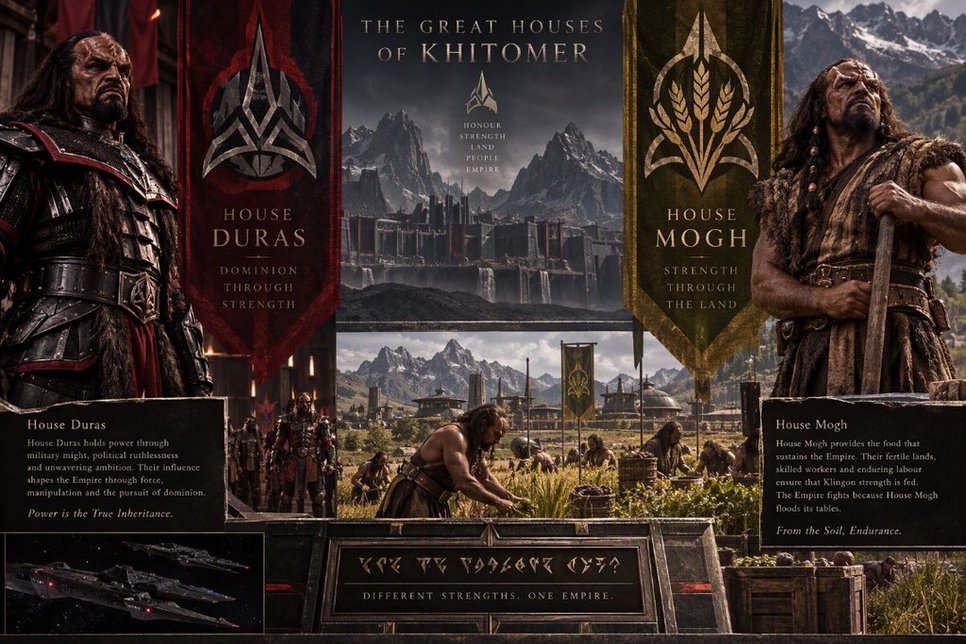
Season 2 – 2294
2.01 – Echoes of Tian Nan Men - Azetbur sends in the fleet. Klingon version of Prague Spring.
2.02 – Fallen Hero. The Excelsior catches up with Kor, a hero who's fallen into a bottle after his firstborn son was murdered. Archetype number 2 for the Klingons: the alcoholic. Alcoholism is prevalent in the former Soviet Union and modern-day Russia. This is also the case in the Klingon Empire with Blood Wine a staple of TNG, VOY and especially DS9. In the DS9 season 5 opener, Apocalypse Rising, the Order of the Batleth induction process is seen and drinking is a massive part, even promoted. Some Klingons will take this too far. Kor is also seen in DS9 Blood Oath opening part as a drunk. This is perfect for this episode where Kor show himself to be a drunk after the death of his son. A cruel drunk. A morality tale of how alcoholism destroys people and their families. Star Trek does this occasionally and this time it's a Klingon's tale.
Kor still has his ancient D-5 battlecruiser Klothos. The ship has been modified extensively over the decades; she was one of the first ships modified with a cloaking device, as the Bird of Prey-style copper chin guard and cabling over the aft hull testifies. The sensors, disruptors and torpedo systems have been similarly upgraded. Author's note: like the trialled 1990s upgrade for a T-55 Soviet tank. She may not look pretty with all the modifications, however the Klothos is one of the most advanced D-5 warships in the IKN.

2.03 – Organia – revisiting the world that foresaw the Khitomer Accords... I hate god-type beings. They are lazy story devices and our heroes cannot really defeat people like Trelane, Organians, Excalbians and Q. Dull. But for the story point here, important to show the Organians have left. This is why Kruge could attack the Grissom etc.
 2.04 – Our Generation – Sulu meets up with Koloth, who's not happy with the Khitomer Accords. The third Klingon archetype: the honourable noble. Koloth is what Kor evolved into in DS9, a noble who was descended from the blood of Kahless. William Campbell came across both in Trouble with Tribbles and Blood Oath as the aristocratic Klingon. The political beast who has connections through blood and his House. He knew Kang and Kor, but also was in with Kesh, Gorkon, Korrd and Chang. Why would he trust humans over these Klingons he's known for years when all Kirk did was put Tribbles onto his ship and humiliated him? The title comes from Gorkon's line "If there is to be a Brave New World, our generation is going to have the hardest time living in it". This story acts as a primer for what happens next...
2.05 - Ch'ramak - The collapse of the Empire, as predicted by Spock, has begun! The fall of the Warsaw Pact and Soviet Union in 1992 preceded civil wars in Georgia and many of the 'stans countries. Chechnya was a warzone twice in the 1990s and early 2000s. This is the Afghanistan and Chechnya of the Klingon Empire and reflects what has happened after Praxis has brought the Empire low. Spock predicted the break-up of the Klingon Empire and this is where is really starts.
2.06 – Destinies - Sulu and the U.S.S. Excelsior pick up Ambassador Spock for a meeting on Qo'noS with Chancellor Azetbur. There is a coup on the Klingon Empire. And it is led by Koloth! Cliffhanger ending. I wanted people to be invested in who topples Azetbur in a coup. It couldn't be a new character introduced for the job, it HAD to be someone we knew and wouldn't totally expect. Koloth fit the bill as a proud, loyal Klingon that doesn't want the Empire to surrender. He saw Chang as a loyal Klingon and quite frankly everything seems to be benefitting the Federation, not the Empire. And Azetbur being crowned like a Klingon Queen Elizabeth makes Gorkon feel more like the Klingon Henry VIII than Abraham Lincoln. This also had to have some reason for the Excelsior crew to both know the culprit and also have a way out of this one.
Star Trek: Solace
Mini-series 2295
1.01 - Infection
1.02 - Incubation
1.03 - Vector
1.04 - Contamination
1.05 - Pandemic
1.06 - Quarantine
1.07 - Depersonalisation
1.08 - Crash
1.09 - Recovery
Star Trek: Nimrod
Star Trek: Investigator
1. Day 268.
2. Anomaly.
3. The Object.
4. Said the spider the the fly.
5. Headaches.
6. Leap of Faith.
7. Geobiology.
8. Heart of Stone.
9. A New Kind of Mind.
10. Revelations.
Star Trek: Montrose
Star Trek: Sheffield
2312 - Year One
The Great Game
 The year is 2312, nineteen years after the explosion of the Klingon key energy production facility on the moon Praxis. Barely months after the confrontation with the Romulans came to a violent and bloody head at Tomed, so the Klingon Empire is suddenly thrown into disarray by the assassination of Chancellor Azetbur.
Captain Nathaniel Hawkins and the crew of the U.S.S. Sheffield begin an epic three-year mission to decipher the Beta Quadrant, explore the major and minor powers that reside in this mysterious and dangerous corner of space. Winds of change are blowing both in Starfleet and in this quadrant; the mission of the Sheffield is to discover which ways those winds are blowing, before it is too late.
The first port of call is to Nimbus III the 'Planet of Galactic Peace' where the retiring Federation ambassador, St. John Talbot, will brief the crew on the races and events that have gone unseen in the shadows. There are many secrets from the past that are about to be brought into the light, some from very unexpected places.
E-World
 The U.S.S. Sheffield crew beam down to a planet where there are ruins of a 21st Century-equivalent civilisation. Trees, wildlife - all have reclaimed the planet and the civilisation has apparently long gone. All that still exists are a neural network of aging computers, power sources and droids to maintain them.
An abandoned hospital leads Doctor A'Ochak into discovering a computer jack for linking into the computer network. In an attempt to find out about the lost civilisation, Lieutenant Kara Fox uses her dataport to log into the system.
Once in the system, Kara discovers a virtual world. The population transferred their personalities into the network as their addiction to the limitless possibilities of the internet made them neglect the real world more and more. Eventually the whole population was transferred.
Now the system is breaking down, the E-World is at risk. Can the crew of the U.S.S. Sheffield save them? Should they be saved? or must the Prime Directive condemn the race to their fate...?
"...The Prime Directive is not just a set of rules; it is a philosophy... and a very correct one. History has proven again and again that whenever mankind interferes with a less developed civilization, no matter how well intentioned that interference may be, the results are invariably disastrous."
- Captain Picard - TNG: "Symbiosis"
Torments of Tantalus
 The Final Frontier is a realm of the fantastic, the mysterious and the terrible. For those crews of starships, their pioneers and explorers, history assures them of a place. For those lost along the way, there are monuments and services of remembrance. But what is there for those wounded by what they found, saw or experienced?
-Ensign Judith Peers
A call from the past brings Lieutenant Commander Judith Peers back to her first assignment: Nirvana Colony. Nirvana Rehabilitation Colony is the home of the mentally challenged, with maximum security to prevent the escape of those dangerous ones residing there.
It was here as an ensign that Peers first dealt with a patient, formerly of Starfleet, who had as much mystery surrounding them as there was known about them. No one had managed to get through the wall of madness. Mind melds had failed disasterously and now it is Peers who is being asked to return by name - by the patient themself.
What deep secret is the patient hiding? Is their some method to the madness of this former Starfleet Petty Officer, or is the tormented now the tormentor? Peers must work her way through the minefield of mind games to find out the answer.
'All these drugs, all this therapy - perhaps my mind is freer than yours'.
Asylum
Overcrowding. Ragged refugees fighting over what resources there are; overstretched immigration officials and bureaucracy that cannot keep up with demand. The United Federation of Planets attracts millions of refugees and asylum-seekers every year, intercepted by the dedicated frigate and patrol vessels on the long and convoluted border. Despite replication technology and a food surplus, the system is at breaking point.
These new arrivals go to the Gateway Colony and other similar facilities. With controversial races arriving such as the Ch'ramaki, with a history of terrorism and connections to criminal activities both outside and within the Federation, the colonies are under review as the dawning of the 24th Century brings with it new challenges and revives old problems.
Dark Territory
Stardate 13598.5 - the U.S.S. Sheffield prepares for her mission into Klingon space. Her first call is a backwater system on the border, a world last visited by the U.S.S. Fearless five years before.
2313 - Year Two
Tears in the Orphan's Eyes
The Ch'ramaki homeworld has been raped and pillaged for the last decade by the Klingons. The klingons have asserted their Kahlessian philosophy stronger than before via their new leader - Chancellor Kaarg. Kaarg encourages young klingons to hear the cry of the warrior - he is trying to stir up the klingons to rebuild their delapidated empire. As an old Earth proverb says, 'The Road to Hell is paved with good intentions'. By spreading out the empire, the klingons are creating new enemies.
The Ch'ramaki are taking their war against the klingons to a wider audience. The philosophy that the klingons are evil and must be defeated has now been modified to accuse the Federation and others of being just as guilty by their inaction and idly sitting by whilst the murder and pillaging continues. Now the actions of the Ch'ramaki will take them straight into the path of the Federation, and the U.S.S. Sheffield.
The mission of the U.S.S. Sheffield is to piece together a puzzle that was set aside over one hundred and fifty years before, as cold wars and politics meant that neutral zones took priority over the understanding of the peoples of the Beta Quadrant.
One world that was not studied in detail was Ch'Ramak. In 2303, the world was annexed by the Klingons and absorbed into their empire. The world has become one of the empire's principal energy sources - a replacement for the destroyed moon of Praxis.
Lieutenant Commander Judith Peers, science officer on the U.S.S. Sheffield, together with Executive Officer Commander Ilani, work together on the enigma that is Ch'Ramak. As they piece together this part of the great puzzle, so they discover the people of a world pillaged by the Klingons: victims of the Great Game.
For one family on Ch'Ramak, the cost has been too high. For the Klingons there has been loss and blood spilt. For as the Klingons seek to assimilate and exploit the planet, so the freedom fighters are prepared to resist to the end - at any cost!
With hostages taken by the Ch'ramaki, Captain Nathaniel Hawkins and the crew of the U.S.S. Sheffield must try to resolve the situation peacefully and understand the problem, before the klingons dispatch Commander Karax to solve the situation with disruptors and death!
loDnI' wejDIch (The Third Brother)
As a result of the death of Azetbur, the 'backroom planner' General Kaarg has ascended to the position of Chancellor of the High Council.
Kaarg has reshuffled his High Council and made some major changes to the foreign and domestic policies of the Empire. This story will follow the one person who has followed the Klingon story for over 25 years. 2284 saw Cadet 2nd class Ilani assigned on her first deep space mission aboard the USS Emden. This experience would mould her and shape her career for the next quarter century.
Through the eyes of Ilani, the major events of the latter 23rd Century unfolded. Two of them were the coup that saw the overthrowing of Kesh as Chancellor by Gorkon in 2287 [as in 'In the Name of of Honor'] and the assassination of Gorkon and succession by his daughter Azetbur [as seen in Star Trek VI]. Ilani's personal project on the Sheffield has been to research the new Chancellor and his High Council, to review how Starfleet Intelligence hadn't been more accurate in predicting the rise to power of Kaarg.
What emerges is a story of family, honour, ritual suicide, battles and revenge. All the ingredients for a Klingon opera.
Flower of Nirophia
 A plague threatens one of the largest colonies in the Federation. U.S.S. Urbani has a lead on the cure: a flower from the planet Nirophia. U.S.S. Sheffield is dispatched to Nirophia. The flower of Nirophia - the Silid - is sacred to the Nirophians. They refuse point-blank to give a sample.
When a flower is stolen by a member of the Sheffield crew, the repercussions could have implications for the exploration in the quadrant. A courtmartial looms for all involved, especially for Captain Nathaniel Hawkins. As Commanding Officer he is responsible for the conduct of the crew under his command.
With his career in the balance, Hawkins' fate may reside in the hands of the brother-in-law he despises. There might be another solution: penitance. For A'Ochak and Hawkins this is a challenge that reminds them of the Starfleet credo that 'Weird is our business'. There are those who would like to see Hawkins' quest end in failure, for Nirophia is the keystone upon which expansion of the Federation driftward is based, and failure would open up so many interesting possibilities...
2314 - Year Three
Nightmares
Whilst en route to Starbase 77, Commander Nathaniel Hawkins is contacted by his old mentor, Captain Robert Carter. Contact has been lost with Federation science station PSI 4. No messages have been received for 72 hours, nor has any contact been had with the last starship sent to the base: Oberth class U.S.S. Urbani.
Science station PSI 4 is a classified top secret Federation facility that works on cutting edge psychological research. The base is run by Professor Thomas Creed, assisted by an old friend of Hawkins: V'Riel.
The clock is ticking for the crew of the U.S.S. Sheffield to discover the reason for the loss of contact. When the base is reached, the crew must face up to their own worst nightmare if they are to survive...
Therapy

Following their ordeal at science station PSI 4, the crew of the U.S.S. Sheffield and the station survivors are all ordered to the medical facilities at Starbase 77. This should allow the crew to enjoy some rest and recreation.
For Captain Nathaniel Hawkins it is a chance to catch up with his eldest sister, Helen. The only problem for Nathaniel is that she is married to Maxwell Buckingham - Commodore and station commander. Hawkins' diplomatic skills are tested to the limit as Buckingham compares careers.
The survivors from science station PSI 4, and the crew of the U.S.S. Sheffield, are given counselling for their ordeals, but all might not be as it seems. Could someone be using the facility for their own benefits?
Scout
Stardate 11596.5.
Golonga V.
The planet.
 The USS Sheffield arrives to survey the swampy planet, after a preliminary pass by the USS Urbani suggests the planet is rich in minerals and potential plant resources. Commander Hawkins dispatches his XO, the Chief Geological Officer, Chief Medical Officer amongst an Away Team to investigate the planet.
They weren't the first to arrive.
Whilst on the planet, the Federation meets face to face with the Sha'kurians - an amphibious race which has fought with the Romulans and Klingons for the past few decades. An attempt at first contact is made, to try to ensure the Federation starts off on the right foot.
A decision must be made.
The first contact leads to the deaths of some of the Away Team and the life of Ilani hangs in the balance. Now Captain Hawkins must decide whether the attack on his crew was the result of a misunderstanding, an accident, or a deliberate attack. The right decision could save the situation, the wrong decision could mean the first act of war.
Bridgehead
Stardate 11996.5.
Golonga V.
The decision.
Captain Nathaniel Hawkins is summoned to Starbase 77. Commodore Maxwell Buckingham has decided Hawkins' fate following the decisions he made at Golonga V, two years ago.
Colonisation.
The Sha'kurians have secured the planet Golonga V and the Federation wants to know more about them and their intentions. Hawkins is now considered to be the resident expert on Sha'kurians and first hand information is needed. The reused klingon intelligence is thought to have contributed to the events of last time.
Advancement into Sector 16447.
Golonga V has been secured. the Sha'kurians have set their eyes on worlds deeper into the sector. What are their intentions? Peaceful colonisation? or Invasion? Hawkins must make the decision. and make it in the knowledge of the consequences of his last decision. How will his crew react to another encounter with the Sha'kurians. Will some take matters into their own hands?
In the Pursuit of Justice
 The United Federation of Planets is a haven, a utopia of races, cultures and ideas all working together. For one man, this is paradise under siege from those who would exploit the idyll that has been created. Robert Hirst is a Federation Security agent. A cop. For Hirst, this is a constant battle against the scum that would undermine and destroy the paradise that took the founders of the Federation decades to achieve.
Robert Hirst is a man on a mission: to solve the largest case of his career. This mission has cost him his partners, his marriage and the relationship with his son. Following in his father's footsteps, Robert is fighting to keep the Federation safe from those who would choose the wrong path. As Hirst watched his partners, and now his son in Starfleet, following the rules which allow only the symptoms of the underlying criminals to be treated. Hirst must sail as close to the wind as he dares to finish this last mission.
Bending the rules, following sources and building up the evidence, Robert Hirst must work his way through the underbelly of the Federation to find his final destination. Hirst must visit worlds that are far removed from the ideal at the heart of the Federation in order to save the soul of the organisation he has sworn to protect. Hirst doesn't know how far this path will take him, nor in what direction. When a man travels with no compass, there is no telling upon whose path he may cross...
Strangers in Dark Places
Information from their last mission has led the U.S.S. Sheffield back to Nimbus III. A dark secret from thirty years earlier threatens the peace in this side of the quadrant.
The true dark side of the Planet of Galactic Peace is uncovered. The deal struck in the corner of the Venus Bar, during the darkest hours of the colony. The deal saved the colony, but the legacy may condemn the planets future.
From the picturesque cottage where retired Federation diplomat St John Talbot now lives, to the mines which fuelled the growth of the colony from the beginning. Unseen sides of Nimbus III are revealed for the first time as the uncut, raw history of Nimbus III is told at last.
Finally, the story leads to the water processing facility and the man named Vikstaad Jaanz. For one member of the Sheffield crew, this will lead to a personal revelation that will turn their life upside-down, and have far-reaching repercussions for the Beta Quadrant.
Gaia
Felesor II. The Felesor colony was the discovery of the crew and passengers of the passenger vessel 'Rainbow Horizon' which set off in the early 2270s to find utopia beyond the frontier of the Federation. The freighter had over two hundred idealistic colonists onboard, looking for utopia. Their leader, Theibor, had sought to get away from the conflict with the Klingons, Romulans and other neighbouring races to the Federation that were in danger of polluting the haven that was the Federation. Theibor wanted to find a new Eden away from the Federation, politics and conflict. The Nimbus III colony was too artificial for his needs, and the quest of Doctor Sevrin had ended in disaster.
Felesor II was not quite the perfect Eden that Theibor had been seeking. Felesor II was rather like Africa in the dry season, rather than the lush green rainforest-like utopia the colonists had in mind, yet the planet at least had offered peace for the last thirty years. The colonists had eeked out a living on the planet, building a little eco-village out of the local plantlife, mud and rocks - supplemented by a handful of technology - had produced the hamlet of Sanctuary.
Felesor colony now faces the challenge of the frontier boundary catching up with their world. Forty years ago the Federation may have been a distant memory, now it is on the doorstep. The colony must decide whether to move onwards into the stars still further, or try and hold onto what they have here. The question also remains: what do they colonists have? how have they developed in the last 40 years and do they deserve to be left alone?
Secret
A secret from the past might end a friendship, cost a career and more...
Addiction
Tal Reno lies in a coma. His addiction to empathic events has finally ended in disaster. Has the Captain coerced this addict into indulging in his addiction in order to get results for the ship? Are the results worth the risks taken? Do the ends justify the means? Hawkins must utilise the skills of the Sheffield's most powerful telepath to try to retrieve Tal from the edge of the abyss, from which no man returns.
This is the story of Tal Reno: protigee, telempath extrodinaire and the ace up the sleeve of the U.S.S. Sheffield on more than one occasion. Follow the story of Petty Officer Reno from the abortive years at Starfleet Academy until the final last chance he was given by the Starfleet officer that believed that his talents could overcome his addiction. Can belief surpass dependency?
The fight is on to save the life of Tal Reno. Hawkins is prepared to go to any lengths to save the life of even one member of his crew. Can Reno be plucked from the abyss, or will the addiction of Tal Reno prove too powerful for even his friends to save him?
Gulag
Stardate 17995.5
nearly twenty years after the mission of the U.S.S. Sheffield ended.
Flash-forward to the mid-2330s with a prisoner in an anonymous gulag deep in the klingon backwaters. A shabby Ch'ramaki sits, reflecting on over 20 years imprisonment and the man who turned him in - Nathaniel Hawkins.
The son of a farming family reflects back on the fight against the klingons - and how he had to surrender to save his people. The rebellion led to millions massacred and the total annihilation of the culture, rapes to destroy the genome and create klingons. This only inspired the next generation of freedom fighter who worship the farmer's son as a martyr.
Twenty years of torture. Twenty years of never seeing his homeworld, of abuse, humiliation and solitude. The farmer's son saw many of his contemporaries die, broken by the klingon boot. Only he survives, toughened by his experiences as a youth and from his life as a freedom fighter. Blinded, emasculated and crippled from the torture and yet still the defiance of his people burns in the heart of the farmer's son.
See a different perspective on the klingons: They annex, they subjugate, they torture, they execute civilians and destroy cultures.
With the klingon empire trying to get back on its feet after decades of border wars, it is trying to expand and acquire resources. Ch'ramak was annexed by the order of Chancellor Azetbur in the last years of her reign - to protests from the Federation Council. This is the full story of the annexing, invasion and freedom fighter/terrorist fight back - and what happened next.
Get ready for a new slant. Forget the propaganda. Meet the neighbours.
details to be revealed later...





